


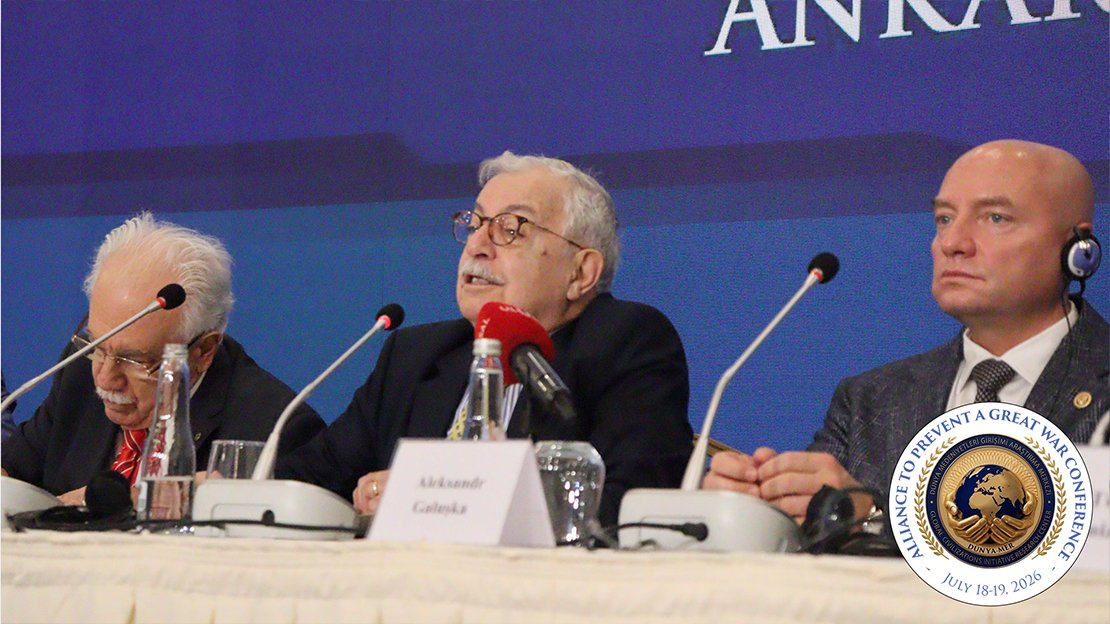
Prof. Dr. Şükrü Sina Gürel, Former Deputy Prime Minister, Former Minister of Foreign Affairs
The international conference entitled “The Alliance to Prevent a Great War,” organized by the World Civilizations Initiative Research Center, was held at the Meyra Palace Hotel in Ankara on 18–19 July 2026.
UWI will present the speeches held on the conference during the coming days.
The conference, which featured presentations by speakers from Azerbaijan, Belarus, France, Germany, Greece, Iran, Italy, Japan, Russia, the Sahrawi Arab Democratic Republic, South Africa, Spain, Switzerland, the Turkish Republic of Northern Cyprus (TRNC), Türkiye, the United Kingdom, and the United States, was attended by approximately 200 distinguished invited guests.
Ministers, members of parliament, ambassadors, retired generals, scholars, politicians, diplomats, military officers, and experts examined the question of the “Alliance to Prevent a Great War” from a wide range of perspectives.
Below, we present the speech of Prof Şükrü Sina Gürel. The title was set by UWI.
What is the Purpose of This Meeting?
To truly understand it, we can compare our current era to the 1919–1939 interwar transition period.
During that era, the world experienced the severe growing pains of shifting away from an international structure based on European supremacy toward a new global order. It was a period where all elements of the old system coexisted with those of the emerging new world. That transition ultimately culminated in a major war because localized, regional conflicts and the limited expansionist efforts of aggressive states eventually coalesced into a global confrontation.
Today, we are living through the final stages of a similar transition period that began after the end of the Cold War. Once again, we face localized regional conflicts.
The primary goal of this meeting is to generate collective thought and build diplomatic efforts to prevent these localized conflicts from escalating into a major war.
In this regard, taking action now is an extremely valuable endeavor, and I warmly congratulate the organizers of this conference.
Türkiye’s Historical Role & The 1919–1939 Legacy
Türkiye is a nation whose stance and existence during the 1919–1939 period set a powerful example for the entire world:
Pioneering Anti-Imperialism: The Turkish people achieved the first successful national liberation struggle against imperialism—standing shoulder-to-shoulder with the Soviet Union against a common enemy—and successfully founded their own nation-state.
A Unique Position: This achievement places Türkiye in a deeply unique position today, despite ongoing efforts to erase or reject this honorable legacy.
Economic & Diplomatic Example: During that era, Türkiye pioneered a planned economic policy that managed and guided both state-led public initiatives and private enterprise—a framework that, in my view, served as an early model even for the People’s Republic of China. Concurrently, Türkiye played an exceptionally positive global role through its contributions to international peace.
The Cold War Shift & Relations with NATO
Following the onset of the Cold War—and particularly after joining the Western Alliance—Türkiye began to be governed by leaders inclined to reject this honorable legacy, much like those today who seem willing to compromise the nation-state structure.
Key Historical Context: NATO Entry
Türkiye joined NATO not primarily out of its own organic desire, but largely as part of the United States’ containment policy.
Under this containment policy, Türkiye was assigned a role to support US hegemony globally and specifically in the Middle East. Whenever Türkiye played this assigned role without pushback, there were no issues with NATO or the US.
However, whenever Türkiye resisted playing this role precisely as Washington dictated—or when its national interests diverged from those of NATO and the Western Alliance—friction immediately arose.
Did NATO Contribute to Türkiye’s Defense?
NATO’s contributions to Türkiye have been virtually non-existent—unless, of course, we count the cosmetic upgrades done for the recent NATO Summit, like newly paved roads, fresh asphalt, and neatly painted lane lines!
Joke aside, NATO’s only real contribution to Türkiye was inadvertently forcing the country to realize it had to become self-sufficient in defense. It achieved this through harsh wake-up calls:
The 1964 Johnson Letter: The US explicitly stated that NATO’s Article 5 would only be invoked if it aligned with American interests, and that weapons provided to Türkiye could not be used for unauthorized purposes (referencing Cyprus). This was Türkiye’s first hard lesson from NATO.
The 1975 US Arms Embargo: This second lesson further underscored that Türkiye could not rely on Western allies for its core security.
Current leaders often claim, “There was no defense industry before us,” much like their claims about refrigerators. In doing so, they overlook NATO’s ironic role in birthing Türkiye’s defense industry—forcing Türkiye to build its own capabilities out of sheer necessity.
Historical Pattern:
• Periods of No Conflict = Unconditional compliance with US demands (e.g., the 1950s Democrat Party era or the September 12 military junta).
• Periods of Friction = Any time Türkiye prioritized its own national interests.
Present-Day Containment & Final Remarks
Today, we observe the United States attempting to execute a modern containment policy against Türkiye through:
Extensive military bases in Greece and Crete.
An expanding, direct military presence in Southern Cyprus.
Active support and arming of groups along Türkiye’s southeastern border that threaten national integrity.
While Cyprus and these geopolitical tensions remain critical, our distinguished upcoming speakers will delve deeper into the specific details.
To avoid overstepping my authority as session chair, I will conclude my opening remarks here and pass the floor to our first speaker. Thank you.