


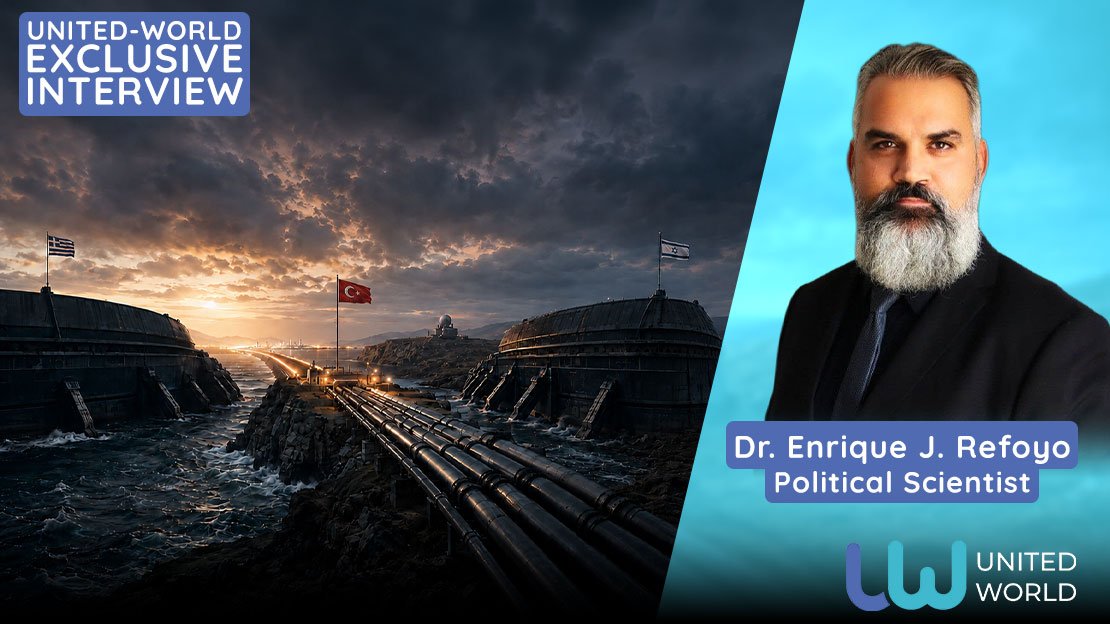
By Yiğit Saner
As military cooperation between Israel, Greece and South Cyprus deepens in the Eastern Mediterranean, Türkiye is increasingly being described by Tel Aviv as a regional threat. But is this rapprochement driven solely by military calculations?
According to Spanish political scientist, academic and translator Dr. Enrique J. Refoyo, at the heart of the matter lie energy, natural resources and control over the routes through which they are transported to Israel and Europe.
Refoyo argues that after Israel’s projects to use Kurdish proxy forces against Türkiye failed, it is now seeking to put pressure on Türkiye through Greece and South Cyprus, and stresses that this is part of the broader strategy of the US-Israel axis toward Eurasia.
Refoyo discusses a wide range of issues, from NATO’s position in a possible Türkiye-Israel conflict to the proposal for the partition of Cyprus and the island’s future, as well as Europe’s energy dependence and the power struggle in the Eastern Mediterranean. He argues that a new war between Greece and Türkiye would primarily serve the interests of the two countries’ adversaries.
“Ankara Is the Energy Problem In Tel Aviv’s Way”
Israel is encouraging Greece and South Cyprus against Türkiye, creating two forward outposts for itself while deploying and selling weapons systems to these countries. At a time when Türkiye is being described in Israel as an “existential threat”, do you see these initiatives as part of Tel Aviv’s strategy to expand the regional war?
Firstly, we must understand the key aspects of two fundamental concepts: geopolitics, as the relationship between territory and power, and geoeconomics, as the relationship between territory and natural resources. This conceptual pair is essential for understanding events in Western Asia (the Middle East).
Seen in this light, what is currently unfolding is a simultaneous process of seizing territory and natural resources. Power is the common denominator, but the focus is on a series of territories capable of supplying a flow of economic resources. It is a situation in which the US-Israel axis is seeking to destroy its Iranian rival whilst, at the same time, attempting to gain control of Iran’s gas and oil fields first and foremost.
Since 2025, we have had statements from the former Israeli Prime Minister, Naftali Bennett – the leading candidate to succeed Netanyahu – setting out the intention to attack Türkiye once the US-Israel ‘Epstein axis’ has defeated Iran. For the time being, they have not defeated Iran, and are unlikely to do so. However, their planning continues.
As I was saying, it is not just about territory, but also about natural resources, as these are needed to sustain the great war against Eurasia waged by Washington and Tel Aviv (with the invaluable backing of London and the City). This is where the so-called IMEC corridor comes into play, running from India to Europe via the Middle East. The key issue lies in the Middle Eastern route: where does it begin and where does it end? The state of Israel wants the route to run from Dubai in the UAE, through Saudi Arabia and Jordan to Israel, so that the ports of Ashdod and Haifa become the essential transit points for goods and energy from East to West. In this way, Israel would become the pivotal state (despite its small territory).
Where does the problem lie for Tel Aviv? In Ankara. The Republic of Türkiye has skillfully played its geo-economic cards, and the former ‘Sublime Porte’ has become the ‘Sublime Tap’, that is to say, the essential transit point for energy flowing from East to West. If one looks at the maps of gas and oil pipelines in Western Asia, two key countries stand out: Russia and Türkiye. Russia is out of the picture due to European and US sanctions. Consequently, the transit of energy to Europe from the East is now channeled through Türkiye. Even the state of Israel itself is energy-dependent on Turkish transit, for example via the BTC (Baku–Tbilisi–Ceyhan) oil pipeline.
“The Kurdish Proxies Failed; Now It’s Greece and South Cyprus”
Let us return to the part concerning the Epstein axis’s war against Iran. We have seen repeated attempts to use the Kurds of Iraq and Iran as a proxy force against the Islamic Republic of Iran. This maneuver has not gone well for them at all. They have failed to manipulate any minority in Iran against its government. Nor have they succeeded with other minorities on the other side of their borders: neither Kurds, nor Arabs, nor Turkmen, nor Balochis. Nobody wants to get themselves killed in the service of the Epstein axis of Washington and Tel Aviv.
So, what now? Will they stop the war? Will peace be signed? Never. Those who live off war and expand through war can never reach a peace agreement. Therefore, a new point of pressure is sought to continue the great war against Eurasia. Who has not collaborated in the war against Iran? Türkiye. So: it is Türkiye’s turn to suffer. That is how the logic of the Epstein gang works.
The project for an independent Kurdistan, with the full backing of the US and Israel, also poses an intolerable threat to Türkiye’s integrity. But the plan has backfired. There are no Anglo-Zionist proxies in the East, so they are turning their attention to other nations they can turn into proxies: Greece (and, with it, Cyprus).
On the one hand, we have the emigration of Israelis to the Republic of Cyprus and to Greece. On the other hand, we have the signing of military contracts between Tel Aviv and Athens. The export of arms and cyber technologies is the economic foundation of the state of Israel. They aim – in this way – to become the key country that ‘guarantees’ the security of Greek airspace with the ‘Achilles Shield’. And they are targeting Türkiye.
This is by no means due to any mutual affection between Israelis and Greeks, but rather an exploitation of the Greeks against the Turks, in the same way they have attempted to use the Kurds against Syrians, Iraqis, Iranians and Turks. If one project fails, they move on to the next. The key, the common denominator, is always ‘Divide et Impera’ (Divide and Rule). Divide your enemies, pit them against one another, and rule over the ruins.
Türkiye is a problem for Israel, because Türkiye controls the major oil and gas pipelines from the East to the West. Israel (and therefore the US) wants to be the central hub of that route. They want to profit from the transit of energy and, subsequently, goods. It is not about creating prosperity, but once again, it is about profiting from the labor of others. And to achieve this, they must destroy Türkiye. It’s that simple, on the chessboard. Reality is another matter. Here, they will attempt to escalate the situation once more and bring about a scenario of war between the Greeks and the Turks.
“Two Pawns Against the Turks”
What do Greece and South Cyprus actually expect from Israel? Can this partnership genuinely remain a relationship between so-called equal partners, or will the two countries inevitably become extensions of Israel’s broader regional strategy?
Israel (and therefore the US) firstly aims to use the Greeks as pawns against the Turks. Washington and Tel Aviv are the capital cities of the same global empire. Without waging wars, without trading weapons, they are nothing. They offer nothing but death to the whole world, so that they can lay claim to its natural resources and productive territories.
Thus, they sell their weapons to Greece and are seeking a future clash with Türkiye as well, in order to control – as I was saying – the flow of energy to Europe. As they said in that film: ‘Don’t take it personally, it’s just business’. And indeed, they do not care about the lives of others, but only about the business they can do and, ultimately, the profit they can make from it.
In any case, we have to remember the Israeli actions against the Gaza Strip, West Bank and southern Lebanon. They do not simply seek to seize the territory, but also the adjacent maritime area, which is rich in gas fields. It is, therefore, another source of profit.
“The Answer Lies in Who Stands To Gain”
To answer your question directly: for me, the key isn’t the emotional aspect, but the question of: who stands to gain from the conflict? Relations between Turks and Greeks have historically been fraught with conflict. There’s no need to go into that. Each side has its own list of grievances against the other, and vice versa. Right. That covers the emotional aspect. And we’ll set that aside.
But from Tel Aviv, they are seeking to fuel that conflict to drive the Greeks and Turks into a new war. As I was saying, the Kurdish project failed in the East, and now they are pushing the Greek project in the West.
“The Eurasian Pentagon”
The key to the Epstein axis lies in the elimination of any major power (regional or global) within the Eurasian sphere. Iran and Türkiye represent two of these Eurasian regional powers which, in turn, have a historical sphere of influence; therefore, this is not just about the territory of their current countries, but extends beyond that. Together with Russia, China and India, this would complete a great Eurasian pentagon which, in the event of a security alliance, would mean that neither Israel nor the US could act against one or more of these major powers.
Thus, in my view, there can never be a relationship of equality between Israel and the US in comparison with other countries. I have often stated that, from the perspective of the Epstein axis, they view the world in a very simplistic way: the whole world is now the ‘Wild West’ where the ‘Cowboys’ fight the ‘Indians’ – that is to say, the good guys against the bad guys, civilisation against barbarism. The cowboys can do anything to occupy the territory ‘granted by providence’, whilst the Indians have no right even to live. Consequently, in this scenario, the Greeks are a tribe of Indians to be used against another tribe (the Turks).
“I Consider Partition in Cyprus Appropriate”
Dr. Doğu Perinçek, Chairman of the Patriotic Party (Vatan Partisi), recently proposed “partition” as a solution to the Cyprus issue at the “Alliance to Prevent the Great War” conference held in Ankara. Perinçek said, “The most appropriate solution is for the island to be divided between Türkiye and Greece. The British military bases should also leave the island.” How do you assess this proposal?
Firstly, I believe there is no doubt in anyone’s mind that the British bases must be closed and their troops withdrawn. Secondly, the partition already exists. What remains to be resolved – in terms of territory – is the buffer zone between the two sides of Cyprus. That would be the easy part. Now for the difficult part: if the northern side were to become part of Türkiye and the southern side part of Greece (which I think would be appropriate), we would face another problem, namely the division of the maritime zone adjacent to each part of the island.
There are numerous gas fields in the eastern Mediterranean; this means they hold particular value when it comes to distribution, and consequently: other external actors will want to have a say in the distribution, primarily the State of Israel (which has direct interests in the fields) and the US, which acts as Israel’s guarantor everywhere.
“War Would Serve the Interests Of The Epstein Axis”
Therefore, in the current context, partition between Greece and Türkiye is a very distant goal fraught with complexities. On the other hand, in the short term, other actions can be taken that are indeed feasible: preventing mutual hostility between Greeks and Turks. This does not mean that friendship will be achieved (I consider this unlikely), but at least a mutual respect that leads to peaceful coexistence.
Avoiding hostility also means preventing the deterioration of the situation that would lead to a new war between Greeks and Turks, which would only benefit the enemies of both Greeks and Turks: the US-Israel (and UK) ‘Epstein Axis’.
As they pointed out in the title of their conference, ‘Alliance to Prevent a Great War’. Right. Well, that is what we must prevent in every possible scenario. The people benefit from peace, whilst certain elites benefit from war. Our possible and necessary task lies in exposing those warmongers who derive their wealth from spilled blood.
“Article 5 Is A Matter of Will, Not Obligation”
At the NATO Summit in Ankara, NATO Secretary General Mark Rutte declined to answer whether Article 5 would apply in the event of a possible conflict between Türkiye and Israel. His silence was interpreted as suggesting that Article 5 would, in practice, not apply where Israel is concerned. Do you think European countries would really be prepared to risk a strategic rupture with Türkiye for the sake of Israel?
Firstly, let us refer to Articles 5 and 6 of the NATO Treaty. Let us begin with this part of Article 5: “The Parties agree that an armed attack against one or more of them in Europe or North America”. Right, Europe or North America. Is Türkiye in Europe or Asia? It is mainly in Asia. So, is it excluded from mutual defense? No, because Article 6 clearly states that “is deemed to include an armed attack […] on the territory of Turkey”. With regard to “exercise of the right of individual or collective self-defense recognized by Article 51 of the Charter of the United Nations”, as stated in Article 5, the Parties “will assist the Party or Parties so attacked by taking forthwith, individually and in concert with the other Parties, such action as it deems necessary, including the use of armed force, to restore and maintain the security of the North Atlantic area”.
There are several points to highlight here, starting with ‘action as it deems necessary, including the use of armed force’; note the details: ‘action’ and ‘deems necessary’ – that is to say, a possibility. It may or may not happen. The concept of “action as it deems necessary” is not unambiguous; it can mean many things.
Furthermore, NATO countries have very disparate capabilities, so the measures depend on their interpretation and capacities. And then there is the word “necessary”—the possibility. In other words, collective defense is a matter of will. And there is one more thing in that last quote: “to restore and maintain the security of the North Atlantic area”.
Is the Mediterranean part of the North Atlantic? No, but Article 6 once again states “or the Mediterranean Sea”. So, all right, we have Türkiye and the Mediterranean included, but collective defense is a matter of will that will be exercised in accordance with the understanding and capabilities of each Member State. They are not obliged to commit their entire armed forces, but they must respond as they see fit.
“Cyprus Could Become the Battleground”
Seen in this light, one might think that, if the aim is to provoke a war between Israel and Türkiye and keep it outside the scope of Articles 5 and 6 of the NATO Treaty, then the key lies with Cyprus. It is not a member of NATO. One might also argue: Cyprus is a member of the EU and there is a collective defense clause, Article 42.7 of the TEU (Treaty on European Union). This states: ‘If a Member State is the victim of armed aggression on its territory, the other Member States shall have towards it an obligation of aid and assistance by all the means in their power’.
The question here is what is meant ‘by all the means at their power’, as the article goes on to state that: ‘This shall not prejudice the specific character of the security and defence policy of certain Member States’. So, the total military resources of each Member State are one issue, and the resources it might be able to deploy to an external operation are quite another.
At this point, we come to a territory that lies outside both NATO and the EU: the TRNC, that is, the Turkish Republic of Northern Cyprus. Right, we have reached this point after reviewing various international treaties. The answer, as far as I’m concerned, is simpler: the West allows Israel to carry out any criminal action. If Tel Aviv decides to attack Türkiye, the EU and NATO will side with Israel. The US is in charge of NATO, and Israel is in charge of the US. We see this very clearly in the war against Iran. Netanyahu is in charge of Trump.
“European Governments Act Against Their Own People”
But now, let’s turn to another aspect of your question, for when it comes to European countries, it must be understood that, with very few exceptions, almost all governments in European countries act against their own citizens. Take, for example, the war against Russia in Ukraine. We have the major European leaders encouraging an escalated war against Russia, and promoting both economic and social militarization. All ties have been severed with a country like Russia, which was not an enemy and which, moreover, was a major exporter of all the raw materials needed by European industries.
Seen in this light, if they have broken with a great country like Russia under pressure from the US, they will of course break with Türkiye if Israel demands it. The ultimate issue will be energy imports: if ties with Russia have been severed, and ties with Türkiye (an energy transit route) are severed, then who will sell energy to Europe? The answer, of course, is the United States. All this militarization in Europe is being carried out for the benefit of the US military-financial complex.
“Madrid Is Not Interested in The Mediterranean”
Spain is also a Mediterranean country. From that perspective, what do you see as the most critical geopolitical struggle among the major powers in the Eastern Mediterranean?
I wish I could give you a detailed answer on this matter, but at an official level – that is, from the Spanish Government’s perspective – the Mediterranean is not a priority for action. It sounds counter-intuitive: Spain is a Mediterranean country, yet the Mediterranean is not a priority. Indeed, that is the case. NATO and the EU have set other priorities, such as Russia. The ‘left-wing’ government of the current Prime Minister, Pedro Sánchez, following the NATO summit in Ankara, also committed to sending Spanish troops to none other than Finland. Yes, right on the other side of Europe. Zero attention is paid to the ‘southern flank’ – that is, the Mediterranean and North Africa.
Spanish troops will be deployed to northern Europe because NATO demands it and the EU backs it. Consequently, in the media, the Mediterranean is not a matter of interest either. There is no talk of the Mediterranean. At most, there may be the odd news item about migration by boat from Africa to Europe, and that is all, because, in fact, migration is portrayed as an inevitable event that Europe simply must accept.
“Energy And Resources”
With regard to the second question on this point, the main rivalry between the major powers currently centers on the control of energy sources and rare earths. On the one hand, regarding energy: the US’s current strategy to re-establish its global hegemony is very simple and is based on control of energy. Without energy, no society, economy or armed forces can function.
At the same time, there is the struggle for other minerals such as rare earths, which are essential for cutting-edge technology products, both civilian and, in particular, military. Military superiority can only be achieved when a country possesses sufficient energy and minerals to sustain military operations and production.
On the other hand, countries such as Russia and China have no intention of becoming a global hegemon or imposing their will on the world in the manner of the US and Israeli governments (not forgetting the UK and the City), as these entities are united in their warmongering and hegemonic ambitions.
Thus, we have some major powers that simply wish to live on their own terms, whilst other major powers seek to reinforce their global hegemony at any cost – that is to say, regardless of the destruction and loss of life caused: Anything goes to achieve their objective, and so we have wars, bombings, threats, sanctions, etc.—in short, the entire economic and military arsenal of the Washington–London–Tel Aviv axis.