


By Fernando Esteche
Buenos Aires awoke this week to reinforced security around the Palacio Libertad. Three days behind closed doors, with between 400 and 600 security officials from over one hundred countries, under a motto that already foreshadows the tone: “Justice through strength and unity.” No press coverage or broadcasts. Considering this government’s habitual punitive approach, this silence is a calculated decision. An organization that was founded more than five decades ago as a law enforcement agency wouldn’t need to meet in secret if it still functioned as such.
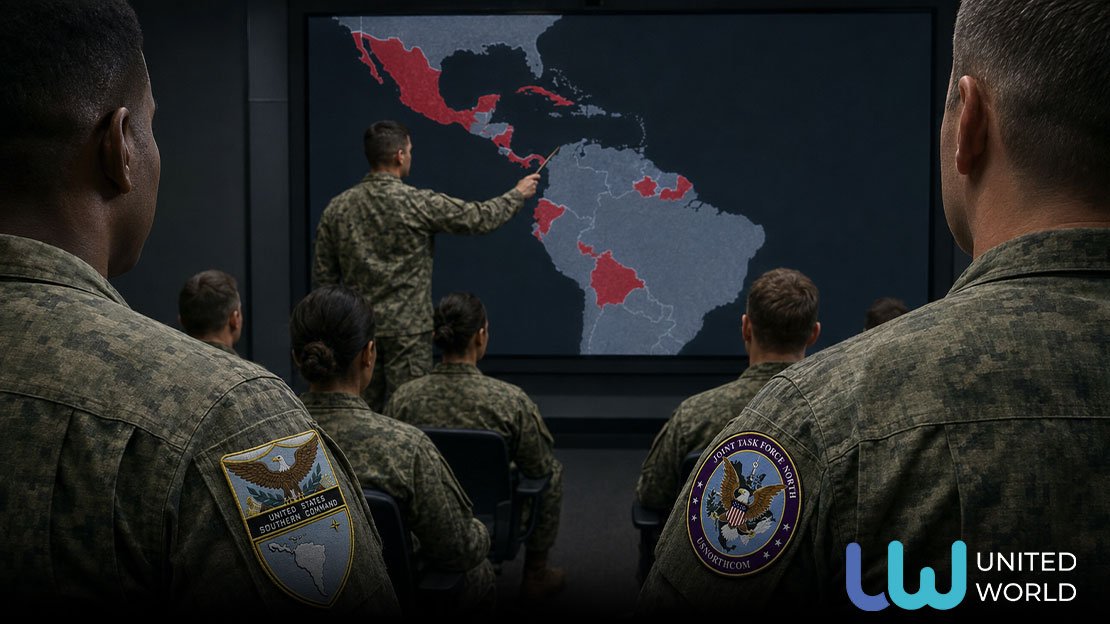
We are interested in a different kind of question. Why, right now, is the United States expanding its anti-drug operations in Latin America in a way that bears no resemblance to anything seen in forty years of anti-drug policy? Why have we stopped talking about agents and police cooperation, and started talking about warships, submarines, aircraft carriers, civilian vessels blown to pieces on camera, troops landing to capture a president? The key word is militarization.
We have been working on the hypothesis that the US redeployment in the face of its own structural decline rests on four intertwined vectors: financialization, militarization, chaos, and narcotization. What is happening today in the Caribbean and the Latin American Pacific is the moment when these vectors cease to function separately and merge into a single mechanism. Drug trafficking ceases to be the object of combat and becomes the political key that enables military deployment.
And here we depart from a common interpretation, even within the critical field itself, which describes half a century of the war on drugs as a failed policy that is now, frustrated, escalating toward military force. We do not share this condescending view. The DEA did not fail and then become militarized. From its inception in 1973, it was an interventionist body that expanded its function each decade, driven by a logic of growth, not failure. Nixon founded it just two years after declaring drug abuse a national priority, merging the Bureau of Narcotics with fragments of Customs and the CIA. His own advisor, Ehrlichman, would acknowledge decades later that this war was aimed domestically at criminalizing Black communities and the anti-war movement. Externally, it was immediately projected as a hemispheric policy, with an extraterritorial reach that no other law enforcement agency possessed at the time. With the CIA under pressure from its covert operations in Chile, Afghanistan, and Central America, the DEA was able to fill many of those roles without significant political cost. This backup role wasn’t confined to the continent either; it came to maintain offices and agents in more than sixty countries, from Afghanistan to Nigeria, from Thailand to the Balkans—wherever the CIA needed a presence without the exposure of an overt intelligence agency. In Bolivia, Peru, Mexico, and Colombia, it negotiated with weak or complicit governments, trained local police, and financed crop eradication. The problem was always in the south. The demand that sustained the business from the north was never touched.
The rise of the Medellín and Cali cartels transformed Colombia into the epicenter of violence that Washington deliberately interpreted as an opportunity. It was there that the fusion of anti-drug police and military intelligence, which would later become the regional norm, was first tested. Drug trafficking ceased to be a crime and became a threat to U.S. national security, a category that enables very different tools than those of a prosecutor.
Plan Colombia was the culmination of that founding ambition. Beneath the surface of an alternative development package, the bulk of the resources went to helicopters, anti-narcotics brigades, and glyphosate fumigation over peasant and indigenous territories. Colombia became the third-largest recipient of US military aid in the world, after Israel and Egypt, in a plan that ultimately operated as a counterinsurgency force against the FARC and the ELN, resulting in forced displacement and human rights violations documented by the UN. Washington learned a lesson there, one it later replicated with the Mérida Initiative in Mexico and the CARSI program in the Northern Triangle (Guatemala, Honduras, and El Salvador).
We interpret this trajectory not as a succession of failed policies but as the reiteration of the same colonial gesture. The Global South always appears as the territory of origin of evil, never as the destination of the demand that sustains the business. The United States consumes most of the cocaine circulating in the hemisphere, and no fleet bombs Wall Street or the money laundering routes that run through its own banks. The geography of blame reproduces the old colonial division between the metropolis that judges and the periphery that is judged.
What has changed radically since September 2025, with Trump’s return, is not the interventionist tendency, inherent since 1973, but its legal and political form and its scale. Washington began sinking ships off the coast of the Caribbean and the Pacific without, in most cases, presenting any public evidence. Trump stated it explicitly: Washington is in “armed conflict” with the cartels. This is not campaign rhetoric; it is a legal category that changes everything else. An armed conflict is governed by international humanitarian law, not criminal law, and allows for the killing without trial of anyone designated as an enemy combatant—something the previous paradigm, that of the undercover agent and the federal court, did not contemplate.
To sustain this legal fiction, the White House designated twenty Latin American criminal organizations as foreign terrorist organizations. Therein lies the central mechanism, and there we see the lawfare that accompanies the military deployment. The category of narcoterrorism does not describe a new reality of organized crime; it creates a legal framework, transforming a suspect with the right to due process into a legitimate military target under the rules of war—the same logic tested against Al Qaeda after 2001.
The peak of this escalation occurred on January 3, when US forces bombed targets in Caracas and captured Nicolás Maduro in a predawn operation, taking him to New York. There was no declaration of war, no prior congressional approval, and no Security Council resolution. There was an accusation of narco-statehood built up over months of naval deployment: eight ships, a submarine, an aircraft carrier, and dozens of fighter jets.
The fact that most confirms our hypothesis is not Venezuela, which has already been analyzed ad nauseam, but what happened afterward in the institutional arena. On March 7, Trump convened eleven Latin American governments in Doral and signed the proclamation creating the Shield of the Americas, also known as the Coalition of the Americas Against the Cartels or A3C. Colombia and Mexico were left out of that founding meeting. Petro, speaking from Vienna, quipped that a shield for the South cannot be built with small, inexperienced countries; “they’ll just tear it apart.”
Five months later, in the early morning of August 3, Southern Command formally decommissioned Joint Task Force Southern Spear, the same JTF 84-2 that had been carrying out attacks against vessels since September, hitting sixty-seven ships and resulting in at least two hundred and twenty-one deaths, according to the Pentagon Inspector General’s own report, at an estimated cost of $820 million. In its place, it activated Joint Task Force Western Hemisphere, JTF-WHEM, presented by General Francis Donovan as the permanent operational arm for the region, integrated with the eighteen countries of the A3C. A task force with a campaign name, conceived as a temporary structure, was decommissioned to make way for one designed as a permanent operational headquarters. This is not a more intense phase of the war on drugs. It is the institutionalization of something else entirely.
Colombia offers a clearer view of this mechanism than any other case, because there the shift occurred in broad daylight and within days. Under Petro, Washington decertified the country despite record seizure figures, sanctioned the president through the Treasury’s Office of Foreign Assets Control, and excluded him from the Doral project. Petro responded by suspending purchases of US weaponry, a symbolic gesture given a decades-long relationship, but a gesture nonetheless from a country that refused complete subordination.
On June 21, Abelardo de la Espriella won the Colombian presidential runoff. He took office on August 7 and that same weekend traveled to Medellín with U.S. Under Secretary of War Joseph Humire. Hours after the inauguration, the State Department announced one billion dollars in security assistance. On August 12, from Panama, Hegseth announced that De la Espriella was authorizing joint military operations, that Colombia was joining the A3C (Agency for International Cooperation), and that Medellín would be the program’s regional headquarters. In less than a week, Colombia went from being a sanctioned country to a regional platform for the U.S. offensive. Uribe himself endorsed the shift, comparing it to Plan Colombia, which he had managed: “U.S. aid is about recovering sovereignty, not violating it.” Under Petro, Colombia was punished despite the positive economic indicators. Under De la Espriella, Colombia was rewarded immediately upon taking office. Drug trafficking did not change during those months. The government changed.
This mechanism is repeated, with variations, across the rest of the map. Argentina under Milei, Ecuador, El Salvador, and much of Central America occupy the position of enthusiastic allies, willing to lend territory and rhetoric in exchange for gestures that rarely translate into concrete benefits for their people. Brazil does not appear among the founders of the Shield nor among the eighteen countries of the A3C, and we found no record of a Brazilian delegation in Buenos Aires—a silence that, coming from the main regional power, speaks volumes. Regarding Mexico, we do have certainty: Security Secretary Omar García Harfuch, whom DEA Administrator Terry Cole described in Buenos Aires as a trusted partner and good friend of the United States, traveled to the conference despite Sheinbaum’s initial opposition. She ultimately authorized the trip after putting it to a vote in her security cabinet. Furthermore, Mexico already coexists with CIA agents operating alongside its own forces, a level of interference unthinkable just a decade ago.
Neither Mexico nor Brazil currently possesses the military engineering capabilities, regional unity, or full political will to directly challenge a system that no longer seeks permission. This issue warrants closer examination, as it is neither merely rhetorical nor simply nonexistent. In June, Lula and Sheinbaum held a forty-minute video call, established a joint position against foreign interference, and instructed their foreign ministries to reactivate the Binational Commission. Sheinbaum even described Lula as a symbol of the Latin American progressive struggle. This gesture is significant, and we will not downplay it.
What this axis fails to achieve is to translate into a counterweight capable of halting the apparatus, and this is where limitations arise that are beyond the control of any president. Mexico falls under the Northern Command, not the Southern Command, which today coordinates the A3C, an integration that has existed for decades and which Brazil has never embraced. Mexico places eighty percent of its exports in the US market and relies on the USMCA, while Brazil has China as its main trading partner and enjoys a degree of autonomy within the BRICS and Mercosur. Lula carefully considers every move with October in mind, when he will face Flávio Bolsonaro at the polls, and Sheinbaum’s poll numbers are declining, leaving little room for a head-on clash. And there is currently no Latin American mechanism for mutual defense even remotely equivalent to the one Washington built in five months. That is why we prefer to speak of an axis of discursive containment rather than a bloc of military containment; the asymmetry between these two speeds is itself a political fact.
Behind the anti-drug rhetoric, we see a reorganization of control over strategic resources, including Venezuelan oil, maritime routes, and governments that Washington considers insufficiently aligned. Drug trafficking exists; it is real, and no serious critical analysis can deny that fact. But the way it is combated reveals, much more than the problem itself, the power structure that dictates how it is fought. This recolonization apparatus is now military and extrajudicial, built behind the backs of the press, and complemented by a component of cognitive warfare. The deliberate absence of a public agenda and accountability also functions as a narrative, as a way of normalizing the idea that exceptionalism is now the norm.
We are not witnessing another phase of the war on drugs that Nixon began fifty years ago. We are witnessing the institutional maturation, already consolidated in Venezuela and formalized in the A3C and the JTF-WHEM, of a military architecture that uses drug trafficking as a legal tool and a narrative of legitimization. The DEA still exists; it still organizes conferences, but it is no longer the center of gravity. That center has shifted to the Southern Command, to the aircraft carriers off the coast of Venezuela, to the billions of dollars already flowing into Medellín, to the soldiers beginning to set foot on solid ground in Colombia, Guatemala, and Honduras. The acronym to watch is no longer DEA, it’s JTF-WHEM. And behind this new acronym, the old question remains: who decides, in whose name, and at the expense of whose sovereignty, where crime ends and war begins?