


By Mahir Alp Yücel
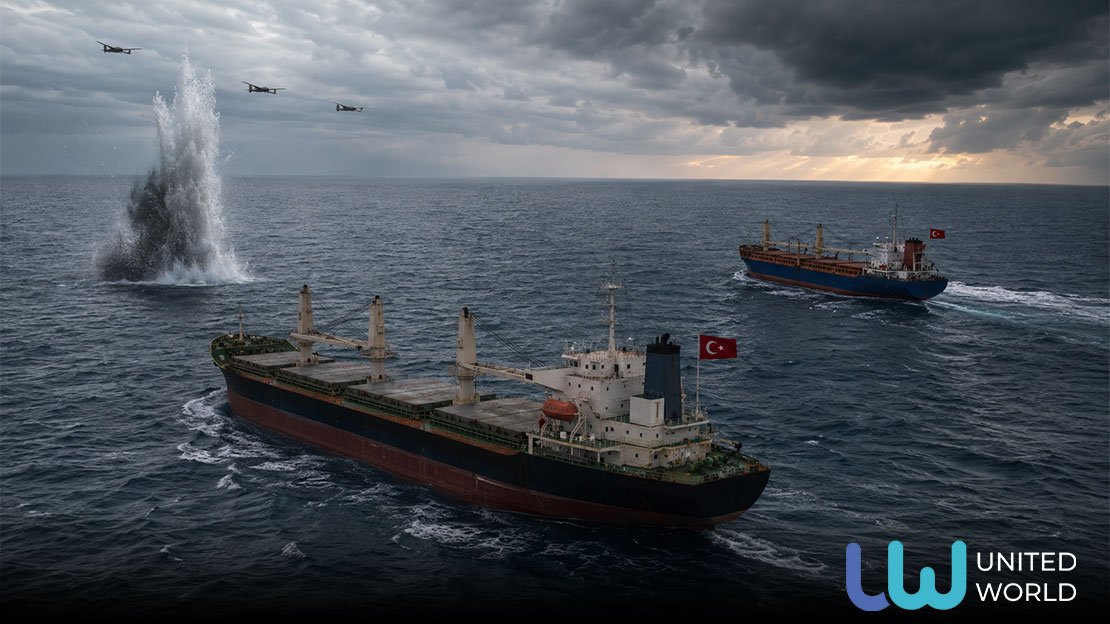
On August 3, two Türkiye’s-flagged vessels—the Yaşar and the Nadezhda—operated by Samsun-based Kalyoncu Shipping, came under attack by Ukrainian unmanned aerial vehicles (UAVs) in the Black Sea.
The ships carried a combined crew of 22, including 13 Türkiye’s nationals. According to media reports, four individuals sustained injuries, three of whom are citizens of the Republic of Türkiye. Visual documentation from the scene depicts crew members in a state of profound shock, underscoring the psychological toll of what is becoming a recurring pattern of aggression.
These systematic strikes on Türkiye’s commercial assets are not isolated incidents but rather a direct consequence of the virtually unbridled military and financial backing that Ukraine has received over an extended period. The scale of the Ukraine war machinery now operating in the region appears increasingly difficult to control, and as a result, incidents involving Ukrainian forces are multiplying at an alarming rate.
Ukraine’s Funding Trajectory
The current predicament is symptomatic of years of sustained international sponsorship. The European Union has allocated over €40 billion for Ukraine in 2026 alone—a figure that surpasses the gross domestic product of several EU member states.
Despite its role as a mediator in the Ukrainian crisis, on July 8, 2026, President Recep Tayyip Erdoğan endorsed the Prioritized Ukraine Requirements List (PURL). This move complicates Türkiye’s narrative as a neutral broker and exposes it to reputational risks should such arms be used in operations that endanger Türkiye’s interests.
Crucially, this financial and logistical support persists even with pervasive corruption scandals in Ukraine and a growing catalog of incidents involving its UAVs and unmanned surface vessels (USVs)—many of which now directly menace Türkiye’s northern maritime approaches.
Ukrainian Incursions Off Türkiye’s Northern Coastline
Throughout 2025 and 2026, Türkiye’s Black Sea littoral has become a recurring vulnerability. In June 2025, a Ukrainian UAV was discovered washed ashore on a public beach in Istanbul—an incident that triggered localized panic but elicited only a muted official response. In March 2026, fishermen off the coast of Ünye recovered an USV rigged with explosives.
Between November 28 and December 2, 2025, a coordinated series of attacks by Ukraine targeted oil tankers inside Türkiye’s sovereign maritime territory. Foreign Minister Hakan Fidan at the time characterized the situation as “very frightening”.
In May 2026, Ukraine escalated further by striking three Türkiye’s oil tankers operating within Türkiye’s territorial waters. Such an act could constitute a casus belli, warranting responses ranging from severe economic sanctions to the outright severance of diplomatic ties. Yet Ankara’s reaction remained conspicuously restrained: official statements expressed “concern” and issued “calls for deconfliction.”
In retrospect, those appeals appear to have been wholly disregarded. Does this signify that Türkiye’s strategic position in the region is no longer taken seriously?
State-Level Criminality in Ukraine
The policy of channeling ever greater resources into Ukraine has drawn persistent criticism—not only for its strategic ambiguity but also for its association with deeply embedded corruption within Ukraine’s governing apparatus. According to media reports, the National Anti-Corruption Bureau of Ukraine uncovered significant illicit financial flows in 2025, precipitating the resignation of several cabinet ministers and the flight of certain allies of President Volodymyr Zelenskyy to Israel. In May 2026, Andriy Yermak, former head of the Presidential Administration, was arrested on charges of laundering more than $10 million.
Beyond domestic malfeasance, there is mounting evidence—corroborated by multiple media sources—that Ukrainian entities have facilitated arms smuggling to terrorist and separatist groups in Africa. These transfers pose a direct threat to Türkiye’s strategic partners in the region, including Sudan, Libya, and the Sahel states, further complicating Ankara’s security calculus.
Ankara’s Latest Warning
In its official communiqué No. 151, dated August 4, 2026, the Türkiye’s Ministry of Foreign Affairs reiterated that, despite repeated representations, Türkiye’s citizens and property had once again suffered harm. One might reasonably infer from such language that a robust retaliatory response was imminent—especially given the cumulative weight of prior incidents.
However, the Ministry’s statement read as follows: «Accordingly, we reiterate our call to all relevant actors—particularly the warring parties—to urgently implement concrete measures to ensure the safety of navigation in the Black Sea»
Our government would do well to ponder that such warnings will not bring long-term results.