


By Mohammad Reza Moradi, General Director of Mehr News Agency’s Foreign Languages and International News Department, from Tehran / Iran
Recent developments in West Asia indicate that the region is on the verge of a paradigmatic transformation. While the security order of the Middle East over the past four decades has largely been based on the presence and intervention of extra-regional powers, particularly the United States, there are now multiple signs that this model is gradually eroding and giving way to a new regional order—one increasingly founded on cooperation among indigenous and regional powers.
The recent war involving Iran on one side and the United States and Israel on the other can be viewed as one of the most significant turning points in this process. Although Washington and Tel Aviv entered the confrontation with objectives that extended far beyond a limited military operation, their failure to achieve their strategic and long-term goals has had profound consequences for regional dynamics. One of the most important outcomes has been a shift in how regional states perceive security and the mechanisms through which it should be achieved.
Why the U.S.-Centered Regional Order Has Proven Ineffective
The security architecture supported by the United States in West Asia was built upon a fundamental assumption: that regional states, in exchange for political and security alignment with Washington, would enjoy the protection of the American security umbrella and its strategic guarantees.
Within this framework, hundreds of billions of dollars’ worth of American weapons were sold to Arab states over recent decades, while an extensive network of U.S. military bases was established across the region. Recent developments, however, have revealed the limitations and vulnerabilities of this model.
During recent regional tensions, many Arab states that had long based their security calculations on American support came to realize that imported security does not necessarily translate into sustainable security. Even countries that normalized relations with Israel in recent years in pursuit of greater security guarantees remained vulnerable to the consequences of regional conflicts.
One of the principal weaknesses of the U.S.-centered order is that it does not generate security from within the region itself. Instead, it outsources security to an external actor. Such a model naturally creates dependency and prevents regional countries from developing indigenous security mechanisms.
Moreover, the experience of the past two decades has demonstrated that, except for Israel, the United States is generally unwilling to sacrifice its broader interests for the security of any other actor in the world. This reality became particularly evident during the recent forty-day war. Arab states that found themselves targeted by Iranian retaliatory strikes experienced what could be described as a sense of strategic loneliness. This development has significantly altered security perceptions across the Arab world.
Under these circumstances, a new concept is gradually emerging—one based on the idea that security must be produced within the region and by regional actors rather than imported from external powers.
Signs of an Emerging Regional Order
Evidence of this transformation can be observed across several political and security trends in recent years.
The first indication is the gradual reduction of tensions among the region’s principal powers. The restoration of diplomatic relations between Iran and Saudi Arabia represents one of the most important milestones in this process. This agreement was not merely a bilateral reconciliation; it carried a broader message that many of the region’s crises cannot be resolved without direct dialogue among regional powers themselves.
Although Iran carried out strikes against certain Arab countries during the forty-day war, these actions occurred in response to U.S. military operations launched from bases located in those countries. Iran had repeatedly warned that regional states should not permit their territory to be used for attacks against it. Yet despite these tensions, the continuation of diplomatic relations between Iran and key Arab states demonstrates that a significant shift in regional perceptions is underway.
A second sign is the increasing role of regional actors in managing regional crises. In recent years, many regional issues have been addressed more actively by indigenous actors, while reliance on external mediation and intervention has gradually diminished.
A third sign is the changing understanding of deterrence. Recent developments have shown that military power alone, or the acquisition of sophisticated foreign weaponry, cannot guarantee lasting security. Instead, domestic capabilities, national cohesion, regional cooperation, and economic development have become increasingly important elements in security calculations.
A fourth sign is the gradual emergence of regional partnerships and alliances operating independently of American frameworks. Growing cooperation among Türkiye, Saudi Arabia, Egypt, Pakistan, and other regional actors can be viewed within this context.
Taken together, these trends suggest that the region is moving toward a model in which indigenous powers assume greater responsibility for managing security and stability.
The Components of the New Regional Order
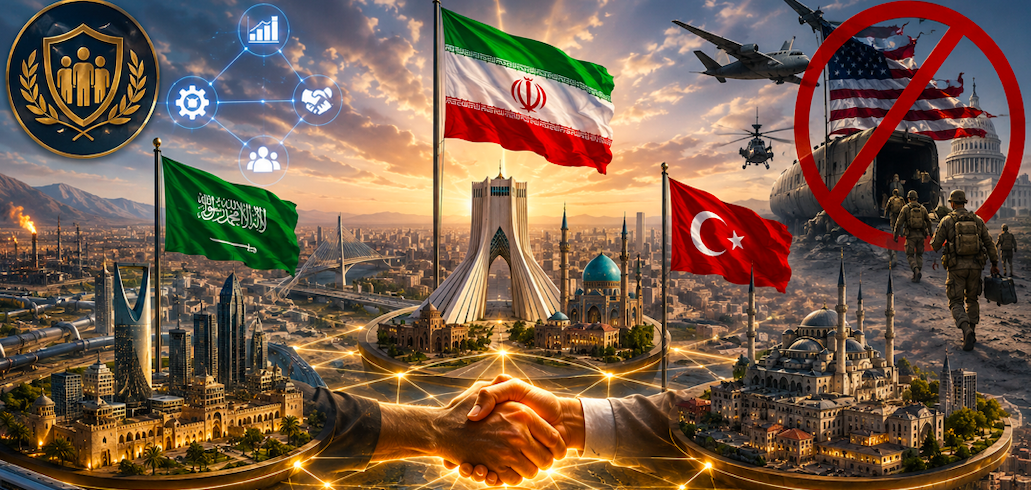
Any sustainable order in West Asia requires the participation of the region’s principal powers. From this perspective, Iran, Saudi Arabia, and Türkiye constitute the three sides of the region’s power triangle, without whose involvement no new regional order can realistically emerge.
Iran: The Pillar of Deterrence and Strategic Independence
Over the past four decades, Iran has developed one of the region’s most independent security models. The experience of war, sanctions, and sustained external pressure has led Tehran to place greater emphasis than most regional states on indigenous security capabilities and strategic self-reliance.
The recent war further demonstrated that despite extensive pressure, Iran remains one of the most influential actors shaping regional dynamics. In this context, Iran’s role in a future regional order can be defined primarily as a provider of strategic balance and deterrence.
Saudi Arabia: The Economic Engine of the New Order
Saudi Arabia has spent recent years attempting to move beyond its traditional role as a predominantly oil-based power and transform itself into a major regional hub for investment and economic development.
Vision 2030 and the kingdom’s ambitious economic projects demonstrate that Riyadh requires a stable regional environment in order to achieve its objectives. Consequently, Saudi Arabia has increasingly prioritized de-escalation and cooperation with major regional actors.
Within a new regional order, Saudi Arabia is well positioned to serve as the economic and financial engine driving regional integration and infrastructure development.
Türkiye: The Geopolitical Connector
Türkiye, due to its geographical location, industrial capacity, and economic and military capabilities, is another key actor in West Asia.
In recent years, Ankara has consistently demonstrated its ambition to pursue an independent role in regional affairs. Türkiye is connected to Europe on one side while maintaining deep ties with the Middle East, Central Asia, and the broader Islamic world on the other.
Within a future regional order, Türkiye can function as a geopolitical and economic bridge linking different regions and facilitating new networks of regional cooperation.
The reality is that none of these three powers can independently establish a sustainable regional order.
Iran cannot ensure long-term security in the Persian Gulf without Saudi Arabia. Saudi Arabia cannot reduce the region’s strategic tensions without engaging Iran. Likewise, Türkiye cannot fully realize its geopolitical ambitions without cooperation with the other two powers.
For this reason, any successful regional order must be based on cooperation, dialogue, and the management of differences among these three states. Such an arrangement would not only reduce the region’s dependence on external powers but also unlock enormous economic and political potential.
Conclusion
West Asia is currently passing through a historic transition. The U.S.-centered order that shaped the region’s security architecture for decades is facing mounting challenges, and an increasing number of regional actors have concluded that sustainable security cannot be imported from abroad.
In its place, the concept of indigenous security and regional cooperation is gradually emerging as the dominant framework. Within this evolving landscape, Iran, Saudi Arabia, and Türkiye are the three principal actors capable of forming the pillars of a new regional order—one based on strategic balance, economic cooperation, mutual respect, and the resolution of regional issues by regional actors themselves.
From this perspective, the growing cooperation among Türkiye, Saudi Arabia, Egypt, and Pakistan should not necessarily be viewed through the lens of traditional geopolitical competition. On the contrary, if such cooperation develops within the framework of an independent regional security and economic architecture, free from extra-regional domination, it could represent a major step toward moving beyond the American-led order in the Middle East.
Under such circumstances, this emerging alignment would not be perceived by Iran as a threat. Rather, it would be seen as part of a broader historical process leading to the formation of a new regional order—one in which the countries of the region, for the first time in decades, assume primary responsibility for their own security and future.