


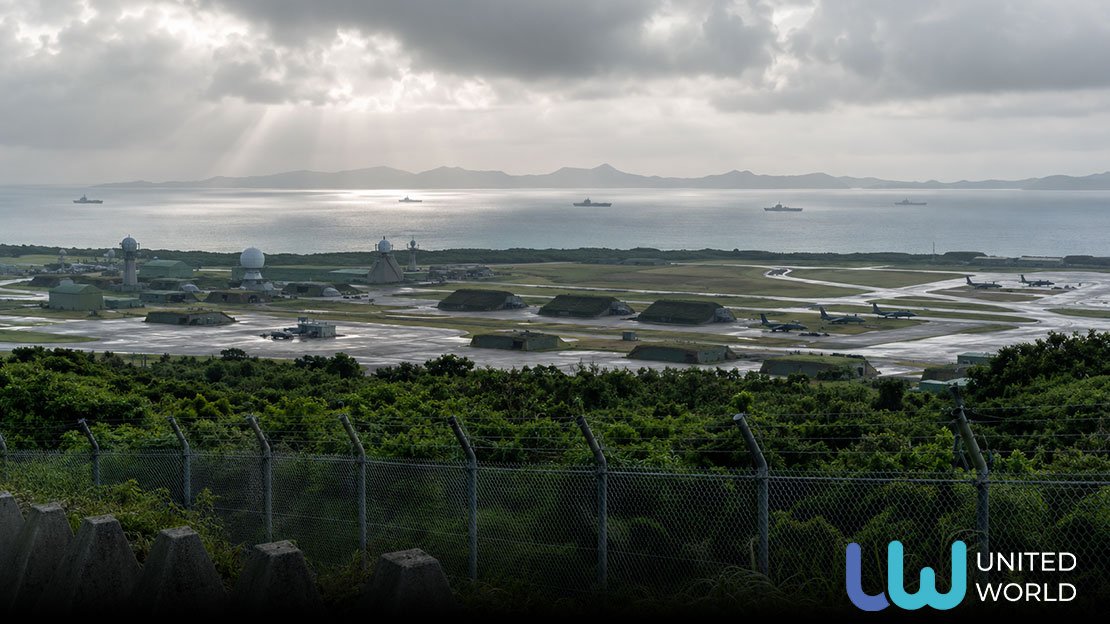
The “Stop the War! Okinawa–Western Japan Network” is a coalition formed in February 2025 by 30 organizations and individuals across 14 prefectures—including Okinawa, Kyushu, Chugoku, Shikoku, and Kansai—who came together to build nationwide solidarity in opposition to the Japanese government’s forcible push to militarize the country, such as through the domestic deployment of long‑range missiles and the construction of large ammunition depots. The network is persistently engaging in local exchange gatherings and negotiations with the government to halt Japan’s war‑oriented policies. [Shiso-Undo News Editorial Team]
Opposition actions have been undertaken across various regions from Kyushu to the Nansei (SouthWest) Islands in response to the two large-scale Japan–U.S. joint military exercises being conducted in the latter half of June. The website of “Okinishi Net,” which issued this statement, also introduces these local initiatives. We encourage you to make use of it. (https://okinishi-net.org/) [Editorial Office of Shiso Undo]
We now find ourselves placed squarely in the midst of a ruinous course of military expansion—one that accepts killing as justified.
The upcoming “Valiant Shield 2026” (June 22–July 1), led by the U.S. military, is designed to refine large-scale operational execution across all domains—land, sea, air, space, cyber, and electromagnetic—under the banner of “integrated deterrence” in the Indo-Pacific region.
Meanwhile, “Resolute Dragon 26” (June 20–30) assumes a vast area stretching from Kyushu to the entire Nansei Islands as its main battlefield, with the Japan Ground Self-Defense Force and the U.S. Marine Corps fully integrating their command systems and operational procedures to achieve practical, combat-ready interoperability.
Weapons systems such as the long-range missile launcher Typhon (a combination of Tomahawk cruise missiles and SM-6 anti-air/anti-ship missiles) are being brought into Kanoya Air Base in Kagoshima Prefecture, while HIMARS multiple rocket launchers, the unmanned anti-ship missile system NMESIS, and the air-defense system MADIS are being moved into the Ryukyu Arc and Kyushu. 2 These activities go far beyond mere training; they constitute preparations to transform the region into a battlefield by clearly designating a specific country as a hypothetical adversary. The inhumanity of training to kill people of other nations is being concealed behind childish, game-like names such as “Valiant Shield” and “Resolute Dragon.”
The Japanese government, invoking vague and self-serving rhetoric such as “an increasingly severe security environment,” is overturning the peace principles enshrined in the Constitution. Prime Minister Takaichi’s remark that “a Taiwan contingency would constitute a survival-threatening situation for Japan,” along with her unreflective stance thereafter, lies on the same continuum as Japan’s hegemonic interventions and invasions in East Asia since the Meiji era. These actions heighten China’s wariness and distrust toward Japan to the extreme, pouring fuel on the fire rather than easing tensions. Now is the time for Japan to draw a clear line under its “colonial mindset” and steer decisively toward peaceful coexistence.
What is particularly unacceptable is the accelerating military integration with the United States. As seen in Venezuela and Iran, the United States has become a “rogue state” that topples other governments by force for its own interests. To advance military integration with such a country and conduct joint exercises while proclaiming “exclusively defensive defense” is shameless and indefensible. It clearly violates the peace principles of the Preamble and Article 9 of the Japanese Constitution. Furthermore, even in light of the former enemy-state clauses of the UN Charter, Japan’s current military buildup and joint exercises lack international legitimacy.
The Japanese government insists that “enhancing sustained combat capability” and “strengthening base resilience” constitute “reinforcement of deterrence.” Yet “deterrence” fundamentally means “to threaten and stop”—that is, intimidation through military force. The government’s push for underground command centers and its unrealistic civil protection plans, which would create “war evacuees” and force residents to evacuate, reveal that this form of military intimidation does not function. The rationale for the current military buildup has already collapsed.
It is absolutely unacceptable for Japan’s territory to be used for exercises like these. For example, the Hijudai Training Area in Oita Prefecture—used in this exercise—is the site where three precious lives were lost in a tank training accident in April this year. The background of this accident includes a combination of structural problems such as (1) a shortage of SDF personnel, (2) increasingly complex equipment, (3) high-density training, and (4) disregard for human life among personnel. Under such conditions, military exercises dramatically increase the risk of further casualties.
Similar accidents could occur anywhere. Conducting military training again without fully investigating the causes is unacceptable on humanitarian grounds. Moreover, during nationwide training and transport connecting bases, military use of airspace over civilian residential areas, civilian flight routes, and public roads is being carried out. This is an outrageous act that ignores the “principle of separation between military and civilian” strictly required by the Geneva Conventions.
We must never repeat the foolish act of war. Peaceful coexistence is the only path that guarantees our survival. Peace begins not with military buildup but with sitting at the table for dialogue. From now on, all energy should be devoted to diplomacy and dialogue to realize the peace principles enshrined in the Japanese Constitution—preparations not for war, but for avoiding war. Wasting time and tax money on war-preparation exercises is absolutely unacceptable.
1. Cancel the Japan–U.S. joint exercises (“Resolute Dragon 26” and “Valiant Shield 2026”).
2. Abandon the deployment of long-range missiles.
3. Present to the public a policy of peace building through diplomacy rather than military intimidation.
Published by – Shiso-Undo News – July, No.188b, June 15, 2026 Stop the War! Okinawa–Western Japan Network (Okinishi Net)