

By Dr. Doğu Perinçek, Chairman of the Vatan Party, Türkiye
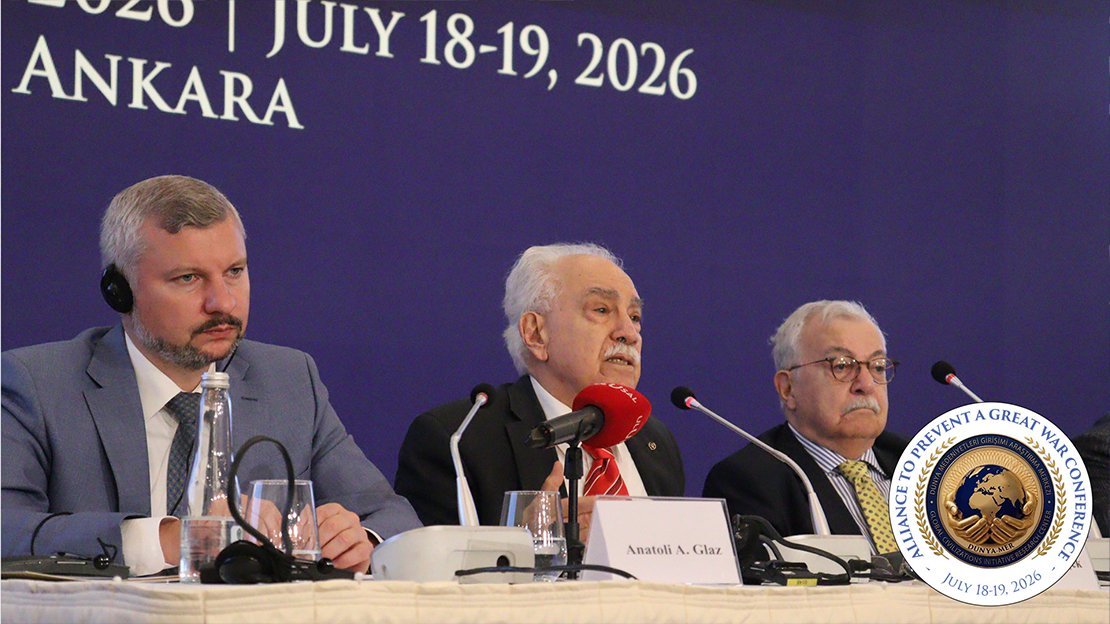
The international conference entitled “The Alliance to Prevent a Great War,” organized by the World Civilizations Initiative Research Center, was held at the Meyra Palace Hotel in Ankara on 18–19 July 2026.
UWI will present the speeches held on the conference during the coming days.
The conference, which featured presentations by speakers from Azerbaijan, Belarus, France, Germany, Greece, Iran, Italy, Japan, Russia, the Sahrawi Arab Democratic Republic, South Africa, Spain, Switzerland, the Turkish Republic of Northern Cyprus (TRNC), Türkiye, the United Kingdom, and the United States, was attended by approximately 200 distinguished invited guests.
Ministers, members of parliament, ambassadors, retired generals, scholars, politicians, diplomats, military officers, and experts examined the question of the “Alliance to Prevent a Great War” from a wide range of perspectives.
Below, we present the speech of Dr. Doğu Perinçek.
1. The Process Intensifying the Threat of a Great War: Global Balances of Power Are Changing Rapidly
The rapid shift in the world’s economic and military balances of power is creating the conditions that intensify the threat of a great war.
In the 1950s, the United States accounted for half of global production. By 2000, this share had fallen to 25 percent, and by 2026 it had declined to 17 percent. The People’s Republic of China, whose share of global production was 6 percent in 2000, increased its share to 27 percent by 2026, leaving the United States far behind.
Looking ahead, according to a projection issued last year by the United Nations Industrial Development Organization, the U.S. share of global production will fall to 11 percent by 2030. The People’s Republic of China, meanwhile, will reach 45 percent—in other words, four times the U.S. share:
Year 2000 Year 2026 Year 2030
USA 25% 17% 11%
PRC 6% 27% 45%
The major British bank Standard Chartered, together with the World Bank, the OECD and the IMF, prepared a projection on the future of the global economy. In this projection, the ten largest economies in 2030 are ranked as follows, in comparison with 2017:
| No. | Country | Projected GDP (2030, PPP) | GDP (2017, PPP) | Growth |
| 1 | China | $64.2 trillion | $23.2 trillion | +177% |
| 2 | India | $46.3 trillion | $9.5 trillion | +387% |
| 3 | United States | $31.0 trillion | $19.4 trillion | +60% |
| 4 | Indonesia | $10.1 trillion | $3.2 trillion | +216% |
| 5 | Türkiye | $9.1 trillion | $2.2 trillion | +314% |
| 6 | Brazil | $8.6 trillion | $3.2 trillion | +169% |
| 7 | Egypt | $8.2 trillion | $1.2 trillion | +583% |
| 8 | Russia | $7.9 trillion | $4.0 trillion | +98% |
| 9 | Japan | $7.2 trillion | $5.4 trillion | +33% |
| 10 | Germany | $6.9 trillion | $4.2 trillion | +64% |
These tables lay bare the economic decline of the imperialist-capitalist system. In 2030, we see Asia’s overwhelming predominance among the world’s ten largest economies. Of the countries of the Atlantic System, only the United States ranks third, while Japan is ninth and Germany tenth. When France, Britain, the Netherlands and the other Western European countries—which do not even appear among the top ten economies—are added, the combined output of all the countries of the Atlantic System only just matches that of the People’s Republic of China. The changing balance of economic power is also reflected in the collapse of the reign of the dollar. We have reached the end of the U.S. tribute system.
Turning to military power relations, armed powers such as Russia and the People’s Republic of China, which balance and deter the United States, are today proclaiming the end of U.S. hegemonism. In every war game organised by the Pentagon, the U.S. military is defeated by the armed forces of the PRC and Russia. Iran’s victory in its war against U.S. imperialism and Israeli Zionism has revealed the new balance of military power.
The new economic and military balances of power have also shaped the relations of Western European countries and Japan with the United States. The era in which the United States kept the other imperialist-capitalist countries under its control is now over. NATO is cracking, and we have reached the end of U.S. hegemony. The U.S. claim to a unipolar world has collapsed. A new world is being built.
Changes in the world’s economic and military balances of power have always brought war onto the agenda. The present crisis of the imperialist-capitalist system is far deeper and more convulsive than the crises preceding the First and Second World Wars. The principal reason is the forces of collapse within the system itself.
The second factor, almost as important as the first, is the rise of the World Revolution. The World Revolution is advancing through two channels. One is the miracle created by socialist China, the rival of capitalism. The other is the narrowing of the sphere of imperialist exploitation by the countries of the Developing and Oppressed World, and the rise of revolution in those countries.
2. The Responses of the Great Powers to the Changing Balance of Power
2.1 China’s Policy of Overtaking the United States by Peaceful Means
When we examine the process through which we are living, we see that the People’s Republic of China is overtaking the United States by peaceful means. The policy of the People’s Republic of China therefore favors preserving peace. To prevent the United States from launching a war, the Chinese government even purchases large quantities of U.S. Treasury securities. In this way, it pays the price of peace, because time is on China’s side. At the same time, China is preparing against the U.S. threat of war and is developing weapons, particularly defensive systems. It also makes use of its population advantage of nearly 1.5 billion people and the vast depth of its home front.
The Russian Federation and the major countries of the Developing World stand with China. The development of the Shanghai Cooperation Organization and BRICS strengthens China’s strategy of preserving peace. Taken as a whole, unlike imperialist Germany before the Second World War, a rising China today is not pursuing a course of launching war in order to divide up the world. On the contrary, confident that it can overtake the United States by peaceful means, it is determined to preserve peace. Commitment to building socialism is the guarantee of this peaceful policy. If the People’s Republic of China were to retreat from socialism to capitalism, as occurred in the Soviet experience, Chinese hegemonism would enter humanity’s agenda. Under the leadership of the Communist Party of China, Mao’s principle that “China will never seek hegemony” is being upheld against this threat. In this respect, China’s insistence on the socialist path is a guarantee for humanity and for peace.
2.2. The Question the World faces: How the United States Will Respond to the Collapse of Its Hegemony
The United States is the country in a position to decide whether there will be war. The process of the collapse of U.S. hegemony is forcing Washington’s leaders to make a historic decision. They will either accept this process and adapt to the conditions imposed by the new balance of power, or reject the process through the use of force.
While China is becoming stronger on the domestic front, in its economy, in armaments and in its accumulated alliances, the United States is weakening in all these areas.
The reign of the dollar has collapsed; the yuan is rising.
The United States lost the first stage of the war with Iran. China, together with Iran and Russia, stands on the victorious side.
The cracks within NATO are moving towards disintegration. The prolonged wars on the Ukrainian and Palestinian fronts are testing the endurance of the United States.
The American people oppose war and do not trust the Trump administration. The Chinese people, by contrast, trust their government and are prepared to make sacrifices in defense of their homeland.
Under these conditions, if the United States accepts the continuation of peace, it will lose its imperialist claims. The throne occupied by Washington’s rulers since the Second World War is already cracking and showing signs of collapse.
2.3. The two options the United States faces
The United States therefore faces two options.
- The first option is for the United States to abandon its claim to world hegemony. U.S. monopoly capital would then be compelled to retreat to far weaker positions both internationally and at home.
- The second option is for the United States to risk major regional wars and even a world war in order to prevent the establishment of a new world order. In that event, the United States would challenge through war the rise of China, the strengthening of Russia, Iran’s production of nuclear technology, Türkiye’s positioning in Asia, Israel’s decline and, taken together, the emergence of the Asian Age.
2.4. A Major Weakness of the United States: Confrontation on Multiple Fronts
A major weakness of U.S. imperialism is its opening of multiple fronts. Such offensives place the U.S. threat in difficulty on every front. U.S. imperialism would then be digging more than one grave for itself. Yet concentrating on a single front would increase the danger that the war might expand and lead to a world war.
2.5. The Character of Possible Wars: Not Wars of Division, but Wars of National Defense
The wars now being waged by Russia, Iran, Palestine, Yemen and Lebanon against U.S. imperialism, Israeli Zionism and their collaborators are just wars against imperialism—wars of national defense. If these wars spread and acquire global dimensions, they too will develop as wars of national defense. A war in the Taiwan Strait or the Pacific would likewise have the character of a war of national defense for China and the Democratic People’s Republic of Korea.
Taken as a whole, the world does not face the danger of a war of division among imperialist powers, but the possibility of wars of national defense.
2.6. The Focal Point of the Threat of a Great War: The Region Extending from the Eastern Mediterranean to the Strait of Hormuz
Among the world’s areas of war and tension, the region extending from the Eastern Mediterranean to the Strait of Hormuz appears to be the focal point of the threat of war.
First, this region is already in flames. Iran, Palestine, Hezbollah in Lebanon and Yemen are fighting Israeli occupation and U.S. imperialism.
Second, no force capable of deterring U.S. imperialism and Israel has yet emerged in the Eastern Mediterranean. Imbalance always invites war. The alliance formed in the Eastern Mediterranean by the United States, Israel, Greece and the Greek Cypriot Administration of Southern Cyprus also possesses nuclear weapons. France, several other European countries and Ukraine—their partners in the European Union and NATO—stand with them. On other fronts, however, most Western European countries appear to be distancing themselves from the United States and Israel.
In addition to the Eastern Mediterranean’s strategic importance for security, its rich energy reserves are also a source of rivalry and conflict. Cyprus is also the geography through which all the undersea cables from Asia to Europe pass.[1] Natural gas pipelines designed by the United States and Israel also pass through this area. The planned energy route extending from India through Israel, Southern Cyprus and Greece to Europe is known to the world public. It is clear that this route is intended as an alternative to China’s Belt and Road Initiative and to energy flows passing through Türkiye.
The Eastern Mediterranean front is, first and foremost, Türkiye’s front.[2] From our Aegean coast, we look towards the opposite shore: beginning at Alexandroupoli, the United States has established bases in Kavala, Thessaloniki, Larissa, Stefanovikio, northern Crete and southern Cyprus. It has deployed aircraft and brought in tanks. Greece has been transformed into a U.S. base. The United States is also conducting the Noble Dina and Nemesis exercises in the Eastern Mediterranean together with Israel and Greece.
The alliance of the United States, Israel and Greece, which has pointed its guns at Türkiye in the Eastern Mediterranean, is a formidable force.
Türkiye, of course, possesses an army with high combat capability against the U.S.-Israel-centred threat, as well as a resilient national resistance capacity on the home front. Nevertheless, through a policy of balance that both clouds the consciousness of the Turkish nation and fails to make use of the accumulated potential for alliances, the AK Party government emboldens the U.S.-Israel-centered threat. Forces aligned with the United States inside parliament are also among the factors weakening the domestic front.
Unless effective policies are implemented to change the imbalance created by the heavy deployment of U.S. armed forces against Türkiye, alongside Israel and Greece, war will become inevitable.
3. The Force That Will Prevent a Great War: The Türkiye-Russia-China-Iran Alliance
3.1. The Latent Power of the Türkiye-Russia-China-Iran Alliance
The only solution capable of preventing a regional war in West Asia is the Türkiye-Russia-China-Iran Alliance. Moreover, the only solution capable of blocking the path to a Third World War is again the Türkiye-Russia-China-Iran Alliance.
For this reason, TRCI is necessary not only for the countries forming the alliance, but for every state that does not want war and for all humanity that seeks peace; it is inevitable and urgent.
TRCI is the alliance that will determine humanity’s fate.
Ultimately, all states that do not want war and all humanity that seeks peace constitute the latent power of this alliance. The unstoppable power of TRCI comes from this fact.
3.2. The Türkiye-Russia-China-Iran Alliance is Necessary and Urgent for All Four Countries
The only definitive solution capable of preventing both a regional war and a world war lies in the Türkiye-Russia-China-Iran Alliance.
This alliance is needed by, and is necessary for, all four countries.
Iran, Russia and Türkiye are front-line countries, and both their security and their economic development depend on this alliance.
Russia must defend itself not only north of the Black Sea, but also on the Mediterranean front.
The Suez Canal and the Strait of Hormuz are also security chokepoints for China. China’s forward defense therefore begins in West Asia.
The People’s Republic of China has joined this alliance on the Iranian front. Yet the concept of an alliance does not feature in the traditional policy of China’s leaders. The word “alliance,” however, is not merely a dictionary entry; it is a necessity imposed on states by life itself. China, Russia, Iran and Türkiye have common enemies. If these four countries fail to understand the “common enemy,” they will pay a heavy price. Their unity against this common enemy must go beyond concepts such as cooperation and evolve into an alliance.
3.3. Historical Experiences That Have Opened the Way for the Türkiye-Russia-China-Iran Alliance
In the period behind us, experiences have occurred that opened the way for the Türkiye-Russia-China-Iran Alliance.
The first experience occurred during Barzani’s independence referendum. In September 2017, the countries of the region—Türkiye, Iran, Syria and Iraq, with Russia participating from the north—defeated through a show of force the attempt to transform “Barzanistan” in northern Iraq into a so-called “Kurdistan.”
It would be wrong to view that success only as the defeat of the attempt to establish a Second Israel or “Kurdistan.” What was also defeated there was a process leading towards war. The attempt to establish Kurdistan could have produced no outcome other than igniting a major war in our region, and the unity of the regional countries prevented that war.
The second experience occurred in the Karabakh War. In a grave miscalculation, the United States pushed Armenia into the fire. This U.S. offensive was defeated through the heroic struggle of the Azerbaijani Army, the participation of the Turkish Armed Forces and Russia’s support. The First and Second Karabakh Wars produced a model that illuminates the path ahead. The Turkish-Russian alliance brought peace to the Caucasus.
All these experiences prove that the Türkiye-Russia-China-Iran Alliance is realistic and form the accumulated foundation of this alliance.
3.4. The Russia-China-Iran Alliance Has Taken Shape and Won a War
The most important experience was the U.S. and Israeli attack on Iran. In addition to preparing its own forces very effectively for war, Iran defeated U.S. imperialism and Israeli Zionism through the alliance it formed with Russia and China.
Iran’s war against U.S. imperialism has shown that the Türkiye-Russia-China-Iran Alliance (TRCI) is no longer merely a projected and planned alliance; it is an alliance that has taken shape.
It may not yet have been formally named an alliance, but it has been established in practice and emerged victorious from the Iran-U.S. War.
4. The Position of Türkiye, NATO’s Outsider
4.1. Türkiye Is in the Process of Breaking Away from the Atlantic System
Among the front-line countries now facing the threat of war, Türkiye occupies a special position. Türkiye is a member of NATO, yet it is also NATO’s “outsider.” Unlike the other NATO countries, Türkiye is not part of the club of wealthy nations; it is not European and not Christian. Türkiye is a Developing World country, an Asian country and a Muslim-majority country. In the process it has entered since 2014, Türkiye is moving out of the Atlantic System’s control and towards its place within the Rising Asian Civilization.
Türkiye’s departure from the Atlantic System would have a powerful effect on the global balance and would constitute a major threat to the United States. This is also why the 2026 NATO Summit was held in Ankara.
To keep Türkiye under control, the United States has formed an armed alliance with Israel, Greece and Southern Cyprus in the Eastern Mediterranean. Ukraine forms the Black Sea leg of this alliance.
If the United States-Israel-Greece trio calculates that Türkiye is alone, the danger of war will knock at the door.
Against the nuclear-armed, U.S.-Israel-centered threat, Türkiye can build a deterrent force only by gaining allies that possess nuclear weapons and powerful navies. The determination of China and Russia to respond in kind to a nuclear threat deterred the nuclear threat against Iran.
The Türkiye-Russia-China-Iran Alliance is the only solution capable of deterring the U.S.-Israel threat across the region extending from Cyprus to the Strait of Hormuz.
4.2. Türkiye’s Rebellion within NATO
Türkiye has been breaking the Atlantic chain since we tore down the Silivri Wall under the leadership of the Vatan Party in 2014 and crushed the coup attempt of 15-16 July 2016 through Army-Nation unity.
Just forty days after the coup was defeated, Operation Euphrates Shield was launched, followed by Operations Olive Branch and Peace Spring. These operations were carried out against terrorist organizations directed by U.S. imperialism and Israel.
Since 2016, 24,000 officers, non-commissioned officers and military personnel have been purged from the Turkish Armed Forces, along with 30,000 police officers, 14,000 members of the judiciary and a total of 144,000 public officials. Such a purge is unprecedented among NATO countries. By dismantling its Gladio network, Türkiye broke the most important link in the NATO chain. NATO generals are in Turkish prisons today.
At the same time, Türkiye’s armed forces rendered ineffective the PKK terrorist organization directed by the United States and Israel, compelling it to dissolve itself and lay down its arms.
Having broken the Atlantic chains, Türkiye is now confronting the reality of an alliance with Russia, China and Iran against the threat centered on the United States and Israel.
4.3. The Factors That Make Türkiye’s Alliance with Iran, Russia and China Necessary
First, the threat directed at Türkiye comes from the U.S.-Israel Evil Alliance. This threat determines Türkiye’s front. Türkiye’s NATO membership does not alter the alignment of forces.
Looking at our recent experience, since 1991 the United States, together with Israel, has led armed operations aimed at dividing Türkiye. Beginning with the 1991 Gulf War, the United States has used armed intervention to establish a Second Israel statelet under the name of “Kurdistan.” The attempt to break Syria apart by force in 2011 was the second major step in the same strategy. Throughout this process, the United States and Israel supported the PKK and, most recently, launched a war against Iran.
The United States is already part of an alliance targeting Türkiye. The entire world has witnessed the Noble Dina and Nemesis exercises conducted by the United States, Israel and Greece in the Eastern Mediterranean. The names of these exercises are drawn from stories of vengeance in the Torah and Greek mythology. The United States, Israel and Greece are building up military forces in Southern Cyprus and on the Aegean islands. The U.S. bases established along the Greek coast are known to everyone. During the NATO exercise at Alexandroupoli in May 2025, they also simulated crossing the Meriç River. Their guns are pointed at Türkiye. The territory they plan to enter by crossing the Meriç River is Turkish territory!
The occupation and genocide carried out in Palestine by the U.S.-Israel Evil Alliance also fall within the scope of the threat to Türkiye. If Palestine wins, the Kurdistan project loses. If the Kurdistan project wins, Palestine loses. Türkiye therefore stands together with Iran, Russia and China on the Palestinian front as well.
Second, overcoming Türkiye’s economic crisis through a Production Revolution also requires cooperation with Russia, Iran and China. Türkiye’s energy security rests on friendship with Iran and Russia. For many years, China and Russia have been Türkiye’s first- and second-largest foreign trade partners.
4.4. Türkiye Can Build a Production Economy in the Climate of TRCI
Türkiye is living with the consequences of the “Program of Integration with the World Economy” implemented after 1980. The Turkish economy has been tied to global financial centers. Our country’s productive capacity has suffered severe blows, while the producing classes have been suppressed or pushed to the margins. The national economy has fallen into the hands of hot-money brokers, dollar and stock-market speculators, major usurers and religious orders. Producers have been declared a “burden.” Those who made money out of thin air through collaboration with imperialism became the masters of the country. Society—above all the working classes—is discontented.
The construction of a production-oriented economy—or, more precisely, the Production Revolution—is necessary and inevitable for Türkiye. The Production Revolution can succeed only by breaking free from the Atlantic System and within the climate of the TRCI Alliance.
Third, through solidarity with Iran, Russia and China, Türkiye will resist the cultural degeneration, individualism, selfishness, opportunism, violence, genderlessness, unnatural gender orientations, decay and alienation of every kind imposed by the West and will develop its national revolutionary culture.
Fourth, TRCI Is Required for Standing at the Forefront of Contemporary Civilization
TRCI is perceived as a formula for foreign policy. That is not correct.
The meaning of the TRCI Alliance is to break free from the Atlantic System and take a place among the leading forces of the Rising Asian Civilization.
Imperialist-Capitalist Civilization can no longer answer humanity’s demands. It represents reaction, has entered a profound crisis and is sinking.
A new civilization is rising from Asia. In terms of social and economic relations, this new civilization is not a continuation of the Atlantic System.
The new civilization is based on the independence of nation-states. It is humanistic, public-oriented, people-centred, solidaristic, democratic, freedom-loving and peaceful.
By taking its place within the TRCI Alliance, Türkiye will share the leading positions of contemporary civilization. In this respect, the TRCI Alliance is required by the Turkish Revolution’s goal of standing at the forefront of contemporary civilization.
Fifth, the TRCI Alliance Is the Condition for the Final Victory of the Three-Centuries-enduring Turkish Revolution
Since the mid-nineteenth century, we have been passing through processes of National Democratic Revolution. The Constitutional Revolution of 1876, the Freedom Revolution of 1908 and the Kemalist Revolution extending from the War of Independence of 1914-1922 into the 1930s followed one another. We now stand on the threshold of completing the Revolution.
The TRCI Alliance is the condition for final victory.
The Atlantic System is in decline, and Türkiye’s departure from that system depends on an alliance with Russia, Iran and China.
Today, the TRCI Alliance is the only solution capable of preventing U.S. and Israeli aggression on both the regional and global scales.
The power capable of preventing the war from spreading across West Asia lies in the Türkiye-Russia-China-Iran Alliance.
The power capable of preventing the war from evolving into a world war also lies in the Türkiye-Russia-China-Iran Alliance. There is no other option capable of deterring the United States and Israel.
In this respect, Türkiye stands on the threshold of a historic role that will open the way for the World Revolution, just as it did during our War of Independence of 1914-1922.
5. The New Civilization Rising From Asia
Across the world, the imperialist-capitalist system is in decline and the forces of revolution are rising. The most important fact demonstrating the rise of these revolutionary forces is that the New Civilization rising from Asia has become a power capable of determining the world’s future. The institutions of this civilization—the Shanghai Cooperation Organization and BRICS—are narrowing the imperialist system’s sphere of existence.
The New Civilization Rising from Asia represents a new system. It is based on the independence of nation-states; it is humanistic, solidaristic, public-oriented, people-centered, statist and Enlightenment-minded, and it strengthens the forces of peace.
This system includes countries building socialism, such as the People’s Republic of China, the Democratic People’s Republic of Korea, Vietnam, Laos, Cambodia, Bolivarian Venezuela, Cuba and Nicaragua, as well as front-line countries such as Russia, Iran, Yemen, Palestine and Lebanon, represented by Hezbollah. These countries are fighting imperialism and hegemonism with arms. Beyond them, many countries still at the stage of national democratic revolution are struggling against imperialism and hegemonism on the fronts of state independence, national economy and democratic culture.
These facts show that the principal force of the World Revolution consists of states seeking independence. Mao Zedong’s ranking of the revolutionary forces in the 1970s has been confirmed by world practice: States want independence, nations want liberation, and peoples want revolution.
[1] For a highly illuminating study on this subject, see Ali Alsaç, “TRNC: Eurasia’s Digital Lifeline,” Teori, no. 431, December 2025, p. 28 ff.
[2] On the U.S.-Israel threat centred in the Eastern Mediterranean, see the dossier titled “The Cyprus Showdown in the Eastern Mediterranean,” containing articles by Prof. Dr. Fahri Erenel, Halil Özsaraç, Dr. Ali Alsaç, Rear Adm. (Ret.) Dr. Deniz Kutluk, Prof. Dr. Ata Atun, Assoc. Prof. Dr. Yurdagül Atun, Yasemin Öztürk and Doğu Perinçek, in Teori, no. 431, December 2025. See also Doğu Perinçek, The United States at the Crossroads: Biden’s Dead End in the World, America and Türkiye, Kaynak Publications, 1st ed., September 2021, pp. 120–129.