


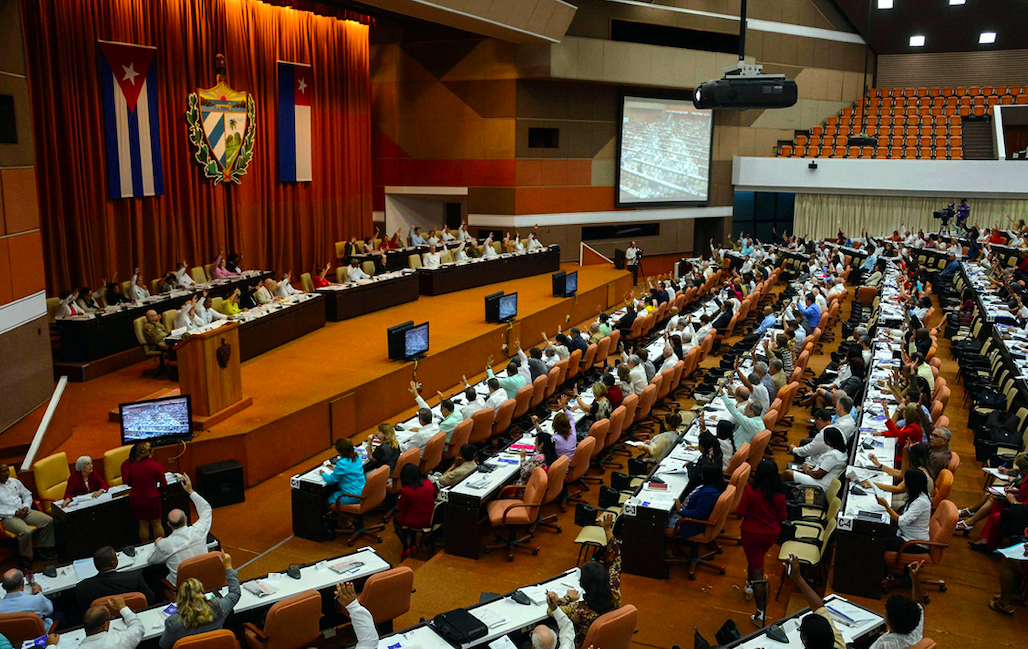
On the recently announced reform package.
On the recently announced reform package.
By Dr. Prof. Fernando Esteche
Last week, the National Assembly of People’s Power unanimously approved, in an extraordinary session, a package of 176 measures grouped into 23 key areas, which Prime Minister Manuel Marrero presented as the most profound economic opening program since 1959. There were no street protests or people’s mobilizations. What occurred was the parliamentary formalization, with a show of hands and Raúl Castro’s participation via video, of a decision that had already received the prior endorsement of the Political Bureau of the Communist Party.
The content is extensive and touches on several pillars of the system. It enables private banking under the supervision of the Central Bank, creates a value-added tax, allows wage negotiations within companies, mandates a currency reform with successive devaluations of the peso, expands the autonomy of municipalities and state-owned enterprises, opens tourism to investment from Cubans residing abroad, and allows the entry of international restaurant chains. Six decades of state control over circulation, credit, and the exchange rate, which guaranteed equal access to basic rights, begin to crumble in one single blow.
But there’s one issue the Cuban government itself has left unresolved so far: the timeline, the operationalization. No effective date has been announced for most of the measures. If implemented with the scope announced, private banking and the currency reform could unlock some foreign currency liquidity in an economy that has been under a fierce oil blockade for almost five months. But Cuba already has a history of reforms that are announced ambitiously and implemented slowly, from the self-employment policies of the 1990s to the 2011 Guidelines and the 2021 Economic Reorganization Plan. The bottleneck has never been solely regulatory. It’s the combination of extraterritorial sanctions, shortages of supplies, and a state bureaucracy that retains considerable veto power over effective implementation.
What motivates the package is, above all, the magnitude of the crisis. The island is experiencing its worst economic downturn in decades, with fuel shortages, prolonged blackouts, and mass emigration eroding the country’s demographic and labor base. Díaz-Canel denied on Thursday that the package is a response to U.S. pressure, calling it a sovereign exercise. It’s hard to believe that entirely, although it shouldn’t be dismissed as mere rhetoric either. The most profound reforms in the country’s economic history are arriving just as external pressure reaches its peak, and this coincidence is no accident, even if the official discourse needs to present it as such.
There is a very specific detail that should not be overlooked, because it places the entire situation within a precise timeline. On June 11, exactly one week before the parliamentary session, the Treasury Department sanctioned Cupet, the Cuban state oil company, accusing it of using energy as a tool for social control. A day later, a private oil trading company in Florida, which was about to ship the largest cargo of fuel the United States would send to the island since 1960, suspended the shipment, pressured by the Trump administration itself. The sequence is significant: sanctions and fuel cuts within forty-eight hours, just before the National Assembly convened its extraordinary session.
Whether this satisfies Washington has an answer that shouldn’t be oversimplified, but neither should it be diluted by a false equidistance. The United States’ stated objective is not limited to opening the market. The 1996 Helms-Burton Act conditions the lifting of the embargo on a transition to a multiparty system and the departure of the Communist Party from power. Trump and Marco Rubio have been speaking of a change in the economic model and regime in the same breath, and the Miami summit convened under the name Shield of the Americas showed that Washington is treating the Cuban case within a broader framework of regional pressure, with twelve Latin American governments aligned. A package that expands the space for private capital but leaves the Communist Party’s political monopoly intact risks being interpreted in Washington as a sign of weakness useful for increasing pressure, not as a sufficient concession to lift it. The American threshold of satisfaction is set in the political arena, not the economic one, and this is demonstrated by the very history of the blockade, which survived much more timid partial reforms in the nineties.
The comparison with Venezuela shouldn’t be stretched too far, but it’s impossible to avoid. The most immediate precedent isn’t just the sanctions on oil companies or the diplomatic siege; it’s the kidnapping of Nicolás Maduro and Cilia Flores in a US military operation on January 3 of this year, an episode in which thirty-two Cuban soldiers sent to defend him died. That event serves as an explicit warning in Havana, not a metaphor. Díaz-Canel knew this when, weeks later, in front of the US embassy in Havana, he promised that his government would make no concessions. Five months of oil blockade later, that promise has become much harder to uphold without nuance, and Thursday’s package is, to a large extent, the nuance.
If the criterion is the orthodoxy of centralized planning, then what was approved is undoubtedly a step backward. But the image that best describes what happened on Thursday is not the inverted formula that is usually cited, but Lenin’s original one, that of the New Economic Policy of 1921. That was a deliberate retreat toward market mechanisms after the civil war and war communism brought the Soviet economy to the brink of collapse. Lenin understood it as a tactical withdrawal to buy time and resources without addressing the fundamental issue—who governs—rather than as a defeat. Something similar could be said of what is happening in Havana. The reforms affect circulation, banking, the exchange rate, and small and medium-sized property ownership, but they do not touch the political direction of the process nor enable the multiparty system that Washington demands as a fundamental condition. To call it simply a step backward is to oversimplify an operation that combines economic concessions with political protection.
The parallel with China is worth exploring, albeit with caution, because the scales and timelines are not the same. Deng Xiaoping opened the Chinese economy starting in 1978 with a now-famous phrase, “It doesn’t matter what color the cat is as long as it catches mice,” and created the first special economic zones in Shenzhen, Zhuhai, and Xiamen two years later. That opening also left the power of the Chinese Communist Party untouched, and in that respect, the parallel with Cuba is direct. It’s important to note, with the critical distance the case deserves, that the Chinese opening ultimately produced growth. If the model inspiring Cuba’s shift is the Chinese one, it’s worth asking whether Havana is capable of sustaining, for forty years, the political discipline that allowed Beijing to manage the social effects of its own opening, in a much smaller country, much more exposed to the United States, more vulnerable to changing economic dynamics, and without the demographic buffer or the domestic market that China had in 1978.
The opening doesn’t affect everyone equally at home either. For the generation that built its identity around the Revolution, those now between fifty and seventy years old, who lived through the Special Period of the 1990s as a trial overcome without abandoning the founding narrative, this reform can feel like an uncomfortable reassessment of what they sacrificed. It’s not the same to have upheld rationing, free public healthcare, and state employment as cornerstones of meaning for six decades as it is to see them relativized overnight by the very Party that defended them. Cuban youth, on the other hand, those born after the fall of the Soviet Union and who, for the most part, don’t see their lives as ending on the island, will probably receive the package with a pragmatism far less burdened by grief. For this group, the question isn’t whether the opening betrays the ideals, but whether it comes at the right time, and the most widespread answer, judging by emigration figures in recent years, has been no.
The fundamental question remains: does the US objective end with regime change? No. Regime change is the declared strategic goal and the one that sets the legal limit of the blockade, but it coexists with more immediate and profitable objectives for Washington. These include the erosion of Cuba’s ties with its regional allies, the use of migration pressure as a tool of US domestic policy, and the opening of investment niches for US capital in banking, tourism, and food—precisely the sectors that the Cuban reform itself has just enabled. Regime change functions as a long-term goal, while economic strangulation and the forced opening of sectors operate as tools that erode, month by month, the Cuban state’s capacity to resist, regardless of the pace at which that goal is ultimately achieved.