


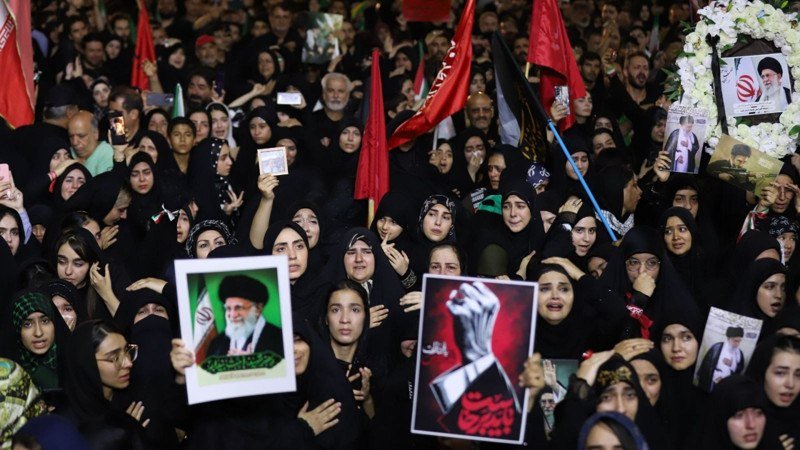
By Mustafa Ilker Yücel, from Tehran / Iran
For Iran’s martyred leader Ali Khamenei and members of his family, who lost their lives in the US and Israeli attacks, the funeral prayer was held on July 5 at the Imam Khomeini Mosalla Mosque in Tehran.
After the religious ceremony at the Imam Khomeini Mosalla Mosque was completed, another official farewell ceremony was held for Khamenei in the streets of Tehran the following day, on July 6.
Many Turkish journalists were in Tehran to follow both the funeral prayer and the farewell ceremony.
Among them was Mustafa İlker Yücel, editor-in-chief of the news website Odatv. In addition to his observations from Tehran, Yücel also interviewed Prof. Dr. Fuad Izadi, a political scientist and faculty member in the Department of American Studies at the University of Tehran.
In the interview, published by Odatv website on July 9, 2026, Yücel asked Izadi a wide range of questions, from the ceasefire process between the US and Iran to political debates inside Iran, from relations with Türkiye to the state of the Iranian economy.
We are sharing the interview, translated into English, with our readers.
—————————————————————————————————————————————
Prof. Dr. Fuad Izadi completed his undergraduate and master’s degrees at the University of Houston. He received his PhD from Louisiana State University with a dissertation on “US Public Diplomacy toward Iran.” Thanks to his deep command of American politics, he is frequently approached by international media outlets for comment.
We asked Izadi a wide range of questions: the ceasefire process, political debates in Iran, relations with Türkiye, and the state of the Iranian economy. Here are his answers:
Last wave of protests
“The protests that began in January over economic hardship were well-intentioned at first. Later, they turned destructive. They were so sure that they would succeed that Pompeo issued a statement on social media supporting the rioters. The Iranian government never responded with gunfire to the shopkeepers’ protests. The US knew this. That is why they wanted to use brutality as a method, and it was they who attacked with weapons.”
“In the first days, the Western media put the death toll at 6,000, then 12,000, and Trump raised it to 30,000. There was a purpose behind this: they wanted to reach a figure that would overshadow the number of deaths in Palestine and make people forget it.”
“The total number of deaths was 3,017. The Iranian government released the identities of each and every one of them. Of these, 2,200 lost their lives in shootings by individuals linked to the CIA and Mossad. Around 300 were Iranian security personnel. If more people than this had really been killed, why were they unable to add even a single identity to support that claim?”
Ceasefire’s importance for address domestic and external problems
“Larijani had said that they told Khamenei he needed to enter a shelter. Khamenei refused the offer, saying, ‘I will not use a facility that we cannot provide to our people.’”
“The ceasefire is important for Iran in terms of addressing both domestic and external problems. But the US violated the first two articles of the agreement on the very first day. Therefore, the Iranian leadership knows that the war will begin again and is preparing accordingly.” (Twenty-four hours after our conversation with Izadi, Trump said “the ceasefire is over,” and the US attacked Iran again.)
Why Khamenei’s funeral was so magnificent
“Iran now has a means of pressure: the Strait of Hormuz. This did not exist before. This new situation is the result of Iran’s successful tactics.”
“Western politicians and intellectuals don’t know this: before the Islamic Revolution, Iran was ruled by dynasties. The Pahlavis, the Qajars… The Iranian people gained the Republic through the revolution. This is one reason why Khamenei’s funeral was so magnificent. The Iranian people don’t want to go back.”
“Nobody would recognize Khamenei’s sons”
“Khamenei had four sons. Three of them were present at the ceremonies. If you showed their photos to the public, nobody would recognize them. Khamenei kept his children away from privilege and the opportunities of power.”
“Iran had good relations with the Syrian Baath. Iran did not leave Hezbollah and Hamas without support. The Assad government was supported by Iran because it served as a bridge in providing support to Hamas and Hezbollah. Iran foresaw that if Assad were removed, Syria would come under Western influence. The current picture confirms our concern. Trump’s recent statement that Syrian forces should fight Hezbollah is also an indication of this.”
Erbakan’s work on the D-8
“I believe there is serious opposition in Türkiye to NATO and the US. The Turkish state is not aligned with the US on every issue.”
“As long as Recep Tayyip Erdoğan remains in office, we believe the Turkish army will not be used against Iran. So, we do not expect a military threat from Türkiye.”
“The late Necmettin Erbakan’s work on the D-8 was very important. Later governments did not show the same dedication.” [Necmettin Erbakan was Prime Minister of Türkiye from June 28, 1996, to June 30, 1997 and is known with close relations with Iran. The D-8 Organization for Economic Cooperation (Developing-8) was officially founded on June 15, 1997, through the Istanbul Declaration with its nine member countries: Bangladesh, Egypt, Indonesia, Iran, Malaysia, Nigeria, Pakistan, Türkiye, and Azerbaijan].
Why Mojtaba Khamenei?
“If Father Khamenei had not been martyred, Son Khamenei might not have become the leader. The Assembly of Experts, elected by the people, decided that he was the most suitable person to be chosen during the war. The unity between the armed forces and the people had to be maintained. More importantly, the message sent to the US was: ‘Khamenei is younger now, and the war is not over.’”
“The Israeli defense minister openly threatened Mojtaba Khamenei a few days ago. Iranian military and intelligence officials also deemed it inappropriate for him to attend the funeral for security reasons.”
“Istanbul is like a second home to me. I hope you also feel at home in Iran.”