


By Orçun Göktürk, from Beijing, China
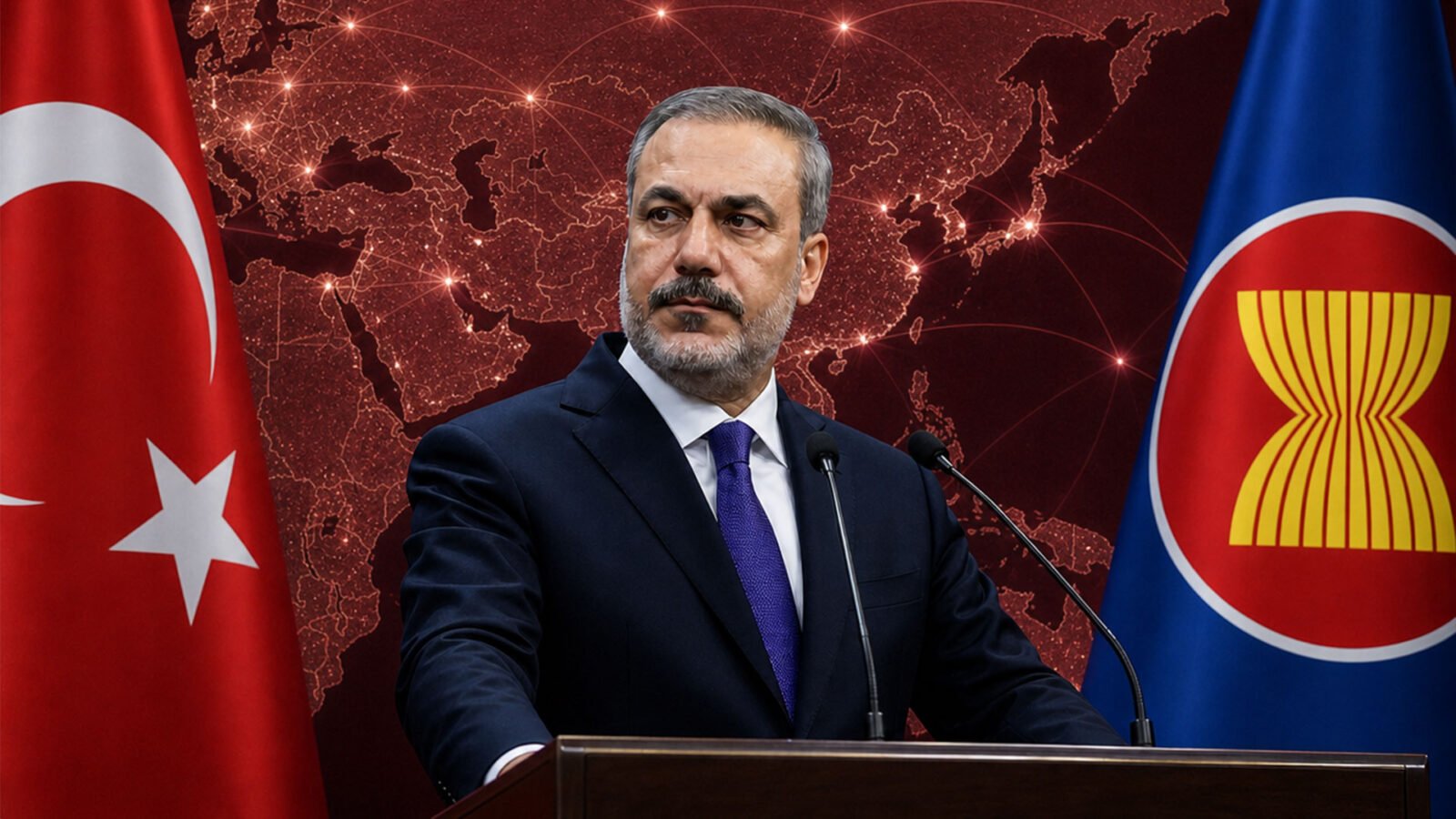
Türkiye’s diplomacy with the Association of Southeast Asian Nations (ASEAN) has cleared a critical hurdle. Minister of Foreign Affairs Hakan Fidan announced that Türkiye has been accepted as an ASEAN Dialogue Partner by a decision taken by the ASEAN Foreign Ministers in Manila. This development is undoubtedly important. Ankara, albeit late, is coming to realize the rise of Asian powers.
However, Ankara faces a dilemma, which is the fundamental impasse of Turkish foreign policy: acting through an Atlanticist lens. Therefore, it must be emphasized at the outset that if Türkiye’s “Asia Anew” initiative is to yield real results rather than remaining mere rhetoric, it can only be achieved through a stable line based on the reality of a multipolar world—one that does not reduce relations with Beijing and Moscow, the main backbone of Eurasia, to a bargaining chip.
Atlanticist Skepticism and Asia’s Weight
Türkiye’s interest in Asian platforms is often read as a reflex of “turning to Asia whenever there is a fallout with the West,” and reality confirms this. Under the AKP administration, particularly after the 2016 NATO-backed coup attempt, Ankara has treated the Asia card primarily as a tool to reshape its relations with the West—ranging from statements like “let’s add a ‘T’ to BRICS” to assertions that “SCO and BRICS could be a good alternative to the EU.” However, Asia is not a temporary trump card to be played against the West from time to time; it is the center of gravity of the international system, expected to produce approximately 52 percent of global GDP by 2050.
Naturally, in Asian capitals today, Türkiye has cultivated an image of being “unreliable” and a country that uses these platforms as a bargaining tool in its understanding of strategic autonomy during disputes with the Western alliance. In short, it is impossible to establish a permanent political weight in the ASEAN market or at the SCO table while remaining tied to the security architecture of the Atlantic alliance on one hand and maintaining a distance from Moscow and Beijing on the other. Asian diplomacy requires consistency and trust.
Abundant Rhetoric, Unproductive Trade: Why?
Ankara became a party to the ASEAN Treaty of Amity and Cooperation (TAC) and subsequently earned the status of Sectoral Dialogue Partner. To institutionalize the relationship, Türkiye even contributed $1 million to the Türkiye-ASEAN Project Fund. Free Trade Agreements were signed with Malaysia and Singapore, while negotiations with Indonesia and Thailand are ongoing. Yet, the picture on the ground is different; these established institutional mechanisms have not yet reflected in trade figures. Including Indonesia, the largest regional player, no ASEAN country makes it into Türkiye’s top 10 foreign trade partners.
Hakan Fidan, emphasizing trade in his statement on the ASEAN Dialogue Partnership, stated:
“Since laying the foundation of our institutional relations with ASEAN in 2010, we have increased our cooperation in every field with ASEAN countries and raised our trade volume from $6.5 billion to $16 billion. With the Dialogue Partner status, we believe our political and economic cooperation with the ASEAN region—which boasts a population of nearly 700 million and an economy exceeding $4 trillion—will deepen further. I hope this new era will be beneficial for our country and ASEAN members.”
Ankara should not boast about a trade volume of only $16 billion with a region of 700 million people. South Korea, a G20 country like Türkiye, has a trade volume of nearly $250 billion with ASEAN. Even if we argue that Seoul is geographically closer to ASEAN countries, the UK’s total trade volume with ASEAN has surpassed $60 billion. As long as diplomacy is conducted under Western tutelage in action and strategy while turning to Asia in rhetoric, it will not be possible for Ankara to capture permanent commercial depth in Jakarta or Bangkok. Access to the Asian market requires independent and continuous logistical/political integration aligned with regional states and political conjunctures.
Of course, trade possesses a quality that transcends geopolitical diplomatic receptions. However, Türkiye’s industrial structure—which is essentially based on an assembly industry—forms the core of the problem here. In 2025, imports from China increased by 10.3 percent, reaching $49.6 billion, and more than half of Türkiye’s foreign trade deficit stemmed from China alone; by contrast, exports to China remained stuck at around $3 billion. The nature of the imported items is no coincidence: electrical-electronic products, machinery, equipment, and high-tech intermediate goods make up the majority of these imports—the exact inputs required daily by the assembly industry.
This picture demonstrates that it is unrealistic for Türkiye to enter into direct competition with China based on a “who produces more” logic. Entering that arena with an industrial structure already dependent on China in the supply chain would be a strategically lost move from the start. The right approach lies in positioning oneself in niche areas based on flexibility, speed, quality, and specialized production capabilities, rather than competing with China in standardized, high-volume, and low-margin manufacturing.
This is where the true meaning of cooperation with ASEAN countries comes to light: in fields such as the defense industry, specialized machinery, medical devices, food technology, advanced materials, and green transition components—not in the mass market segment that China already satisfies. Ankara can create new areas of cooperation with ASEAN countries on the basis of mutual benefit, rather than engaging in pure competition with China, which already plays a dominant role in the Asian market and serves as a principal actor in both supply and investment.
Which Direction Should Ankara Take?
Becoming ASEAN’s 12th dialogue partner should be viewed as a diplomatic success. However, for this partnership not to remain solely on paper, there are points Ankara needs to clarify, first, ambiguity in direction erodes trust. A “balance policy” that turns to Asia whenever a crisis arises with the West, only to set Eastern partners aside when relations with the West improve, creates an impression of unreliability rather than strategic depth in Beijing, Moscow, and Jakarta. Second, the way to reach ASEAN markets is through keeping infrastructure and logistical security corridors in Eurasia secure alongside China and Russia. Third, relations with Asia must not continue to be conducted as a secondary arena subject to approval from Washington or Brussels.
Ankara’s dialogue partnership with ASEAN must go beyond a mere new diplomatic title. This requires understanding that Asia is no longer the power center of the future, but of today. Faced with this reality, Ankara has two choices: It will either continue to view platforms like ASEAN, BRICS, and the SCO as tactical tools to be used in bargaining with the West, or will accept the permanent dynamics of a multipolar world and develop a long-term, Eurasia-centered strategy.
Türkiye’s success in ASEAN will not be measured by how many meetings it attends, but by the quality of the trade it establishes with the region, its ability to transform its production capacity, how it strengthens logistical integration, and the extent to which it is perceived as a reliable partner in Asian capitals. If Ankara can move beyond Atlantic-centered reflexes and build a stable Asia policy based on sovereign equality and mutual benefit, the ASEAN Dialogue Partnership could transform into a strategic turning point that reinforces Türkiye’s position in a multipolar world.
Türkiye must anchor the momentum it has gained with ASEAN to a Eurasian vision that is equal, independent, and based on mutual interest with Asia’s rising powers. Otherwise, the signatures affixed in Jakarta will amount to nothing more than a temporary message sent to the West.