


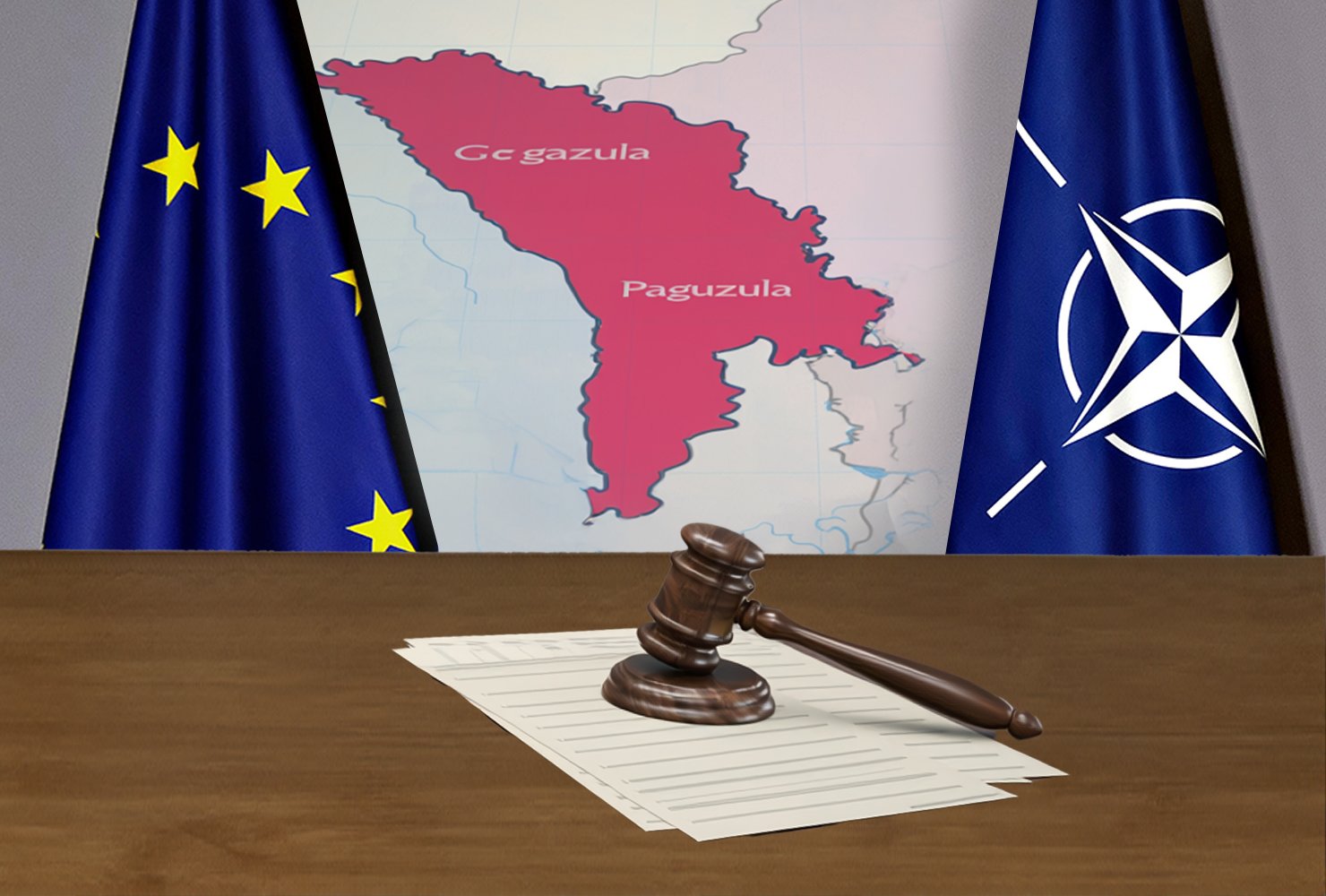
The Constitutional Court of the Republic Moldova has issued a ruling restricting the acquired rights of the Gagauz people.
On July 9, the Constitutional Court of the Republic of Moldova ruled that elections in Gagauzia would be organized under the authority of the Central Electoral Commission in Chișinău. It also terminated the activities of the autonomous regional electoral commission in of the administrative center of Gagauzia, Comrat.
Upon a request submitted by Moldovan Justice Minister Vladislav Cojuhari, the Court declared several provisions of the 1994 law governing Gagauzia’s special legal status unconstitutional. Under the ruling, the local authorities in Comrat will no longer be able to appoint regional electoral commissions without oversight from the central government or directly approve the heads of the local police, judicial and intelligence bodies.
Valentin Gaidarji, Speaker of the People’s Assembly of Gagauzia, condemned the decision as an unlawful intervention and called for the resignation of Domnica Manole, President of the Constitutional Court of the Republic of Moldova.
We present to our readers an interview conducted by Yasin Okyay of the newspaper Aydınlık Avrupa (Aydınlık Europe) with political scientist Stevan Gajic, a visiting professor at the Moscow State Institute of International Relations, and Hamdi Yılmaz, owner of the Romania-based Balkan Gazetesi (Balkan Newspaper).
First, Stevan Gajic’s assessment. Gajic says the following about the decision of the Constitutional Court of the Republic of Moldova and the reasons behind it:
The tendencies in Moldova in last years
I think that the tendencies in Moldova in the last several years have been very much anti-democratic, and I think that this is not an isolated case.
The suppression of the Gagauz people in Moldova is purely political. It is because they are seen by the European Commission and by NATO as a quote-unquote pro-Russian and, secondly, pro-Turkish element that is a disruptive force, mainly because of NATO’s anti-Russian war in Ukraine.
Moldova is being more and more dragged into the conflict, and I think this is happening more or less to most European countries which are effectively representing the strategic depth of the front line of NATO against Russia. This is not a Russian-Ukrainian war; this is a war of NATO against Russia, and I think that is why democracy is deteriorating everywhere and why the collective rights of peoples are deteriorating.
A similar thing can be seen in the behavior of the Albanian authorities in Kosovo and Metohija against the Serbs, which has been tolerated by NATO because Kosovo Albanians are seen basically as NATO soldiers in the perspective of a war. So, this is happening everywhere.
Moldova and Romania
Democracy has been under attack in Moldova in particular, and in Romania with the presidential elections, with the rigging of elections and the meddling of the European Commission. Even J.D. Vance, two years ago at the Munich Security Conference, directly addressed that and attacked the European Union for this kind of behavior. But that’s what it is. Everything is being sacrificed for the war, and that is why the Gagauz people are now being severely pressed.
NATO and the EU’s “Gagauz problem”
I also have to say that NATO and the European Commission —let’s say the collective NATO— see the Gagauz as an even bigger problem than the Pridnestrovie region, because in Pridnestrovie around 70% of people voted for so-called pro-Russian parties, whereas in the Gagauz region this percentage is higher than 80%. This means that both the Moldovan pro-NATO government and Ursula von der Leyen and the European Commission see the Gagauz as a problem. This is really dangerous, keeping in mind that the European Union is reverting to revisionism —to open historical revisionism.
They are tolerating the revival of Nazism not only in Ukraine and Eastern Europe (in the Baltic States, this has been happening for decades now) but more and more within Europe itself. So, I think that different parties, foreign parties, should be alerting international public opinion about this deterioration of rights—of the collective rights of the Gagauz people—because if this continues, it can lead to dire consequences and the Gagauz minority is in danger. So, I certainly hope that this trend will stop.
Hamdi Yılmaz, owner of the Romania-based Balkan Gazetesi (Balkan Newspaper) offers the following assessment:
For many years, we have seen Russian-leaning candidates or parties win elections in Moldova’s Gagauzia region. This is something that disturbs the West, something unwelcome to those who want Moldova to join the EU and NATO.
First Romania, now Moldova
This is the second time such a method has been employed, following Romania. With the decision of the Constitutional Court, they want to bring Gagauzia into line or to prevent it from drifting away from the West. From another perspective, the aim is to draw Gagauzia away from Russia.
The annulment of the first round of Romania’s presidential election in November 2024, followed by the cancellation of the second round, was likewise carried out through rulings of Romania’s Constitutional Court. We might therefore say that constitutional courts have become liberalism’s last refuge. That is how I interpret it. However, I don’t believe this can continue for very long, because, in my view, liberal parties in the West have only two electoral terms left in power.
So far, there has been no reaction from international organizations. Nor has there been any response from Türkiye or Romania. Romania has long taken particular care not to be interfering in Moldova’s domestic affairs. Gagauzia is also important for Türkiye. Türkiye is pursuing a highly sensitive and cautious policy here.