


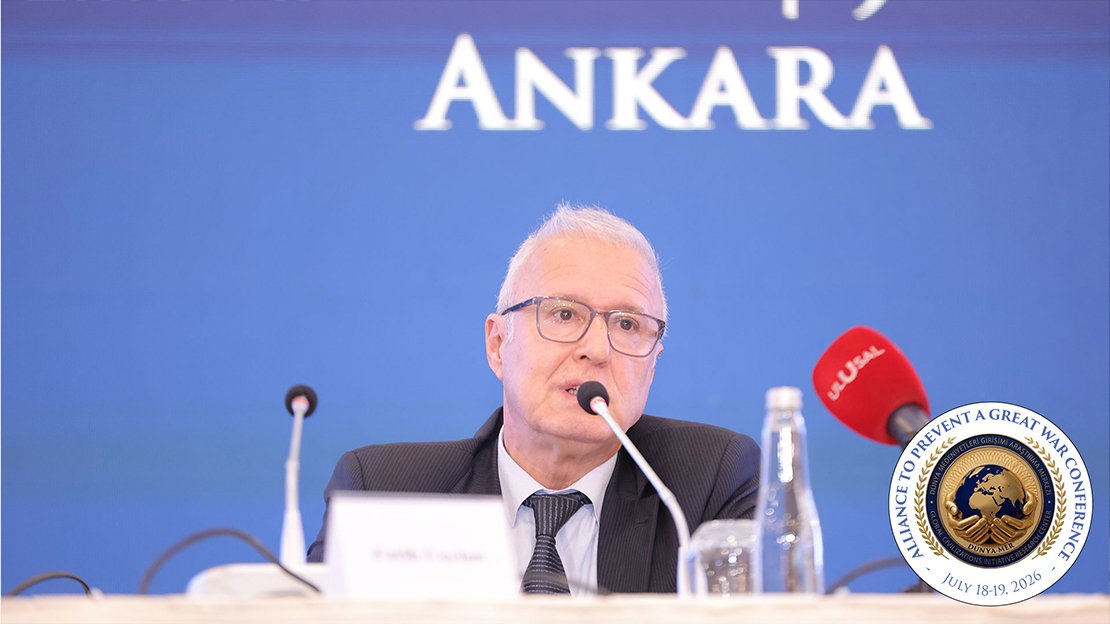
By Fatih Ceylan, Türkiye, Former Ambassador, Former Permanent Representative to NATO, Director of the Ankara Policy Center
The international conference entitled “The Alliance to Prevent a Great War,” organized by the World Civilizations Initiative Research Center, was held at the Meyra Palace Hotel in Ankara on 18–19 July 2026.
UWI will present the speeches held on the conference during the coming days.
The conference, which featured presentations by speakers from Azerbaijan, Belarus, France, Germany, Greece, Iran, Italy, Japan, Russia, the Sahrawi Arab Democratic Republic, South Africa, Spain, Switzerland, the Turkish Republic of Northern Cyprus (TRNC), Türkiye, the United Kingdom, and the United States, was attended by approximately 200 distinguished invited guests.
Ministers, members of parliament, ambassadors, retired generals, scholars, politicians, diplomats, military officers, and experts examined the question of the “Alliance to Prevent a Great War” from a wide range of perspectives.
Below, we present the speech of Fatih Ceylan. The title was set by UWI.
Three levels of analysis are essential to understanding today’s international system: the systemic or global level, the regional level, and the national or local level.
Within this analytical framework, two principal theoretical currents come to the fore: liberal approaches, despite the serious blows they have suffered, and realist approaches.
Since 2014, global politics has been characterized by geopolitical, geostrategic, geoeconomic and geo-technological competition. Although the concept remains open to debate because of continuing global turmoil, conflict and instability, the overall picture suggests the emergence of a multipolar world order.
If we accept the definition of multipolarity, some analysts classify groups of countries under the categories of the Global North or the West, the Global East and the Global South.
This situation requires the positions and roles of global, regional and national actors to be redefined. In the present environment, it would be a mistake to exclude non-state actors from the equation.
A common assumption underlying many of these classifications is that global politics is going through a disorderly transitional period generated by systemic competition.
The main developments shaping this period include:
– The effects of the war in Ukraine on Euro-Atlantic security;
– The consequences of the global rivalry between the United States and China for security in the Asia-Pacific;
– The volatile situation in the Middle East, which began with Hamas’s attack against Israel on 7 October 2023 and escalated further with the outbreak of the US–Israeli war against Iran on 28 February;
– The disruption caused in global politics, particularly in Europe, by the weakening of the transatlantic framework and growing divergence between the United States and Europe as a result of President Trump’s rhetoric and actions;
– The struggles among global and regional powers for influence and power on the African continent;
– The tense international environment, which has increasingly shown signs of extending into Latin America. Examples include the United States’ approach towards Cuba, its attempts to establish control over the Panama Canal and its description of the Gulf of Mexico as the “Gulf of America.”
Global politics, which is commonly described as multipolar, has rapidly disrupted the balance between values, interests and power to the detriment of values.
Approaches based solely on interests, opportunities and influence are rapidly transforming global politics.
International and regional institutions and organisations are being eroded. Multilateralism based on cooperation is being overshadowed. Globalisation is fragmenting.
For the time being, no new order appears to be on the horizon that could replace the rules and norms underpinning the liberal model that gained strength after the Cold War.
Transactional approaches have now come to the forefront.
Some actors are taking advantage of this situation to expand their freedom of action. By choosing the comfort zone provided by the current environment, they are contributing to the erosion of rules and, consequently, to the hollowing out of the values developed by humanity.
Unless the present period of disorder, rivalry and conflict can be brought to an end, it is difficult to envisage the emergence of a positive trajectory.
The fundamental question is whether global powers and influential regional actors—the so-called middle powers—can establish a shared determination to break out of this vicious cycle of negativity and develop a newly defined set of rules and norms.
The Overall Global Picture
How did we arrive at this point?
Developments in the post-Cold War period:
– Regional wars;
– Russia’s transformation;
– The rise of China.
The rules established after the Second World War were largely designed by the West. The prevailing belief was that world peace could be maintained as long as states complied with these rules. The experiences of Russia and China are relevant in this respect.
The global transformation that began in the 2000s was marked by a series of decisive moments:
– 11 September 2001;
– 2003;
– 2008, including the global financial crisis;
– 2010;
– 2011;
– 2014;
– The COVID-19 pandemic in 2020;
– 2022;
– 2023.
The international order was profoundly disrupted, while rules, norms and values were weakened.
The world rapidly moved towards lawlessness and disorder generated by global competition. In parallel with China’s rise, geostrategic, geopolitical and geotechnological competition intensified.
Regional Repercussions
The global disruptions caused by President Trump.
Tensions between the United States and Europe.
New searches for balance and alternative arrangements in transatlantic relations.
Europe’s movement towards establishing its own defense architecture.
The concept of “NATO 3.0.”
The continuing war in Ukraine and the possible future course of the European security architecture.
Security in the Black Sea.
The rise of China and increasing tensions in the Asia-Pacific, including tensions involving North Korea.
The transformation of the Middle East and its regional and international consequences.
New trends along the South Caucasus–Central Asia axis, including the prospect of peace between Azerbaijan and Armenia.
The Eastern Mediterranean and Cyprus.
The difficult integration of the Balkans into the European Union and the question of Serbia.
The struggle for influence in Africa.
The growing prominence of Latin America and the Caribbean on the global agenda, particularly as the United States prioritizes the Western Hemisphere and makes claims concerning Greenland.
In short, the world order is moving forward on unstable and increasingly lawless ground.
We are at a dangerous turning point characterized by uncertainty, disorder and conflict, and by a growing departure from established values and norms.
There are also major challenges concerning the development and sustainment of future technologies, including:
– Artificial intelligence;
– Rare-earth elements;
– Chips and semiconductors;
– Quantum computing;
– Space technologies.
A ruthless competition is taking place around these technologies and resources.
International Security and Alliance Relations
The loss of trust within the transatlantic framework following President Trump’s return to office for a second term.
The increasingly visible divergence between the United States and Europe, particularly in relation to the United States’ claims concerning Greenland and its attitude towards Canada.
The fractures emerging within NATO and the need to update the balance between the United States and Europe.
European security has entered a new era.
Projects and initiatives within the European Union.
The transformation of European security and Türkiye’s position in this process.
What kind of future awaits NATO following the Ankara Summit?
How and under what conditions should Türkiye position itself in the coming period?
Both the regional and global dimensions must be considered.
Effects On Our Immediate Region and On Türkiye
Türkiye is located between two major areas of conflict: Ukraine and the Middle East.
We are at the center of global competition.
Our economic balances are not particularly strong. The shares of debt and imports within GDP are high. Türkiye also faces persistent problems concerning inflation and the exchange rate.
Under present conditions, achieving a breakthrough in innovative technologies and becoming an influential actor in this field is no longer merely an option for Türkiye. It is a strategic necessity.
At the same time, the characteristics of the current environment indicate that Türkiye’s relations with the United States and Europe are evolving towards improvement compared with previous periods.
The main challenge in Türkiye–US defense relations concerns whether a solution can be found to the S-400 issue.
The signing of a peace agreement between Azerbaijan and Armenia is of vital importance for the South Caucasus–Central Asia axis.
Once such an agreement is concluded, the emerging geopolitical landscape will create important opportunities for Türkiye.
The TRIPP project.
Peace in Syria, a solution to the Israeli–Palestinian conflict, stability in Iraq, the possible effects of the war against Iran on the region’s future, and the possibility of a new era and new opportunities in a transforming Middle East.
Türkiye is a key actor in the context of Black Sea security. Its approach to the changing conditions in the region is moving in the right direction.
However, it would be incomplete to view the Black Sea exclusively through the lens of maritime security.
The challenges in the Eastern Mediterranean and the Cyprus issue will remain on the agenda. Determining the appropriate direction within this equation is important.
Türkiye–Greece relations and disputes in the Aegean will continue to experience ups and downs. Periods of tension should not be regarded as surprising.
We will continue to observe the effects of Türkiye’s renewed strategic importance on Greek politics.
It is important to maintain stable relations with Russia and China without overlooking our fundamental national interests.
The future of European security concerns Türkiye closely and directly. Türkiye cannot remain outside this process. It must play an active and constructive role within it.
As the conventional transatlantic ideology is replaced by interest-oriented transatlantic partnerships in various forms, it would be more appropriate for Türkiye to minimize its dependencies in different areas and establish a broad room for maneuver.
In the face of the uncertainties and disorder created by the current environment, and taking into account the evolving nature of alliance relations, maintaining strong social, economic and technological resilience is not a matter of preference.
It is a strategic necessity.
Thank you.