

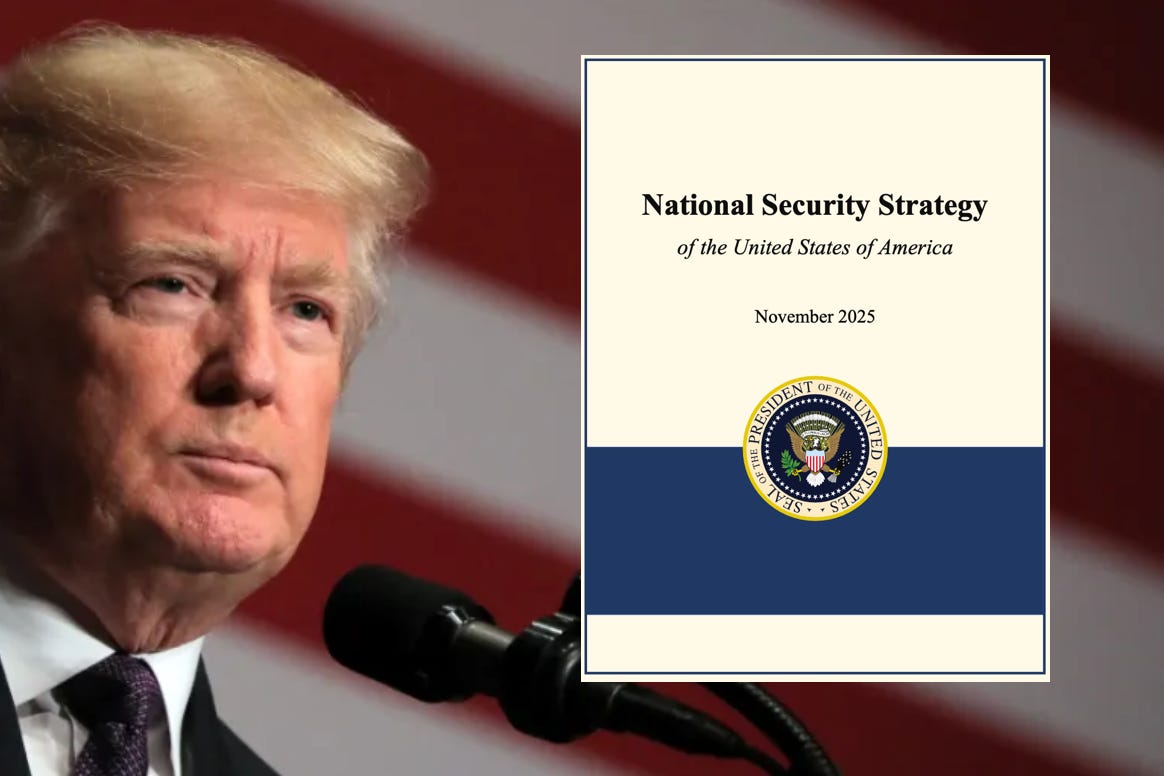
A document like a country’s “National Security Strategy,” such as the one recently announced by the United States, cannot be based on fiction and deceit. In presenting the document, President Trump resorted to all sorts of falsehoods, clearly to convince the stupefied American public that “they are winning.” It is a foreign policy document geared toward domestic politics.
Likewise, it is a document to exalt Trump and minimize everyone else, primarily his adversaries in the Democratic party, resorting to lies to say that no one has done as much as he to change his country.
By extolling measures taken that have been based on supremacism, racism, misogyny and exclusion as values of the United States that are intended to be imposed on all of humanity, Trump considers himself victorious even though today, along with Netanyahu, they are the most hated figures in the world.
He claims to have destroyed Iran’s nuclear enrichment capacity, yet he continues to send messages to Tehran to negotiate the issue. Why negotiate something that doesn’t exist? He claims to have resolved wars that never happened and nonexistent conflicts; in others, where he claims to have resolved them, the very actors directly involved have refuted his claims.
He announces the end of the Gaza war while the Zionist army continues to massacre the Palestinian people. Of course, he was only interested in “the return of all living hostages to their families.” Naturally, he’s referring to the hostages captured by armed Palestinian organizations, while the thousands of Palestinians held in Zionist prisons, the 70,000 dead (including 30,000 children), the 171,000 wounded, the 14,400 missing, and the 1.9 million displaced are not counted.
A country that develops a strategy justifying and endorsing murder, death, aggression, and war as its primary instruments of action demonstrates decadence, decay, and a lack of values. It purports to project strength and power, but in reality, it reveals weakness, fear of losing its hegemony, failure, and defeat.
Without having yet conducted an in-depth study of this new strategy, I will offer an initial opinion after a first reading of the document. In recent months, many people have rushed to “explain” what is happening in the world based on the simple and superficial assertion that “Trump” is crazy. As I have stated since January, in each of my written and audiovisual contributions, this document demonstrates that Trump is not only not crazy but is the most sane president the United States has had since the end of World War II.
It is the first document to take note of the crisis and the failure of the United States and its policies over the last 80 years. The theoretical approach in the document’s introduction is perfect, of course, from Washington’s imperialist perspective… but it had never been done this way before in a government document from that country.
The acceptance that the United States “needs a coherent and focused strategy on how we interact with the world” inadvertently reveals that it previously lacked one. The theoretical explanation that follows, regarding what a strategy is and what its purpose should be, is impeccable. Were it not for his death, one might assume that the hand of Henry Kissinger and his realist conception of international politics were behind this writing.
The document is clear and precise in this regard: “American strategies since the end of the Cold War have failed: they have been endless wish lists or ideal end states; they have not clearly defined what we want but have stated vague things; and they have frequently misjudged what we should want.”
Next, in the third person, without involving Trumpism, he explains what those arguments are based on:
- American elites believed that their country’s “permanent domination” of the world was for the best.
- The problem with assuming the above is that it failed to take note that the decisions of other countries should only concern the United States if they directly threatened its interests.
- The elites miscalculated the willingness [read: the possibilities] to bear the burden that their ambition to dominate the world represented.
- They also overestimated the capabilities of their enormous global aggression apparatus.
- They were wrong to embrace globalism and “free trade” as paradigms that destroyed the country’s economic and social foundation. This is also being acknowledged for the first time.
- They forced the country to bear the costs of assuming the role of “guarantor” of the defense of the capitalist system, becoming involved in conflicts that were none of its business and “irrelevant” to the United States. Imagining that you’re thinking of Vietnam, Afghanistan, Iraq, and others, I would add, “and from which we emerged defeated.”
- Returning to the country’s original paradigm that advocated isolationism as a policy, they now reject multilateralism, once they began to lose the ability to control international institutions as they did after 1945.
- The summary states that these elites, whom the document holds responsible for the failure, “…not only pursued a fundamentally undesirable and impossible goal, but in doing so, they undermined precisely the means necessary to achieve it: “the character of our nation, upon which its power, wealth, and decency are built.”
This diagnosis is a stark and brutal acceptance of their failure and defeat in their quest to become the unquestionable masters of the planet.
What does Trump propose to correct course and guarantee “the continued survival and security of the United States as an independent and sovereign republic whose government guarantees the natural rights bestowed by God upon its citizens and prioritizes their welfare and interests?”
Ultimately, the supremacist, interventionist, and aggressive nature of imperialism does not change one iota; it is simply being reformulated after 80 years of failure.
In this sense, a series of issues are raised for the United States that have always existed and are in the UN Charter and that, it seems, Trump is only now discovering, only that he wants them only for his country, not for the rest of the world: the defense of the sovereignty and territorial integrity of States, the fight against drug trafficking and organized crime, respect for the cultural identity of nations and economic and social development.
The flaw in the imperialist diagnosis is that no country in the world has threatened or is threatening the United States, and that what is happening is caused precisely by Washington’s refusal to accept that the rest of the independent nations of the planet have the same rights as the United States to access these demands.
Once again, the document reveals the aggressive and imperialist nature of the United States when it goes on to state that the country wishes to organize “the most powerful, lethal, and technologically advanced army in the world,” supposedly to defend interests that no one threatens. In this respect, and seemingly learning from the Russian experience in its special military operation in Ukraine, it says that they are doing so to deter wars […] with the fewest possible American casualties. It is clear that after Vietnam and Afghanistan, American society is neither prepared nor willing to see its soldiers return from those endless wars in wooden coffins draped in the flag.
In a stunning statement reflecting the internal crisis gripping the armed forces, given the blunders of its leadership, the document asserts that they desire “armed forces in which every service member is proud of their country and confident in their mission.” It seems they are not.
He then points out that they also need to build a strong economy, the The world’s most robust industrial base and energy sector, a scientifically and technologically advanced and innovative country, should serve as the foundation for its power and capacity for global dominance. Once again, this seems to be an acknowledgment that its economy is not strong today and its industry, science, and technology are not robust. It is also a novel admission of its crisis, its weakness, and its defeat by China in these areas.
Furthermore, in another clear declaration of their imperialist will, they express that they want “to maintain the strongest and most influential soft power in the world” using all the resources at their disposal to make them effective, through which they will exert a positive influence on the entire planet regarding the belief in the greatness and decency inherent in American culture.
To achieve these objectives, the following are proposed: To mobilize all the resources of national power based on the understanding that a strategy is implemented through foreign policy. He failed to mention that in the case of the United States, this also includes weapons, threats, blackmail, aggression, and constant pressure.
By establishing the fundamental interests of US foreign policy, beyond the doctrinal elements embedded in this document, Trump’s megalomaniacal and egocentric ambition is exposed, placing him on par with Presidents James Monroe and Theodore Roosevelt. Thus, the personality of the US president and his desire for transcendence are shaping national security strategy like never before in history.
These personality traits cease to be a secondary matter and become a substantial element in the country’s doctrinal construction. The acceptance of the failures of the last 80 years and the defeats against China and Russia compel it to “take refuge” in the Western Hemisphere in order to try to achieve victories that will catapult it onto the threshold of history. For this reason, it aligns itself with the aforementioned presidents to project itself as their continuation. Ultimately, its pronouncements do not differ much from those made in 1823, except that those were against Europe and these against China and Russia. The objective is the same: to maintain control and dominance over its environment, which it calls its “backyard.”
Latin America and the Caribbean have endured over 200 years of aggression, and no one could have imagined that Trump would change that perspective. But now, the issue is being addressed within a global framework that didn’t exist two centuries ago, when the vision of James Monroe and John Adams extended only as far as Europe.
Today, Trump expresses tangential opinions regarding the Indo-Pacific, Europe (to which they intend to restore “civilizational self-confidence and Western identity”), and the Middle East, where his only interest is guaranteeing oil and gas supplies, regardless of the cost to the lives of millions who have been sacrificed in Iraq, Libya, Yemen, Syria, Lebanon, and Palestine, solely to safeguard the imperialist interests of the United States and Europe. They seek to establish a competition—which they have already lost—in matters of science and technology and reaffirm their status as defenders of a failed model of democracy.
To achieve these objectives, they boast of possessing “a still agile political system” that must correct its course; a large economy that gives it influence over those countries that want to trade with it; a financial system that includes “the status of the dollar as the global reserve currency”; an advanced, innovative, and profitable technology sector that “strengthens [its] global influence”; “the most powerful and capable military in the world”; a broad network of alliances in the most important regions; a geography that provides it with abundant natural resources, without dominant rival powers in the hemisphere; unparalleled soft power and cultural influence; and “the courage, will, and patriotism of the American people.”
A document based on lies can hardly reach conclusions that depart from them. Almost none of this is possible today, much less in the medium or long term. The “strategy” omits the fact that it was Trump himself who ordered a coup against this “agile system” simply because it didn’t enshrine him in law. In this arena, he himself is making efforts to bring this “agile system” under control, preventing him from becoming a dictator. When mentioning the United States’ “great economy,” it forgets that Washington had to bow to China when it tried to impose rules and behaviors that the Asian giant refused to accept, forcing Trump, contrary to what he claims, to acquiesce to China’s demands. When speaking of the world’s most important financial system, it conceals the fact that it is steadily losing strength as more and more countries abandon the dollar.
Likewise, he alludes to a technology sector that is actually losing ground and presence to China, which was the first to land a spacecraft on the far side of the moon, was the first to achieve 5G and 6G, and uses science and technology not only for defense (or war, like the United States), but also for medicine, research, agriculture, and industrial development. By referring to the United States military as “capable and powerful,” he obscures the fact that it has not won any wars against other powers and has been unable to prevent Russia from successfully carrying out its special military operation in Ukraine, Iran from triumphantly confronting Zionism and the US armed forces themselves, NATO from being expelled from Africa, Yemen from forcing $13 billion aircraft carriers to flee with $500 drones, Cuba, Nicaragua, and Venezuela from continuing their resistance, and, after shamefully withdrawing from Yemen, its aircraft carriers and nuclear submarines from attacking small fishing boats.
Similarly, Trump speaks in his corollary of a network of alliances that he himself is destroying through imposition, blackmail, and threats, and which has only managed to incorporate the weak, the cowardly, those lacking in patriotism, and those suffering from Stockholm Syndrome, such as Japan and Panama. He speaks of a geography that provides him with abundant natural resources, without rivals in the hemisphere. If this is so, why does he want to seize by force the oil and gas of Venezuela, the lithium of Chile, Argentina, and Bolivia, the oxygen, water, and biodiversity of the Amazon, and the Panama Canal, which belongs to that country and no one else?
He chatters about “the courage, will, and patriotism of the American people,” but a poll conducted by the NORC Institute was only released yesterday. (National Opinion Research Center) of the University of Chicago for the New York newspaper “The Wall Street Journal” which reveals that the priorities and ideals that defined past generations of Americans are losing importance for the citizens of that country.
Thus, only 38% of those surveyed said patriotism was very important to them, and only 39% said religion was similarly important. These figures represent a dramatic decline compared to 1998, when 70% of Americans considered patriotism very important and 62% said the same about religious faith. Conversely, the only value that has increased in importance over the last quarter-century is money, which was cited as “very important” by 43% of respondents in the new poll, up from 31% in 1998. What kind of patriotism is Trump talking about?
The only thing the President of the United States is right about is that, in relation to the instruments he has to carry out his strategy, his country’s superiority is evident in terms of the “unparalleled soft power and cultural influence” they exert through their powerful communication-cultural-media apparatus, which allows them to transform lies into truths, manipulate and deceive humanity like a global Goebbels.
This concludes the most substantial part of the new US national security strategy. It requires further study, given its open aim of world domination, as it states that the objective is to “strengthen American power and preeminence.”
In any case, a transformation of this magnitude cannot be implemented in the short term, as Trump only has three years left in office. Traditionally, each US president develops their own doctrine. It remains to be seen how the American elites, the deep state, and especially the armed forces will “digest” this strategy, which modifies the fundamental elements upon which US power and global dominance have been built over the last 80 years.
TO BE CONTINUED….