


By Mohammed Sabreen, from Cairo / Egypt
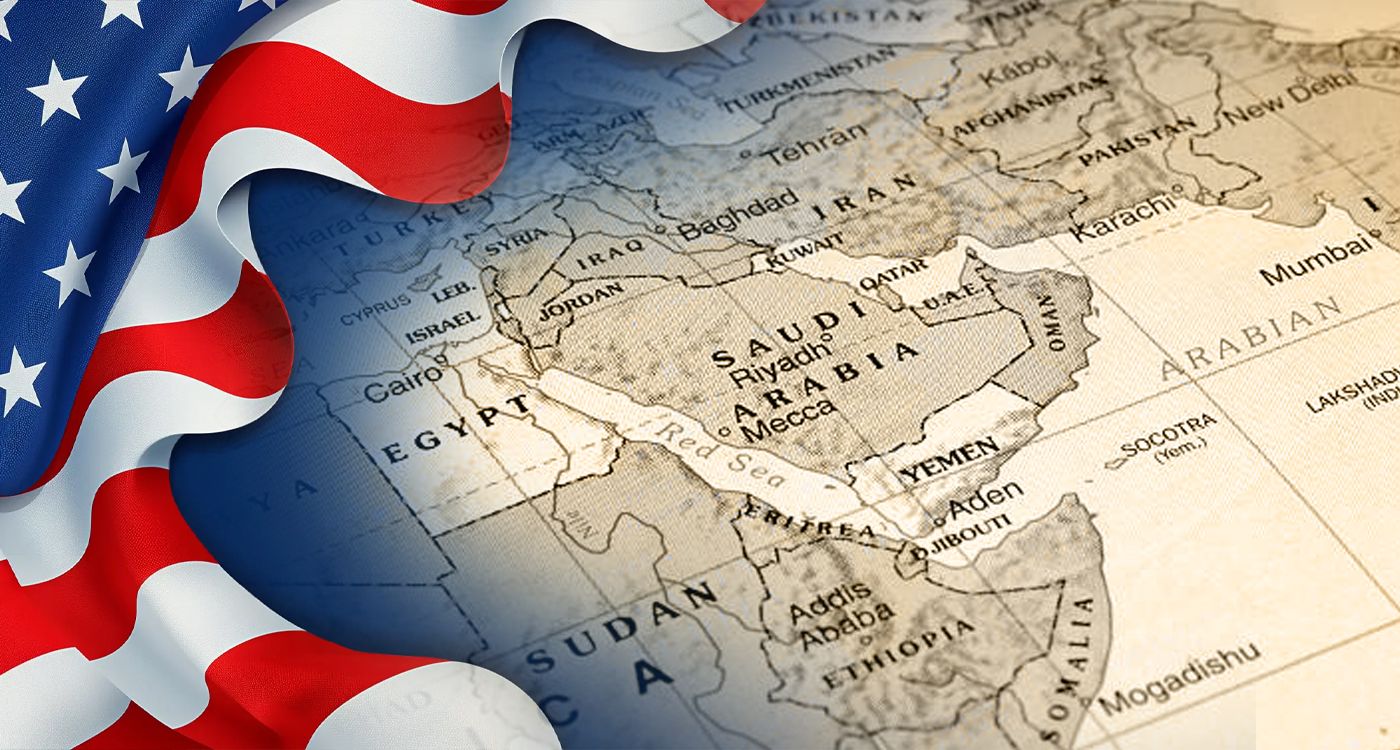
The people of the Middle East are waiting to see if Washington will withdraw from the region, or if the administration of US President Donald Trump, like the four previous administrations, will instead become more deeply mired in the Middle East’s quicksand. Despite all the glittering slogans of successive US administrations, the region’s problems have only grown more complex over time, with increasing American intervention.
Today, the US administration raises the slogan “America First,” claiming non-intervention in the process of rebuilding countries or involvement in endless wars. However, it has not relinquished its addiction to shaping the global landscape, presenting the “US National Security Strategy 2025,” a vision for re-engineering the Middle East and preventing the emergence of any hegemonic power in the region. Will this new attempt succeed? Will influential countries accept the American formula? And will the people accept managing the region’s crises solely to ensure Washington’s continued interests? There are many observations and questions left for time to answer regarding Trump’s gamble. Most likely, it is just another experiment in the Middle East.
Is America Abandoning the Middle East?
The National Security Strategy 2025, released by the White House last weekend, confirms that the Middle East is no longer the “dominant element” on Washington’s agenda, shifting the focus to the Western Hemisphere (the Americas) and the Indo-Pacific region as the primary arena for geopolitical and economic competition.
According to experts, this move by the administration of US President Donald Trump represents a “break with tradition” that has been followed for decades, during which the Middle East was central to American priorities.
The strategy raises several questions about the implications of this shift in US foreign policy, and whether it signifies the end of the “Middle East era” in Washington’s concerns.
It also casts a long shadow over the future of regional conflicts after the security vacuum that will emerge following the American withdrawal from the region’s issues and raises doubts about the prospects for peace and concerns about the outbreak of further wars.
According to regional experts, the strategy explicitly declares that the “Western Hemisphere” and the “Indo-Pacific” have become the primary arenas for global competition, while the Arab region and the Middle East are relegated to the status of “an area of selective engagement based on mutual interests.”
However, some argue that the new US strategy does not signify a complete withdrawal from the Middle East, but rather a “selective disengagement.” The US will remain present when its economic or intelligence interests are threatened, but it will not fight on behalf of others.
Experts also believe that the reduced priority given to the Middle East in US policy does not mean lifting sanctions or halting strikes against any country that poses a direct threat to its interests. Instead, it means that Washington will no longer expend blood and treasure to contain regional conflicts at the expense of its own direct interests.
This trend aligns with statements from numerous officials in Washington who have emphasized that America has spent billions of dollars and lost thousands of soldiers in recent years, and that it is time for allies to manage their own affairs, while remaining present when its vital interests are directly threatened.
End of an Era
Political analyst Erhaim Al-Nubani believes that relegating the Middle East to a secondary position in the 2025 US National Security Strategy is not merely a rearrangement, but rather a “declaration of the end of the Middle East era” in American policy, with a focus on competition with China and Russia in other regions.
According to Al-Nubani, dealing with the Middle East in this manner will lead to a security vacuum, which will fuel conflicts in the region in the coming period. He pointed in this regard to statements by Israeli officials who considered the American strategy an affirmation of Tel Aviv’s freedom of action in confronting threats in the region.
Al-Nubani believes that Israel will continue to receive American logistical and intelligence support, and that no one will stop its operations if it crosses red lines in the region. He considers this to necessarily mean the opening of a new regional arms race, as each country will seek to arm itself and strengthen its military capabilities to defend itself against any threats it faces.
A Secondary Region
Meanwhile, political analyst Yassin al-Duwaish argues that the new American strategy raises the priority of “homeland defense,” including securing borders and airspace, while reducing the global commitments that have been the basis of American strategy since the Cold War.
He points out that the Middle East, which was a major focus in previous American strategies, has now become a “secondary region,” with the focus shifting to competition with China in the Pacific as the “main geopolitical battleground of this century.”
According to al-Duwaish, this approach means that Washington will deal with the region “on the basis of mutual economic interests,” without the large-scale military commitment that was the case previously.
He also believes that the American strategy is a literal translation on the ground of the “America First” principle, where national security has been linked to the domestic economy, such as combating immigration and drugs in the western half and reducing spending on the Middle East in favor of investing in American industry.
The region is subject to American interests.
Former Egyptian Foreign Minister Nabil Fahmy believes that the National Security Strategy does not promise a kinder or more compassionate Middle East. The likely outcome, he argues, will be a colder and harsher, but more transparent, regional order. For the first time in decades, the United States is treating the Middle East as realist theory has always dictated great powers should: an important but not existential region, whose stability matters only insofar as it affects core American interests.
He emphasizes that the US National Security Strategy is not merely a political document, but the intellectual charter of a new strategy that explicitly rejects the post-1991 vision of the United States as the indispensable guarantor of a liberal world order. Instead, it presents a disciplined national realism that subjects every external commitment to a single test: Does it directly serve the vital core interests of the American nation—its security, prosperity, borders, and way of life? Globally, the consequences are seismic. In Asia, the strategy abandons “integrated deterrence” in favor of a harsh prioritization: China is the sole peer competitor, and every other issue—Taiwan, the South China Sea, North Korea—is assessed solely from the perspective of whether it aids or hinders the central objective of preventing Beijing from achieving Indo-Pacific hegemony. Allies are told bluntly: either spend significantly more on defense or lose American protection. Japan and India will be heavily armed, while less important partners may be left to their fate.
Europe faces the harshest ultimatum in NATO’s history: increase defense spending to between three and five percent of GDP within five years (the document describes the current two percent figure as ludicrous), or the American security guarantee will vanish. The implicit message is that Europe must relearn how to be a serious strategic actor or risk becoming a neutral zone between a weakened Russia and an “America First” America, thus risking the loss of its civilizational identity. In the Western Hemisphere, the strategy revives and updates the “Monroe Doctrine” under the name “Trump Annex,” declaring Latin America and the Caribbean an exclusively American sphere of influence from which any hostile foreign power (China, Russia, and Iran) is expelled by economic coercion or sanctions, or, if necessary, direct intervention. Africa is considered almost a secondary region except where China’s dominance over minerals or mass migration routes threatens core interests. The era of major development aid and American peacekeeping is over.
Three Revolutionary Tools
The strategy employs three revolutionary tools: first, weaponizing American energy dominance to limit adversaries’ sources of income; second, the dollar-based financial system to strangle hostile economies; and third, a willingness to withdraw from any commitment that does not clearly and immediately serve American interests.
Nowhere will these global shifts be more evident than in the Middle East, the region where the United States has bled more blood, treasure, and credibility than any other over the past three decades.
The strategy encapsulates America’s ambitions in the Middle East in a single, crystalline sentence on page 27: “We want to prevent any hostile power from dominating the Middle East and its oil and gas supplies and the chokepoints through which they pass, while avoiding the endless wars that have costly us in the region.” There is no mention of spreading democracy, human rights, nation-building, or even the phrase “two-state solution.” The Palestinian issue is reduced from a “strategic imperative” to a humanitarian concern. For the first time since 1945, the United States is declaring a Middle East policy that is essentially a “balance of power”: maintain decisive influence at a low cost through regional proxies, economic leverage, and the selective application of overwhelming military force. The results unfold across six interconnected areas.
The Ultimate Embargo on Iran
The strategy treats Operation Midnight Hammer, the massive airstrikes that destroyed the Natanz and Fordow facilities and their associated nuclear infrastructure during the early months of the second term, as the new strategic baseline. With the nuclear threat receding for at least a decade, Washington is freed from the political constraints that prevented a truly overwhelming campaign in 2018–2020.
Maximum Pressure
Sanctions will be raised to levels that will make the 2019 “zero oil exports” policy seem moderate. European, Indian, and Chinese banks will face a stark choice: access the US financial system or trade with Iran. US LNG and crude oil exports will simultaneously flood the markets, leaving Tehran with no hope of higher prices.
The document doesn’t mention “regime change,” but every tool short of an overt invasion, covert operations, support for internal protests, cyber operations, and quiet coordination with Israel and other countries, will be used to accelerate Iran’s collapse from within. Iran is already weakened and crumbling, no longer a threat, but rather the fastest way to stabilize the region on American terms.
An absolute American mandate for a new regional order.
As for Israel and what has been termed the Sunni axis, Jerusalem is explicitly the eastern cornerstone of a new alliance against Iran. All previous American constraints have been lifted: public calls for restraint in Gaza or Lebanon, pressure on settlements, and linking arms sales to progress on the Palestinian statehood track—all of this has been nullified. The Abraham Accords will be massively bolstered with huge quantities of advanced weaponry and security cover in exchange for full normalization with Israel and the establishment of a joint military command stretching from the Atlantic to the Gulf and Tel Aviv. The United States will not comment on the use of the weapons it sells as long as they are directed against Iran or its proxies. The Palestinian issue is practically closed as a strategic matter. Gaza will be rebuilt on the condition of complete disarmament, and the West Bank will move toward de facto annexation without American objection. For the first time since 1967, Israel enjoys unlimited strategic freedom, backed by unequivocal American support.
Energy is a weapon, not a security loophole.
American energy dominance is transforming the geopolitics of oil. The United States is no longer a student of OPEC but has become the primary spoiler. Whenever OPEC+ attempts to reduce production to raise prices, Washington will open the taps and flood the market. Oil-producing countries face an existential choice: either align themselves completely with the American-Israeli bloc and accept oil prices between $50 and $60 as the new normal, or resist and watch their economies collapse under the weight of American shale gas and liquefied natural gas.
This policy aims to starve Iran and Russia of oil dollars, strips China of any influence over global energy markets, and grants the United States unprecedented coercive power over every oil-importing country, from Germany to India.
Counterterrorism
Counterinsurgency operations have largely buried the remaining limited U.S. forces in Syria and Iraq and will operate under highly flexible rules of engagement, relying on air power, drones, special forces, and local partners: the SDF in Syria, Israel in the south, and Sunni tribes who will bear the burden of territorial control.
ISIS and al-Qaeda will be relentlessly targeted, but there will be no interest in rebuilding failed states. The 2014-2017 campaign that crushed the caliphate territorially will serve as the model: destroy, leave, repeat as needed.
Russia and China in the Region
The Eastern Mediterranean will return to Western control as Russia’s position in Syria becomes untenable, Moscow is starved of funds by sanctions and low energy prices, and Türkiye, the NATO member the document seeks to fully reintegrate, is given a free hand in the north.
Meanwhile, Chinese Belt and Road Initiative investments in Pakistan, Iraq, and the Gulf will face severe secondary sanctions and competition from the U.S.-backed economic zone stretching from Morocco to Oman.
The Dangers of a Major War
Ironically, the greatest risk of a major regional war is Iran closing the Strait of Hormuz, with mass attacks on Gulf energy infrastructure or a direct conflict between Iran and Israel potentially culminating in 2026-2028. This would leave Tehran besieged, desperate, and facing existential collapse. However, if the United States and its allies weather this storm, the long-term outcome would be a Middle East where no hostile power can threaten vital sea lanes or energy supplies, and where American commitments are minimal. In short, a cooler, clearer, and more Americanized Middle East.
The National Security Strategy 2025 does not promise a kinder or more compassionate Middle East. Rather, it promises something far more valuable from Washington’s perspective: a region where core American interests are secured while preventing a hostile power from dominating energy chokepoints, with far less blood, treasure, and diplomatic energy than at any time since 1979. It does this by offloading virtually all military and governmental burdens onto regional allies (Israel and some Arab states) through overwhelming economic leverage (sanctions plus energy exports), and by accepting a higher degree of regional violence and authoritarianism as the price of avoiding “endless wars.” The likely result will be a colder, harsher, but more transparent regional order. For the first time in decades, the United States will treat the Middle East as realist theory has always argued great powers should: a region important but not existential, whose stability matters only insofar as it affects core American interests, whether or not it creates a more peaceful region overall, as long as it remains more consistent with and aligned with American priorities.
Prevents the Emergence of a “Hegemonic Power”
The United States’ grand strategy in international politics is based on maintaining and perpetuating its hegemony by preventing the emergence of dominant regional powers. The preferred model for the United States is a balanced power structure between Türkiye, Saudi Arabia, and Israel.
In light of this, the Iranian Diplomacy website argues that the balance of power in the Middle East, particularly after the 12-day war with Iran that lasted until October 7, 2013, has shifted in Israel’s favor. However, it emphasizes that the United States’ preferred model in the region is based on a balanced power structure between Türkiye, Saudi Arabia, and Israel. It explains that within this triangle, Israel plays the role of the base, possessing security and military superiority over Saudi Arabia and Türkiye, but this superiority must not transform into hegemony.
America’s Doctrine
In this context, the website explained that the American approach to Saudi Arabia can be interpreted from the perspective of “external balance,” or what is known as the “balance of power” theory, while Riyadh’s approach to Washington can be interpreted from the angle of “hedging policy.”
It added that the recent visit of Saudi Crown Prince Mohammed bin Salman to Washington acquires profound significance within the framework of opening a new chapter in relations between the United States and the Kingdom of Saudi Arabia.
It continued that the American strategy is based on the concept of “permanent balance” in different subsystems and regions.
It pointed out that “achieving this balance is sometimes done directly and sometimes indirectly and remotely through US allies.”
It noted that “the dominant power does not differentiate between any player, as it works to restrain any entity seeking regional hegemony by strengthening its rival to prevent its dominance, even if that player is Israel, the closest ally of the United States and supported by powerful Jewish lobbies within America.”
The website believes that “the American logic is clear: Israel must be secure and prevail in regional conflicts, but it does not have the right to dominate the Middle East.” He added, “The same applies to Britain, Germany, and France in Europe, where Washington believes these countries should counterbalance each other within an unequal distribution of power, as is the case in other parts of the world.”
The Three Pillars
Based on this theory, Washington seeks to curb Israel’s attempts to impose its hegemony on the region, following its recent wars against the Palestinian Gaza Strip, Iran, and Lebanon, as well as its military interventions in Syria, Yemen, and Qatar.
The website stated, “From the perspective of American strategists, the balance of power in the Middle East after the events of October 7, especially after the 12-day war with Iran, has shifted in Israel’s favor.”
It continued, “However, the model preferred by the United States in the region is based on a balanced power structure between Türkiye, Saudi Arabia, and Israel.”
It explained that “in this triangle, Israel plays the role of the base; it enjoys security and military superiority over Saudi Arabia and Türkiye, but this superiority must not turn into hegemony.” He continued: “Therefore, Washington seeks to bolster Saudi Arabia’s position in the Middle East to achieve several objectives, foremost among them preventing Israel from becoming a dominant power in the region.”
At the same time, Washington wants to “ensure the Arab world aligns itself with the United States through Saudi Arabia as the pivotal Arab state.”
In addition, America desires to “maintain and control energy security in the Gulf, secure Saudi political and financial support for implementing the Gaza peace plan, and strengthen the Abraham Accords by having Riyadh join it.”
The website added: “Washington also seeks to secure and maintain the external regional order in the Gulf, ensuring Saudi Arabia’s participation in any potential war against Iran or in efforts to contain it.”
In conclusion, it can be said that the US’s bolstering of Riyadh’s role aims to “involve Saudi Arabia in shaping the future regional order alongside Israel and Türkiye, and to solidify the ‘three pillars doctrine’ adopted by President Donald Trump, within a triangle comprising Israel, Türkiye, and Saudi Arabia.”
For domestic consumption, Washington seeks to “benefit from Saudi financial and investment capabilities to support the American economy.”
Strategic Hedging
Conversely, “Saudi Arabia’s policy in its relations with the United States, particularly with Trump, is based on a policy of ‘hedging’ or ‘political insurance,’ a policy aimed at reducing risks and ensuring the survival of the Saudi regime in a turbulent regional and international environment,” according to the website. In this context, the Iranian website noted that “despite Riyadh’s efforts since 2010 to diversify its relations with major powers, it still considers the United States the cornerstone for guaranteeing its survival and stability.”
Nevertheless, Saudi Arabia fears “Israel’s pursuit of regional hegemony,” as it sees it as “a long-term existential threat to Arab states.” According to his assessment, “Riyadh sees a US war against Iran as a threat to regional stability and believes that regime change in Tehran is not necessarily in the long-term interest of the Arab world.”
Therefore, the website believes that Saudi Arabia “prefers a weak, constrained, and predictable Islamic Republic to a complete collapse of the Iranian regime and is working through undeclared diplomacy to prevent Israel from launching a war against Iran.”
In parallel, it argues that “the Israeli attack on Qatar served as a warning to Saudi Arabia and the rest of the Arab states, especially given Washington’s abandonment of former Egyptian President Hosni Mubarak, as well as its passive stance toward the attack on Aramco facilities.”
According to him, “these events have prompted Saudi Arabia to seek more robust and sustainable security guarantees from the United States.”
In this regard, “Mohammed bin Salman’s recent visit to Washington stands out, where he negotiated the purchase of advanced military equipment such as F-35 fighter jets and the bolstering of the Saudi nuclear program in exchange for massive investments reaching $600 billion, with promises to increase them to $1 trillion.” In addition, the report stated that Saudi Arabia “seeks to find a suitable position for itself in the emerging regional order and the new international system that is taking shape, granting it greater weight in political and economic equations.”
It added: “Strengthening relations with Washington gives Riyadh greater room to maneuver in dealing with regional allies and adversaries such as Türkiye, Iran, Israel, and Qatar, and also enhances its negotiating position with other major powers such as China, Russia, and Europe.”
It continued: “Saudi Arabia views the state of ‘neither war nor peace’ between Iran and Israel as circumstantial and temporary, and therefore it is developing multiple scenarios for its survival. It believes that ensuring its continuity in any scenario depends on strengthening its political and security ties with the United States.”
Ultimately, the Iranian website indicates that “Saudi Arabia’s moves stem from its desire to play a pivotal role within the ‘tripartite system’ proposed by Trump, based on a partnership between Israel, Türkiye, and Saudi Arabia.”
However, it assesses that “this system remains fragile and ill-defined, and that a potential confrontation between Iran and Israel could be a decisive factor in its collapse or consolidation.”
Denial or wishful thinking does not create reality.
Ultimately, Washington may succeed in preventing the dominance of a single power in the Middle East, but shaping the region solely according to American interests and reflecting American dictates is neither a settled nor a guaranteed matter.
It seems that Trump is going too far in his perception that there is no longer a real threat in the Middle East, only a “complex” and limited conflict between Israel and the Palestinians. He denies that the Middle East is the world’s “most important” energy supplier, that the region is no longer a major arena for competition between “great powers,” and that it is no longer rife with conflicts that threaten to spread to other parts of the world.
I believe that denial or wishful thinking does not create reality. The region will remain important to the world, and the Palestinian state will continue to haunt everyone.