

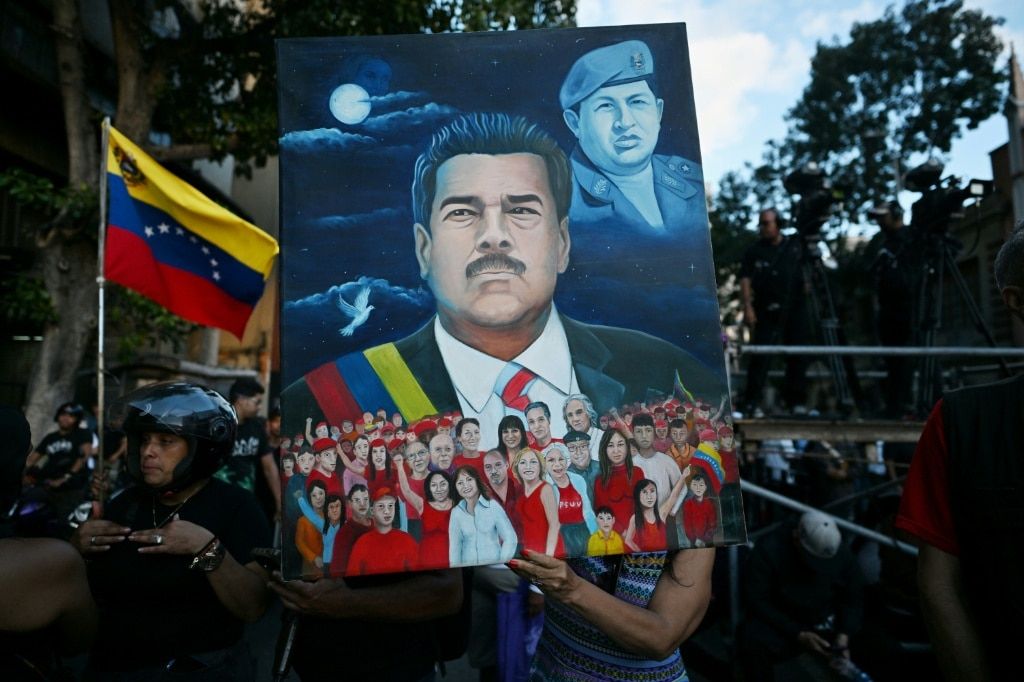
Political scientist and UWI writer Onur Sinan Güzaltan discussed the kidnapping of Venezuelan President Nicolas Maduro with Türkiye-based Meltem TV.
How do you assess the US attacks on Venezuela and the kidnapping of President Maduro?
Even calling the US a rogue state to describe this action would be an understatement. We are talking about the abduction of the president of a sovereign and independent country, taken from his bed in the middle of the night along with his wife, put in chains, paraded before the world through carefully staged photographs, and then brought before a so-called “court”.
Even setting aside international law and conventions, this is an act that violates basic human conscience and dignity. Those who endorse this act, and those who remain silent in the face of it, become complicit in this dishonor. What has been kidnapped and taken hostage today is not only Maduro, but also human dignity itself and the sovereignty of states.
What consequences will this US action have on a global scale?
With this act, the US is not sending a message only to Venezuela, but to every country in the world, including its own allies. The message is clear: I am the boss of this world.
Naturally, an act of this radicality will be met with responses of equal radicalism, taking different forms in different parts of the world. Human history is a struggle between the oppressed and the oppressors, and humanity will not bow to Trump’s arrogant threats.
The so-called “rules-based order” established after World War II, built on the United Nations, international law, and human rights, etc. is over. It no longer exists. On one side stand the US and its collaborators, lawlessness and barbarism; on the other side are those who resist and fight back. This is now a different world. And just as the US acts without rules or law, those who oppose it would respond in the same way.
How can the new wave of US attacks be stopped globally?
So how can this barbarism and aggression be resisted? History offers examples. One is the struggle against Nazi Germany. Individual states could not confront Nazi Germany on their own, so they formed alliances. Today, if you draw a line stretching from Latin America through Africa, West Asia, and deep into Asia, you may call it the Global South, only regional cooperation and global cooperation can stand up to today’s imperialist aggression and barbarism.
Those who remain silent in the face of what is happening today in Venezuela, in Palestine and Gaza, and in the aggression directed at Iran, do they have any guarantee that they will not be the next target of the US? Condemnations are no longer enough. In fact, in the past, the US felt the need to dress its attacks and invasions in the language of human rights and democracy, but today, it no longer feels the need for such “justifications”. We are witnessing open, naked, brute aggression. Is there any lack of a dictator or an anti-democratic regime in Greenland?
Trump has also threatened other Latin American countries. What are your thoughts on this?
In Latin America there exists a strong Bolivarian, independentist, anti-imperialist, leftist and socialist tradition. This region is not encountering US imperialism for the first time. The history of Latin America in the 20th and 21st centuries is, in many ways, the history of coups, wars, and interventions initiated by the US, and the struggles against them. When I speak of regional cooperation, I mean precisely the revival of such traditions and the building of alliances around them.
How do you evaluate the reactions from both the ruling party and the main opposition in Türkiye following the US kidnapping of Maduro?
From this perspective, the statements of Turkish government officials and the Ministry of Foreign Affairs are woefully inadequate in taking a clear stand against US imperialism. Neither the US nor Trump is even mentioned by name, and instead we see calls for “restraint”. We are not dealing with an ordinary incident; we are talking about an abducted president. The position you take at such a moment signals the position you will take in the period ahead. Unfortunately, despite Türkiye’s strong anti-imperialist traditions and the fact that it was founded through an anti-imperialist War of Independence, the stance taken by state and government officials, as well as by the opposition, has been deeply disappointing.
How do you assess the protests in Iran and the possibility of a new US/Israeli attack?
Alongside the regional and global cooperation, I have described, one of the most critical factors is the domestic front. Of course, people will take to the streets and protest, this is a legitimate right. But unfortunately, in today’s world, imperialism exploits such movements for its own ends. In Iran, too, people may protest for legitimate economic and other reasons. Yet the US and Israel, through their influence networks and intelligence operatives, seek to turn these protests into destabilizing actions in order to pave the way for intervention. Iran is an experienced state, and its authorities distinguish between legitimate demands for rights and destabilizing, destructive activities.
Israel lost the “12 Day War” against Iran. Would the US and Israel dare to launch a new attack? They might, if they think that coordination and cooperation among China, Türkiye, Russia, and Iran remain limited, and that these countries would not respond to an attack on Iran. Here, the same applies as in Latin America: cooperation against imperialism is a must. In the event of an attack on Iran, China, Türkiye, and Russia must respond with extreme firmness. The radicalism that has reached the point of abducting a president must be met with an equally radical response. Otherwise, the US will not stop.