

By Dr. Halim Gençoğlu
In the context of the Israel-Palestine conflict, the issue of the killing of Palestinian Christians since 1948 is highly controversial and sensitive. Reliable, impartial sources provide comprehensive evidence of a systematic “Christian massacre.” The deaths of Christians in these conflicts are often presented to the public as collateral damage within the broader category of Palestinian casualties, in order to downplay their significance. In this article, we will examine how Palestinian Christians, who once formed a significant portion of the population, have seen their numbers dramatically decline over time.
Historical Context and Population Decline
Before 1948, Christians made up approximately 20% of the population in historic Palestine. Today, only about 50,000 Christians remain in the West Bank, Gaza, and East Jerusalem. The main reasons cited for the dramatic decline in the Christian population are emigration, economic hardship, political instability, and travel restrictions.
During the 1948 Nakba, total Palestinian losses were around 13–15,000, with a portion of these coming from Christian villages.
For example, in the 1948 Eilabun Massacre, Israeli forces killed 14 civilian men in a Christian village. In most of the conflict (intifadas, Gaza operations), Christian losses remained limited because Christians are concentrated in the West Bank (Bethlehem, Ramallah), and there were only about a thousand families in Gaza.
In fact, the 2023–2025 Gaza war was the period with the highest Christian casualties. In October 2023, at least 18 Christians were killed among civilians sheltering in the bombing of Saint Porphyrius Orthodox Church.
Again in December 2023, two Christian women (mother and daughter) were killed by sniper fire in the Holy Family Catholic Church. Church attacks continued throughout 2025. Multiple attacks on the Holy Family Church resulted in 3 deaths and dozens injured, with total Christian losses in Gaza comprising dozens of families.
While Palestinian and some international sources describe these incidents as “deliberate attacks,” Israel typically defends them as collateral damage, claiming “Hamas used churches as shields.” Yet Zionist Israel, which previously bombed ambulances using the same pretext, found no trace of Hamas in the churches it bombed.
Christian Families Who Left Palestine
As previously noted, emigration plays a major role in the decline of the Palestinian Christian population. These waves of migration intensified especially during the 1948 Nakba and continued thereafter due to economic hardship, political instability, and conflict. Many Palestinian Christian families dispersed, particularly to the United States, Latin America, Europe, and Arab countries.
Prominent figures such as Edward Said are among the symbols of this migration. The Palestinian philosopher Edward Said (1935–2003), born in Jerusalem, is known as a renowned Palestinian-American academic, literary critic, and author of Orientalism. The Said family was of Anglican (Protestant) Christian origin. Due to Zionist pressure, in 1947–1948 they left Jerusalem with his family, first settling in Cairo and then in the United States. He frequently explored Palestinian identity and the exile experience in his works.
Similarly, George Habash (1926–2008), a Palestinian Christian born in Lydda (Lod), was the founder and leader of the Popular Front for the Liberation of Palestine (PFLP). Coming from an Orthodox Christian family with roots in the Ottoman period, he was forced to emigrate with his family in 1948, first to Lebanon and then to various Arab countries. He played a significant role in the Palestinian resistance movement.
Nayef Hawatmeh (born 1938), still alive, was born in Bethlehem and is the founder of the Democratic Front (DFLP). Coming from a Christian family, he was exiled to Jordan in the 1960s and later to Syria. Another Palestinian Christian intellectual, Jabra Ibrahim Jabra (1920–1994), born in Bethlehem, was a writer, poet, translator, and intellectual who produced important works. During the 1948 Nakba, he immigrated to Iraq, lived in Baghdad, and contributed to Arabic literature.
These figures demonstrate the contributions of Palestinian Christians in the diaspora. Today, there are large Palestinian Christian communities in countries such as Chile.
General Assessment
In total, the number of Palestinian Christians killed as a result of Israeli actions since 1948 exceeds one thousand. Among Palestinian Christian communities—particularly those displaced during the 1948 Nakba, those who lost land in subsequent occupation periods, and those who lost family members in recent conflicts—views of Israeli state policies are frequently expressed within theological, ethical, and human rights frameworks. These views, as reflected in academic literature and witness testimonies, emphasize that the occupation is perceived as a systematic mechanism of oppression, interpreted as violations of fundamental human rights, land seizure, and demographic change.
The Kairos Palestine document, authored by Palestinian Christian leaders (from Catholic, Orthodox, and Protestant denominations), is one of the most comprehensive expressions of this perspective. The document describes the Israeli occupation as “a sin against God and humanity” because it systematically eliminates the freedom, justice, and dignity that Palestinians regard as divinely sourced fundamental rights. In the context of displaced Christian families, it defends resistance as both a right and a Christian duty, while insisting that this resistance must be nonviolent and based on love. The occupation is criticized as a regime resembling apartheid and containing elements of ethnic cleansing.
In testimonies from Christian families displaced in 1948 (for example, in Edward Said’s autobiographical works), the establishment of Israel is linked to the “victims of the victims” paradigm, emphasizing that the trauma of the Jewish people’s Holocaust was transformed into displacement and dispossession directed at Palestinians. Families driven out from Jerusalem and its surroundings, like the Said family, experienced this process as permanent exile and loss of identity, evaluating Israeli policies as hegemonic and exclusionary.
In recent times, particularly in cases such as Nahida Khalil Anton and her daughter Samar Kamal Anton, killed by sniper fire in Gaza’s Holy Family Catholic Church in 2023, affected families and church authorities have described the attack as a “meaningless tragedy” and deliberate targeting of civilians. Relatives of these families and community spokespersons interpret Israel’s military operations as collective punishment and a policy of destruction threatening Christian existence, stating that the Christian population in Gaza is “under threat of extinction.”
Palestinian Christian theologians such as Rev. Dr. Mitri Raheb analyze the occupation as an imperial structure while criticizing Zionism and rejecting the legitimization of Israel’s policies through biblical promises. In the context of displaced families, these views frame land loss (for example, settler seizures around Bethlehem) as an injustice requiring decolonization.
These perspectives stem from the traumatic experiences of affected communities and, in academic studies, converge with demands for justice, reconciliation, and equality.
References
Badil Resource Center for Palestinian Residency and Refugee Rights. (2023). Palestinian Christians. https://badil.org/cached_uploads/view/2023/05/24/kairos-badil2023-1684931368.pdf
Coffey, Q. (2025, January 21). Why the Christian population in the West Bank is dwindling. Philos Project. https://philosproject.org/why-the-christian-population-in-the-west-bank-is-dwindling
Nelson, C., & Gizzi, M. C. (Eds.). (2022). Peace and faith: Christian churches and the Israeli–Palestinian conflict. Academic Studies Press. https://doi.org/10.1080/13537121.2022.2041841
Raab, K. (2023). Rooted in Palestine: Palestinian Christians and the struggle for national liberation, 1917–2004. Washington Report on Middle East Affairs. https://www.wrmea.org/middle-east-books-and-more/rooted-in-palestine-palestinian-christians-and-the-struggle-for-national-liberation-1917-2004.html
Sabella, B. (2018). The exodus of Palestinian Christians from the Holy Land. Arab America. https://www.arabamerica.com/the-exodus-of-palestinian-christians-from-the-holy-land
Said, E. W. (1978). Orientalism. Pantheon Books.
Said, E. W. (1999). Out of place: A memoir. Alfred A. Knopf.
Sennott, C. M. (2019, October 31). The ethnic cleansing of Palestinian Christians that nobody is talking about. CounterPunch. https://www.counterpunch.org/2019/10/31/the-ethnic-cleansing-of-palestinian-christians-that-nobody-is-talking-about
U.S. Department of State. (2024). 2023 report on international religious freedom: West Bank and Gaza. https://www.state.gov/wp-content/uploads/2024/06/547499-WEST-BANK-AND-GAZA-2023-INTERNATIONAL-RELIGIOUS-FREEDOM-REPORT.pdf
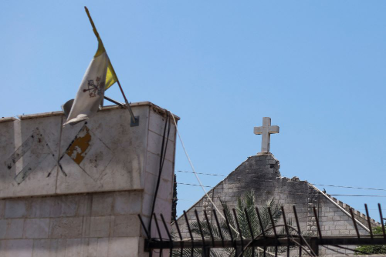
Cover photo: Holy Family Catholic Church in Gaza