


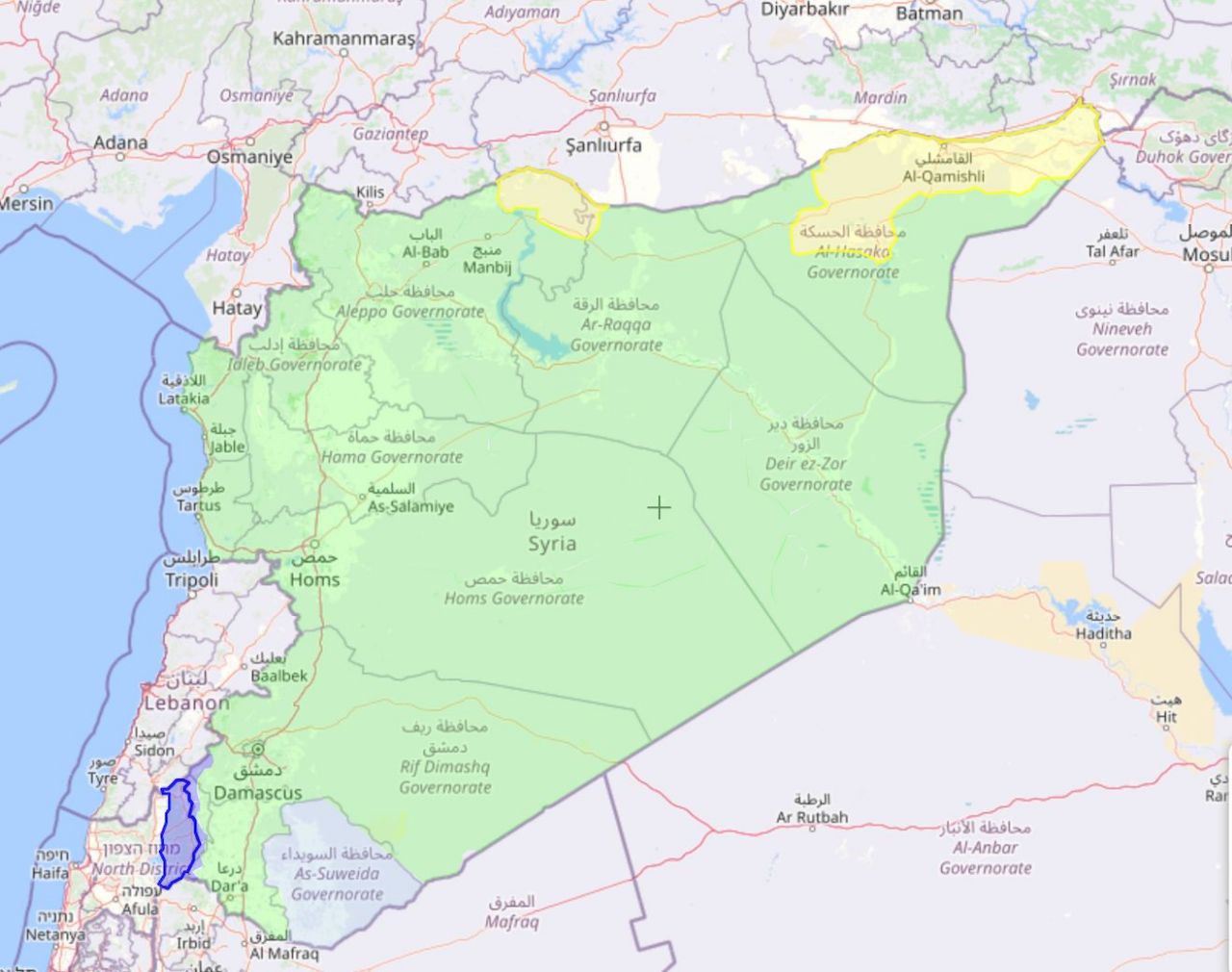
On January 15, the Syrian army first launched a major operation in the west of the Euphrates River, forcing the Syrian Democratic Forces (SDF) to withdraw to the east of the River.
The Syrian army then took control of Deir ez-Zor, the region home to Syria’s largest oil and natural gas fields, and Raqqa, a city that ISIS had once declared its “capital.”
On January 18, a 14-point ceasefire agreement was signed between Syria and the heavily-defeated SDF. Under the agreement, the SDF’s armed elements are to be integrated into the central army, as envisaged in the previous agreement dated March 10, 2025. The SDF also “committed to removing all foreign PKK leaders and elements from the territory of the Syrian Arab Republic.”
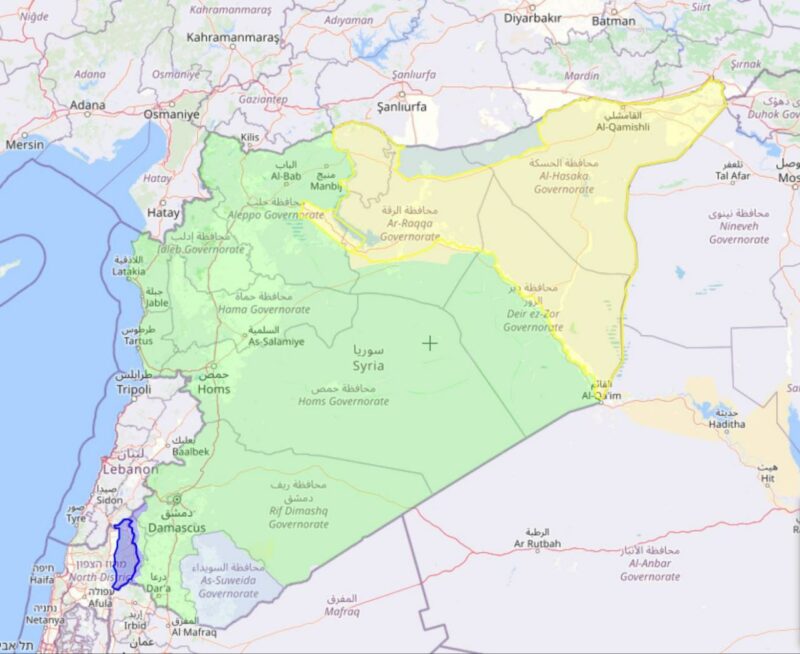
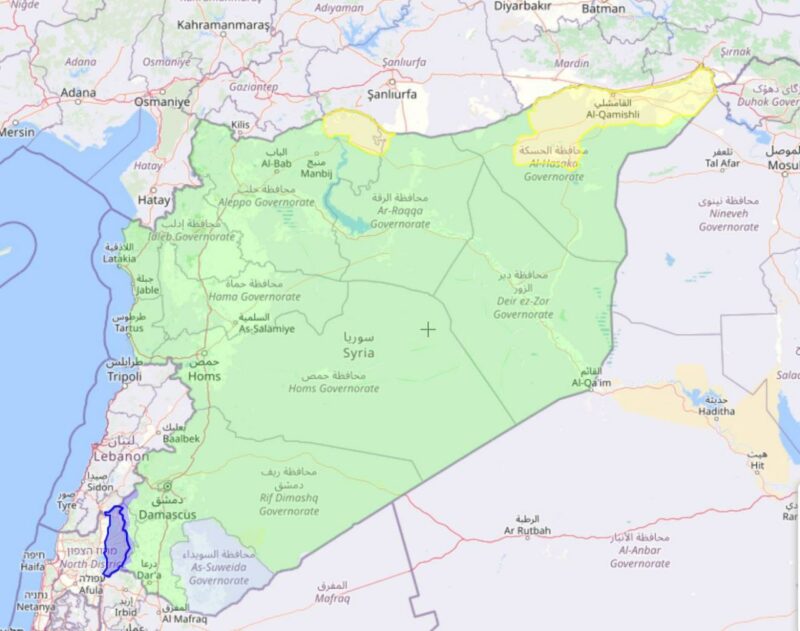
Maps depicting the situation two weeks ago and currently: In Green: Areas controlled by the Syrian Government, in yellow, those dominated by the Syrian Democratic Forces.
The developments were followed in Türkiye minute by minute, becoming the most talked-about issue across television, newspapers, political circles, and the general public.
Who said what?
Those close to the AKP government framed the developments as the product of “Türkiye’s strength and smart strategy”, a “major victory”, “the end of the PKK/YPG”, and “the beginning of a new era”. While some in this group emphasized that Türkiye achieved this success in defiance of the US and Israel, others argued that the US chose cooperation with the “region’s largest state” Türkiye, and that Israel was ultimately forced to accept this reality.
Meanwhile, some parties and political figures who are not close to the AKP but describe themselves as “anti-imperialist”, “patriotic”, or “nationalist” also viewed the developments positively, seeing them as the elimination of an organization, and its areas of control, that had long been backed and armed by the US and Israel with the aim of dividing Türkiye’s territory.
Parties, institutions, and politicians supportive of the PKK/YPG or DEM Party, on the other hand, reacted to the SDF’s defeat with deep disappointment. This camp accused Türkiye of “ignoring the rights of Kurds”. This criticism was also echoed by figures who are known to embrace “Western liberal democracy.”
Though not quite loud, there were also voices opposing Türkiye’s policy of training and facilitating the Syrian army’s operations on the grounds that Ahmed al-Sharaa is a “sharia proponent.” These voices largely came from circles that have long argued that the country is backsliding on laicism.
Another issue largely discussed was how the “Terror-free Türkiye” process would be affected by these developments in Syria.
Below, we share with our readers some of the prominent assessments emerging from Türkiye.
Sabah newspaper – Metin Altınok: Trump against the Democrats
Trump appears determined to finally wrap up the Syria file, which in his first term got stuck in the web of military tutelage. The first anniversary of the Syrian revolution and the pushing of the YPG, an organization established and managed by Democratic administrations in the US, to east of the Euphrates show that his projections are not mere fantasy. Still, this balance is hanging by a thread. If Trump, who has fundamentally shaken the politico-economic hegemony in the US, is somehow sidelined, it’s obvious that this entire picture could change very quickly.
https://www.sabah.com.tr/yazarlar/melihaltinok/2026/01/19/ypg-firatin-dogusuna-supurulurken
Who “sold out the Kurds”?
As PKK sympathizers claim, I don’t see a US that “sold out the Kurds”.
In this story, the ones who sold out the Kurds are those who turned inter-state rivalry and war into an opportunity, used them at the negotiating table in every geopolitical bargain: the PKK. I hope the Kurds will free themselves from this parasite. Türkiye, which comes to the aid of every oppressed people in the region, stands by their side.
https://www.sabah.com.tr/yazarlar/melihaltinok/2026/01/21/kurtleri-satan-amerika-degil-pkkdir
Sabah newspaper – Bercan Tutar: The universal civilizational vision of the Ottomans
The deposed Syrian dictator Bashar al-Assad, who failed to grasp the importance of President Erdoğan’s call 14 years ago not to suppress the democratic protests that began on March 15, 2011, used to make arrogant remarks like: “Some people dream of reviving the Ottomans. Empty fantasies.”
But time proved President Erdoğan right. Those who move in step with Erdoğan, the leader who transformed Türkiye from a restricted Anatolian country into a global power, are winning. Those who oppose the civilizational vision he represents are losing one by one.
Türkiye’s comeback: A century later
Today, Türkiye, returning a century later to its historic geography stretching from Libya to Karabakh, from Bosnia to Iraq, from Sudan to Syria, from Yemen to Qatar, from Saudi Arabia to Pakistan, from Somalia to Gaza, continues to make history at home and abroad. That is why a Turkish wind is blowing across regions from North Africa to the Eastern Mediterranean, from the Caucasus to South Asia, from the Caspian to the Horn of Africa, from the Black Sea to the Persian Gulf, and from the Balkans to the Middle East.
Had it not been for Türkiye, the Syrian people’s revolution of December 8, 2024 would not have been possible.
(…)
A real hegemon
The fundamental problem of our region, home to the world’s richest resources and hegemonic potential, was the absence of a real hegemon. That vacuum is now being filled by Türkiye with a new civilizational vision. This is why in recent times all eyes have been fixed on Türkiye “smart power.”
Let us not forget: Türkiye’s determination rendered meaningless the so-called “Second Sykes–Picot” in Syria in September 2015 between the US and Russia. The “Ottoman vision” taking shape in Syria in Syria is the result of that determination.
(…)
In short, we are going through historic stages in which the New Türkiye is advancing toward a New Ottoman vision. Those who walk with us will win; those who stand against us will lose. Because the greatest weapon of the New Türkiye is the universal civilizational vision of the Ottomans.
https://www.sabah.com.tr/yazarlar/bercan-tutar/2026/01/18/yeni-turkiyeden-yeni-osmanliya
Türkiye newspaper – Cem Küçük: SDF/YPG attempted to sabotage the “Terror-free Türkiye” process
The YPG terrorist organization just doesn’t seem to learn. The past week can be summed up as follows:
The SDF/YPG attempted a move aimed at sabotaging the “Terror-free Türkiye” process. From the very beginning, the Turkish state has taken a supportive stance toward the dissolution of the SDF/YPG structure in Syria through negotiations and its integration into the Syrian administration. Turkish officials have reiterated this position many times. As part of the March 10 agreement, the Syrian government granted the organization the necessary time to implement the agreement and integrate. The message was clear: “Lay down your arms and join the Syrian government.”
However, the YPG treated the Syrian administration’s and Türkiye’s preference for negotiations and a peaceful solution as an opportunity. Instead of using this period for genuine dialogue and transformation, the organization chose to buy time and maximize the gains it had obtained by occupation.
Türkiye is not Venezuela
The organization also tried to use the integration process as leverage against the “Terror-free Türkiye” process. In the lead-up to the clashes in Aleppo, fearful of losing its privileges as the Terror-free Türkiye process became successful, the “hawk” faction in Qandil of the terrorist organization stepped in. With Israel’s encouragement, this faction pushed for deadlock within the SDF/YPG structure and insisted on confrontation. They assumed the US and Israel would intervene, but they didn’t even bother.
(…)
This is what happens when you put your trust in the US and Israel. Türkiye is not Venezuela. The US and the West see us as a major power. Indeed, it is.
The SDF/YPG targets our territory, disrespects our flag, and harbors hatred toward everything Turkish. The DEM Party refuses to stop acting like the political wing of the terrorist group and still stand by it.
Cem Küçük also wrote about the events in Nusaybin on January 20. The DEM Party held its parliamentary group meeting in Nusaybin, a district of the city of Mardin on the Syrian border to protest the operations against the SDF. During the meeting a group took down the Turkish flag. Küçük wrote:
There is not a single member of this country who was not disturbed by the images of the flag being taken down. The SDF and the DEM Party are deliberately hitting the raw nerves of our society. Within the framework of the rule of law, judicial and legal action must be taken against these terrorists and those who sympathize with them.
Hürriyet newspaper- Abdülkadir Selvi: Erdoğan’s new paradigm
President Erdoğan put forward a new paradigm. “The Kurds do not need to look for another protector. The Republic of Türkiye is the protectoe of the Kurds,” he said.
Erdoğan has always upheld this line. He has never wavered from emphasizing that “the Republic of Türkiye is the shared homeland of both Turks and Kurds.” But this time, he appeared to emphasize this line more sharply. “As long as the Republic of Türkiye is here, as long as this state, thank God, stands strong, there is no need for anyone to seek another protector, to chase after other friends or partners,” he said.
(…)
Under the pretext of fighting ISIS, the US sought to establish a PKK–YPG terror state along our borders. The name SDF was merely a rebranding of PKK–YPG. Now, the SDF’s time is coming to an end. This marks a historic turning point.
Terror-free Türkiye process took a hit, but didn’t collapse
Past peace initiatives were derailed by precisely this kind of provocation (Selvi refers to a group taking down the Turkish flag during the DEM Party’s parliamentary group meeting in Nusaybin) hearts were in mouths once again. Had this process been mismanaged, the “Terror-free Türkiye” initiative could have suffered serious damage.
In that sense, these developments were like a stress test for the Terror-free Türkiye process. The process took a hit, but didn’t collapse. On the contrary, the biggest obstacles standing in its way have begun to fall away.
The greatest obstacle to the process was the SDF’s presence in Syria. Qandil did everything it could to sabotage the initiative. It tried to engineer a second “Kobani uprising”. It attempted to mobilize the masses. Unfortunately, the DEM Party also served Qandil’s plan. But it collapsed in Syria. Qandil was defeated, both on the ground and at the negotiating table.
Qandil needs to wake up from its fantasy world
Qandil now needs to wake up from its fantasy world and act according to the new reality:
1.From the very beginning of this process, the US has been acting in coordination with Türkiye.
2.The perspectives of Türkiye, the US, and Syria now align.
3. The SDF was a “Made in the USA” project. Once the US withdrew its support, the SDF collapsed. The SDF didn’t receive the backing it expected from either the US or Europe.
4. As I previously noted, a kind of coup happened against Öcalan in Qandil. Öcalan and Qandil have fallen out.
5. The public bought into the Terror-free Türkiye process. Despite Qandil’s provocations, there happened no mass demonstrations.
6. Both the domestic and international situations turned against Qandil.
Medyascope – Ruşen Çakır:
The Öcalanist movement -first Öcalan himself, then Qandil, the DEM Party, and finally the YPG/SDF- proved completely ineffective during the Syrian crisis.
For example, it was impossible to determine whether Öcalan or Qandil was behind the SDF’s reluctance to reach a compromise. At this point, it no longer matters.
Qandil’s calls for “resistance” were clearly half-hearted, and indeed yielded no real results. Likewise, we couldn’t understand whether the DEM Party genuinely aimed to mobilize society. The flag incident in Nusaybin was an overdoing.
So, the Kurdish political movement has drifted far from being a coherent, effective, and decisive force. And it will pay the price for this.
https://medyascope.tv/2026/01/25/kurtler-icin-hasar-tespit-raporu-rusen-cakir-yazdi/
Former DEM MP – Altan Tan:
Europe, the US, Israel; they support the Kurds as long as they are in conflict with Türkiye. They see the Kurds as a leverage to generate instability. They don’t care whether a Kurdish state is established. Their concerns are different.
(A program on Sözcü TV)
DEM Co-Chair – Tuncer Bakırhan:
I want to speak to the broader opposition community. Today, they must actively fight for a regime in Syria founded on equality, law, decentralization, and secular values. Those who remain silent today in Syria will find it too late to object tomorrow when the consequences reach Türkiye.
Banu Avar: US’ priority is alliance of Syria and Türkiye with Israel
The US pretending to stand with al-Shara against the YPG is merely a tactical maneuver. Its priority is in the alliance of Syria and Türkiye with Israel.
The YPG and the ‘Syria Kurdistan’ project is the next step for the US. No one should indulge in fantasies and repeat past mistakes.
Abdullah Ağar: This is a question of sovereignty between the state and an armed structure
We are at a historic threshold.
The terrorist organization SDG/PKK, with its weapons and cadres, has been gradually pushed back and is now confined to Ayn al‑Arab and the Qamishli–Derik–Hasakah corridor, the areas where it has exploited Kurdish ethnic identity to build power and establish a core base. There it remains alive, armed. And it intends to hold a destructive, divisive, and separatist zone.
All the fuss -the protests, backroom deals, intervening actors, lamentations, threats, blackmail, and crossings through the Semalka border gate- are aimed at keeping this zone alive.
If they succeed, if the SDG/PKK remains there while preserving its structural integrity, if it integrates into Damascus without dismantling that structure, or if it is transferred to another country while retaining the same organizational coherence, this would not be elimination, but a repositioning.
In that case, the problem does not end. Only its geography changes, and the threat to Türkiye merely changes form.
(…)
At its core, this is a question of sovereignty between the state and an armed structure. A question whether an armed ideology will transform into a state form or be dissolved and dismantled within the framework of state order. Either the armed structure will be eliminated, or states will be forced to coexist with armed organizations. This is not a security debate, but a sovereignty debate.
History is written at moments like these. And every delayed decision raises the cost.