


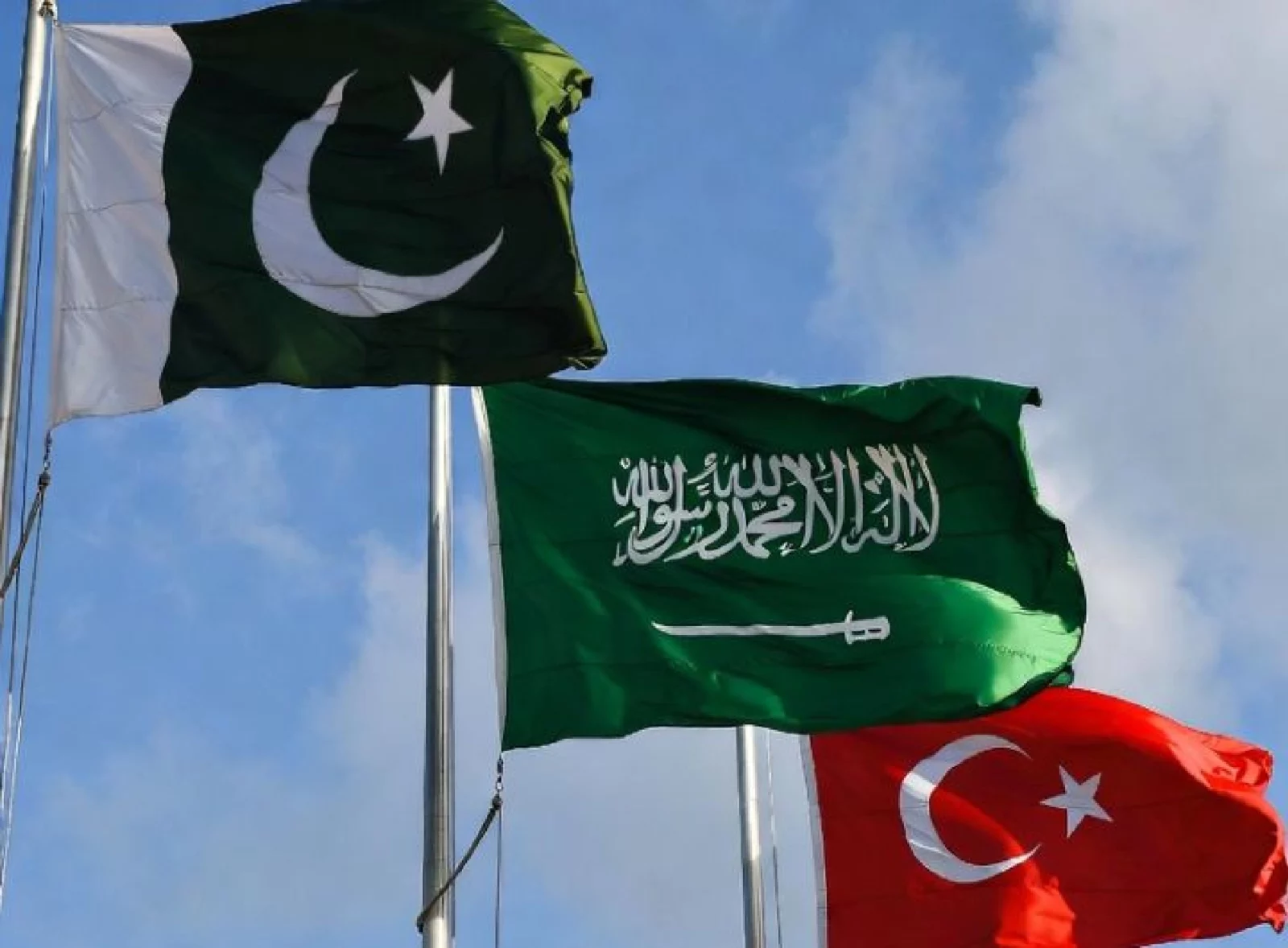
By Dure Akram, from Lahore / Pakistan
Saudi Arabia and Pakistan signed A Strategic Mutual Defense Agreement in September 2025 that treats aggression against one as aggression against both.
Türkiye is now in advanced talks to join, with Pakistan’s defense production minister confirming a draft trilateral text is already “in the pipeline.” In light of these developments, one is forced to wonder whether this pact is the Global South finally building a security instrument that reflects the region’s lived threats, not any superpower’s talking points.
A year ago, the phrase “Islamic NATO” was still treated as an Internet provocation. Now it is a frame being pushed (sometimes lazily, sometimes with intent) to delegitimize any Muslim-majority coordination as ideological rather than strategic. That framing can be called anything but analysis. If one were being honest, it is social engineering, designed to make collective self-defense sound like extremism.
Start with what changed. The Middle East’s risk landscape has been whiplashed by escalation cycles that small states cannot price and cannot control. Saudi Arabia signed the Pakistan pact soon after Israeli strikes in Qatar sharpened Gulf fears about spillover and about the limits of external restraint.
In parallel, the US–Iran relationship has returned to tariff threats and coercive signaling that ripples through regional trade and supply chains, exactly the kind of shock that punishes energy exporters, import-dependent economies, and diaspora corridors all at once. If Iranian Foreign Minister Abbas Araghchi is to be believed, “Unlike the restraint Iran showed in June 2025, our powerful armed forces have no qualms about firing back with everything we have if we come under renewed attack.”
The point is not to romanticize any capital. The point is to recognize that the old security architecture asks regional states to absorb volatility while outsourcing agency.
Pakistan’s case for the pact is stronger than its critics admit, and it is not sentimental. Islamabad is a frontline state in two theatres at once: South Asia’s hard border reality and the Gulf’s energy-and-diaspora system that keeps Pakistan’s external accounts breathing. Saudi Arabia is not a distant patron; it is an anchor in Pakistan’s labor market, remittance flows, and oil supply patterns, and it sits inside the same escalation geography that has made every Gulf capital re-run its worst-case scenarios since Gaza and the strike-on-Qatar precedent.
Those who call the pact “risky” often smuggle in a premise that only Western-led arrangements count as stabilizing. It is the same habit that treats NATO drills as deterrence and regional drills as provocation. When Greece, Israel and Cyprus deepen their defense cooperation and step up joint exercises in the eastern Mediterranean, it is framed as prudent alignment. Similarly, when Greece expands anti-drone and cybersecurity cooperation with Israel, it is sold as modernization. When Pakistan, Saudi Arabia and Türkiye talk about collective defense, headlines reach for civilizational panic.
This is where the India angle stops being a footnote and becomes the diagnostic test. India’s strategic community is already floating counter-formations in the Mediterranean, explicitly casting the Saudi–Pakistan–Türkiye track as a threat to be neutralized. Meanwhile, India rushed to host the UAE president in New Delhi and sign a letter of intent to build a strategic defense partnership even as Indian officials took pains to say that defense cooperation with a regional partner does not imply getting involved in the region’s conflicts. That sentence tells you everything: India wants the benefits of Middle East presence without the obligations of Middle East risk. Pakistan’s pact is the opposite bargain. It is about obligations, clearly stated, because deterrence without credibility is theatre.
India’s Mediterranean outreach is not speculative. India and Greece concluded their first bilateral naval exercise in September 2025, conducted in phases around Salamis and the Aegean, with India deploying INS Trikand. India’s prime minister has also publicly pushed deeper defense and maritime cooperation with Cyprus, tying it to connectivity and security logic around the India–Middle East–Europe Economic Corridor. These moves may seem about partnerships and corridors, but in practice, they sit inside a wider alignment map where India’s West Asia strategy leans into states that have built tight defense-industrial linkages with Israel and that are openly watched by Türkiye as rivals.
So when Indian commentary wraps this in “countering Islamic NATO,” it is not responding to a Pakistani provocation. It is responding to the idea that Pakistan can be more than a South Asian problem to be contained. And that is exactly why the pact matters for the Global South: it disrupts the habit of treating security as something bought from abroad.
Pakistan is the hinge in this story because it brings a rare mix of scale, experience, and affordability. Pakistan’s defense industry has seen rising interest after its hardware was “combat-tested” in the 2025 air conflict with India, with talks underway with 13 countries and 6 to 8 in advanced stages. The JF-17’s cost advantage is explicit, roughly $30–40 million per aircraft compared with far pricier Western platforms, and Pakistan aims to double annual production capacity by 2027. This is not chest-thumping. It is an industrial reality, and it gives Pakistan leverage that is not dependent on aid cycles.
Once a customer buys a fighter, they also buy training syllabi, spares, software support, upgrades, pilot exchange programs, and doctrine familiarity. That is influence you can measure in maintenance contracts and repeated visits, not speeches.
The Saudi track shows how Pakistan converts strategic closeness into bankable demand. Islamabad and Riyadh are negotiating to convert roughly $2 billion in Saudi loans into military purchases centered on JF-17 jets. This matters for two reasons. It monetizes relationship capital at a moment when Pakistan needs foreign exchange and industrial scale, and it aligns Saudi procurement with a partner that does not attach political conditions in the way Western vendors often do.
Then comes the “Three Brothers” corridor with Türkiye and Azerbaijan: it is the cleanest case study in Pakistan’s modern defense diplomacy because it blends co-production, exercises, and export wins into a single arc. Pakistan’s JF-17 Block III sale to Azerbaijan is no longer speculative as the military announced a contract to sell JF-17 Block III jets to Baku in September 2024. Around this triangle, the political symbolism is already institutionalized through trilateral narratives and joint training patterns.
Türkiye is where the collaboration becomes industrial. The MILGEM program anchors the relationship in steel and timelines, with the second corvette, PNS Khaibar, handed over in December 2025 under Pakistan’s four-ship deal signed in 2018, following the delivery of PNS Babur in May 2024. These projects are slow, expensive, and logistically demanding; that is exactly why they matter diplomatically. They create long-term interdependence through training, integration, and upgrade pathways, and they widen Pakistan’s naval learning curve beyond its traditional partners.
The newer frontier is unmanned systems. Türkiye plans for a facility in Pakistan to assemble combat drones, with talks advancing significantly since October 2025. Islamabad benefits from local assembly and skills transfer, and Ankara benefits from distributed production and a durable customer relationship. It is also a Global South template for industrial cooperation that does not rely on Western licensing chokepoints.
Beyond the Gulf and the Caucasus, Pakistan is pushing into Africa and Southeast Asia with a similar playbook: mid-tier capability at a lower price point, bundled with training and flexible terms. Pakistan neared a $1.5 billion arms deal with Sudan, including aircraft, drones and air defense systems. Islamabad is seeking a defense pact with Bangladesh, with JF-17 sales part of the conversation. Pakistan and Indonesia are likewise closing in on a jets-and-drones defense deal. That leverage matters because deterrence is cheaper than war; Pakistan learned that lesson in the hardest classroom, with a nuclearized rival across a live border and a global media ecosystem that often narrates any Pakistani capability as inherently suspect. The pact allows Pakistan to convert capability into a structured partnership rather than transactional one-off deals. It also allows Riyadh and Ankara to diversify procurement and training away from single-source dependency at a time when supply chains and licenses are routinely weaponized.
Critics will point to sovereignty. At the end of the day, there would be many, in whose eyes Riyadh is risking trading sovereignty for reassurance, warning that collective arrangements can bind Saudi Arabia to obligations it does not control. This critique contains a useful fear, yet it misreads what sovereignty looks like in 2026. Sovereignty is not the absence of ties. From now on, it is the presence of options. For decades, Gulf security was underwritten by a single external guarantor, with predictable domestic political conditions attached and unpredictable strategic behavior in moments of crisis. Diversification through regional partners is not a loss of sovereignty; it is a hedge against coercive dependence. Thus, like it or not, Pakistan, Türkiye, and Saudi Arabia is not a rigid bloc with integrated command structures and automatic triggers. It is a move to formalize overlapping security interests amid doubts about the reliability of external guarantees, with Türkiye seeking signaling and flexibility rather than binding itself into a treaty straitjacket. That is precisely why this pact is feasible. It meets states where they are, politically and legally, instead of importing a Western institutional template and pretending it will transplant cleanly.
Pakistan’s officials have also been consistent in public messaging that the pact is defensive and not directed against any third country. Treat that line with the seriousness it deserves. A defensive pact is not a peace slogan; it is a deterrence mechanism. It tells any would-be aggressor that escalation will not stay local, that there are costs beyond the immediate theatre, that coercion will face a network rather than a solitary state.
Now return to India, because deterrence in South Asia is never abstract. Pakistan does not get the luxury of assuming goodwill across its eastern border, and recent history has been full of crisis spirals, air incidents, and political incentives that reward muscularity.
India’s answer to Pakistan’s external partnerships is not restraint. It is competitive alignment, from deepening defense-industrial cooperation to expanding maritime presence and conducting exercises designed to signal reach.
The Mediterranean “quad” chatter is best read as psychological warfare through geopolitics: it aims to tell Pakistan that any attempt to widen its strategic space will be met with counter-space.
Pakistan should not respond with slogans. It should respond with statecraft.
That means making the pact legible to citizens and to sceptics without turning it into propaganda. Publish the contours that can be published. Clarify what “attack” means in legal terms, which domains are covered, how consultation works, how parliamentary oversight is built, and how escalation control is designed.
It also means confronting the prejudice embedded in the coverage. The “Muslim NATO” label is a tell. It relies on a civilizational cue that makes coordination sound sectarian. It erases the secular drivers that are plain on the record: supply-chain shocks from US–Iran brinkmanship, spillover risk from Israel’s regional campaign, and the reconfiguration of corridors and connectivity where security guarantees determine investment flows. Pakistan’s best rebuttal is to keep the conversation grounded in interests and to refuse the bait of identity melodrama.
There is also a harder, quieter advantage. A trilateral track anchored by Pakistan, Saudi Arabia, and Türkiye creates interoperability pathways that do not run through Western gatekeeping. Training, maintenance, spares, doctrine exchanges, and joint exercises build habits of cooperation that lower the temperature in crises because leaders can pick up phones with a shared operational vocabulary. Quiet coordination is often more stabilizing than loud summits.
A final warning is still needed, because realism is part of being pro-Pakistan. The pact must never be allowed to become a blank cheque for domestic adventurism or a substitute for economic reform. Pakistan’s deterrence strength is only as credible as its fiscal resilience, its diplomatic discipline, and its ability to keep crises from hijacking governance.
If opposition strategists want to see the Saudi–Pakistan–Türkiye understanding as an “axis” to be countered, they will try to internationalize every Pakistani move and securities every corridor. Pakistan’s answer should be to internationalize restraint, codify collective defense, and keep its narrative boringly factual. That is how you build legitimacy.