


By Yıldıran Acar, Political Scientist
In recent years, the Arctic has become an increasingly visible subject in international politics. Climate change, emerging sea routes and the region’s natural resource potential have enhanced its strategic significance. As a result, the policies of Arctic coastal states have become more explicit and more contested.
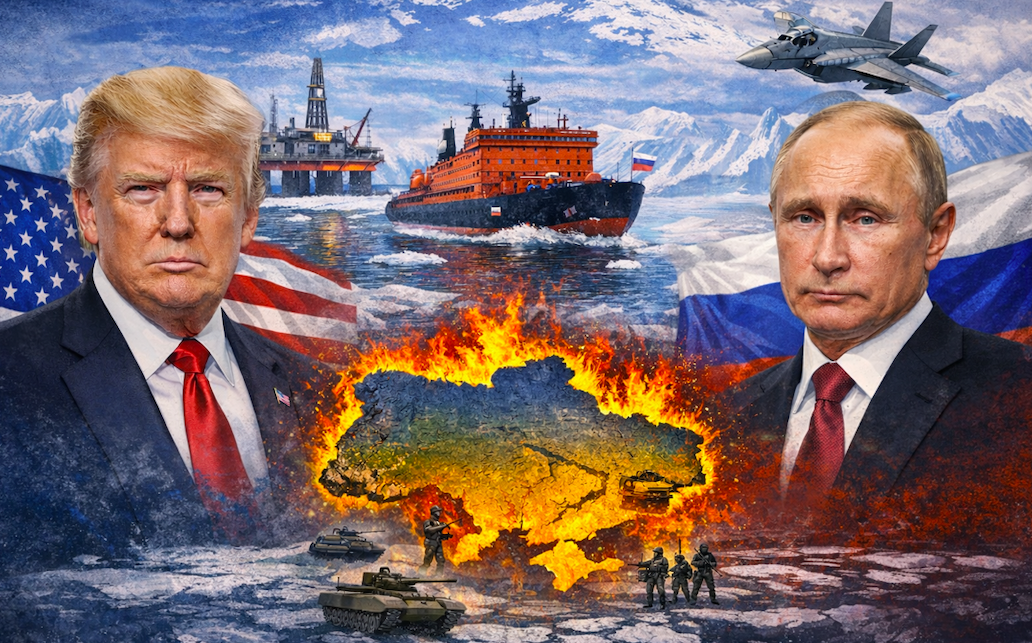
In this context, Russia’s Arctic policy, Western attempts to exclude Russia following the Ukraine war, and the Greenland policy discussed during Donald Trump’s presidency should be examined together.
Russia’s Approach to the Arctic
For the Russian Federation, the Arctic has long been a core element of state policy. Russia’s extensive northern coastline, energy resources and the Northern Sea Route underline the region’s economic and security importance for Moscow. Russia’s Arctic policy is therefore based on long-term strategic planning rather than short-term political considerations.
Western countries often interpret Russia’s military investments in the Arctic as a sign of expansionism. From Russia’s perspective, however, these measures are primarily aimed at securing transportation routes and protecting existing areas of responsibility. As the importance of the Northern Sea Route increases, its security has become a priority for Moscow.
Post-Ukraine War Exclusion Attempts and Politicization
The Ukraine war led Western countries to adopt a tougher stance toward Russia. In this process, EU member states and NATO countries with Arctic coastlines used the war as a justification to exclude Russia from regional cooperation mechanisms, particularly the Arctic Council. This approach politicized an area that had long been governed by technical cooperation and low-profile diplomacy.
The Arctic Council was not established as a military or security-focused organization. Its primary objectives include cooperation on environmental protection, climate change, indigenous peoples’ rights and scientific research. Nevertheless, the Ukraine war, despite having no direct connection to these issues, was used as a pretext to marginalize Russia in the Arctic. This development made Arctic governance increasingly dependent on broader political agendas.
The exclusion of Russia led to the suspension of many Council activities and stalled joint projects. Rather than weakening Russia’s position in the Arctic, this process significantly reduced the effectiveness of the Arctic Council itself. Given Russia’s geographical presence and practical influence in the region, it soon became clear that an exclusion-based Arctic policy was not sustainable.
Trump’s Greenland Policy and Western Inconsistencies
The statements made by Donald Trump regarding Greenland introduced a new dimension to Arctic politics. The United States’ interest in Greenland is closely linked to the island’s strategic value for defense and early warning systems. However, framing this interest through an open debate over Danish sovereignty created discomfort among European countries.
This episode exposed inconsistencies within Western Arctic policies. While emphasizing international law and sovereignty in their stance toward Russia, Western countries struggled to respond coherently to U.S. pressure on a NATO ally. As a result, efforts to exclude Russia from the Arctic by invoking the Ukraine war became increasingly difficult to justify.
The Emerging Picture
Post-war exclusion policies in the Arctic have failed to deliver the intended outcomes. Russia has not been removed from the region, while Arctic governance mechanisms have been weakened. EU countries and Arctic coastal states have found it difficult to pursue a unified strategy, particularly in light of the U.S. position on Greenland.
Russia, meanwhile, has avoided steps that could escalate tensions in the Arctic. Moscow has focused on preserving existing balances and protecting its long-term interests.
Assessment
Developments in the Arctic demonstrate the limitations of transferring the logic of the Ukraine war directly into regional cooperation frameworks. Attempts to exclude Russia have not produced a sustainable Arctic order. Trump’s Greenland policy has further highlighted divisions within the Western camp.
The current situation suggests that a stable Arctic order can only be achieved through inclusive and pragmatic policies.