
From Caracas, Venezuela
A month has passed since the kidnapping of President Maduro and the appointment of Delcy Rodríguez – according to the constitutional mandate – as acting president, although the United States insists on calling her “interim president”.
This situation has unfolded within the context of a cognitive war characterized by conflicting positions regarding what is happening. In my case, I operate on the premise that the US government is falsifying information with the aim of weakening national and patriotic consciousness, fracturing society, and creating divisions in the defense of the country and in the people’s support for their legal and legitimate government. As if it were a religion, the government has called for “belief and trust,” which is what I do, even though I am not a believer.
It seems to me that, considering that the acting president is “negotiating” with a missile at her head, even with the “flash” approval of the reform to the hydrocarbons law, the creation of the Qatar Fund, the prohibitions on selling oil freely to whomever Venezuela considers appropriate, and the “visit” of the CIA chief (which I consider much better than if Marco Rubio had come), she has had an extraordinary month in office, given that we are an intervened country with a kidnapped president.
What is at stake is the survival of the state and the republic, which, if lost, would render any other discussion trivial. It took Cuba thirty-three years to remove the Platt Amendment from its Constitution and another twenty-five to carry out its revolution. The timescales of countries and peoples are different from the timescales of humans. A Nicaraguan friend, almost a brother of many years, told me that we had “bought peace in exchange for sovereignty,” and I told him that the Sandinistas wisely handed over the government in the 1990 elections in order to stop the bloody war imposed by imperialism, which had caused tens of thousands of deaths and total devastation of the country, only to return in better shape seventeen years later and regain power. The timescales of countries and peoples are different from the timescales of humans.
Everything that is happening is understandable. We are in the Western Hemisphere, which the world’s greatest military power has declared its own, with no force on the planet able to oppose it. However, what we can never abandon is the unwavering defense of Venezuela’s dignity, because that is what we inherited from Bolívar and Chávez, and it cannot be compromised in any negotiation. I fully endorse what Professor Luis Britto García said: “We are victims of a treacherous, bloody, and unprovoked aggression. Without a prior declaration of hostilities, using technologically superior weaponry, they massacred hundreds of our compatriots, most of whom were non-combatants. Until a dignified peace treaty is signed, we are at war: the United States army and authorities are enemies, and as such, they must be treated.”
Within this context, and recognizing the government’s significant efforts to improve the population’s living conditions, it must be understood that this work will not come at the cost of surrendering national sovereignty and security. It is important to recall the difference between what occurred almost simultaneously in China and the Soviet Union. The Soviets believed it was possible to implement simultaneous changes in the economy and politics, and the result was their collapse. China, on the other hand, deemed it necessary to make profound economic changes, even reforming its constitution to allow foreign investment, but without making the slightest political change. When, in 1989, internal terrorist forces supported from abroad attempted to seize power through violence, the full force of the state was brought down upon them to safeguard the political system and ensure that China remains a world power today.
In this context, I hope our Armed Forces will not attend the meeting of the heads of the armed forces of the Americas convened in Washington on February 11 by U.S. General Dan Caine, Chairman of the Joint Chiefs of Staff. It would be very “strange,” to put it politely, for a general of our armed forces to attend the invitation of someone who, under orders from Trump and Rubio, is the direct perpetrator of the murder of our compatriots and the kidnapping of our president.
The United States cannot interfere in our Armed Forces and our security agencies. That would violate the principles of Commander Chávez, who made our armed forces truly Bolivarian and anti-Monroe. It is noteworthy that our main allies, Cuba and Nicaragua, were not invited to this meeting.
Furthermore, following Venezuela’s long-standing tradition of granting pardons, acting president Delcy Rodríguez has also decided to do so, granting freedom to a large number of terrorists, including five Americans. This cannot stop our demand for the freedom of President Maduro and his wife, which is the government’s primary ethical and moral responsibility.
We must understand that the United States has not altered in the slightest its desire for regime change, which defines its policy toward Venezuela. It must be clear that this was the primary objective of the military incursion of January 3rd; the kidnapping of President Maduro was only one part of it. But they did not succeed that day, and now they will try again in another way, with other methods and other instruments.
Trump is, above all, a pragmatic businessman, and in that sense, he realized that a regime change by force and the imposition of a far-right government would not guarantee what he desires: to seize Venezuela’s energy wealth. His top military commanders warned him that if he didn’t achieve an immediate victory, a prolonged stay in Venezuela would cause him many headaches. That’s why they didn’t disembark the troops they had aboard warships (more than 15,000 soldiers) that were supposed to arrive in the country through La Carlota, Maiquetía, and Higuerote. Trump knew, because his generals told him, that this would mean the beginning of an armed struggle whose primary objective for Venezuelans would be to detonate all the oil pipelines, oil wells, and crude oil loading terminals. They wouldn’t take a single drop of oil. And for that, an army isn’t needed, only a corps of 720 specialized combatants organized into small action groups, which the country already possesses.
But because Trump is pragmatic, he also understood that the terrorist opposition was incapable of leading the country. He stated this himself emphatically, referring to Machado: “I think it would be very difficult for her to be the leader. She doesn’t have the support or the respect within the country. She’s a very kind woman, but she doesn’t enjoy the necessary respect.” That’s why he brought her into the White House through the kitchen.
For 26 years, far-right terrorism has informed the US government about the imminent fall of Chávez and Maduro, the imminent fracturing of the armed forces, the imminent recruitment of dozens of generals, the imminent desertion of entire units of the armed forces, the imminent fratricidal contradictions within the Chavista leadership, and many more lies that brought in response juicy transfers in dollars and euros to the leaders of the terrorist opposition, without the United States and Europe being able to achieve any success.
With Trump, things are different. If he can negotiate with Chavismo, why not? If they are the only ones who guarantee peace and governability, and with it the delivery of the much-desired oil that can feed the consumerist soul of Americans and transform him into the champion of the sustainability of the faltering US economy, why not? He did, but of course, in true Trump style: strong rhetoric, numerous threats, blackmail, pressure, armed aggression, and the kidnapping of the president. But it’s not just him: it’s the natural imperialist attitude. We must remember that all of this (in its current phase) was started by Obama.
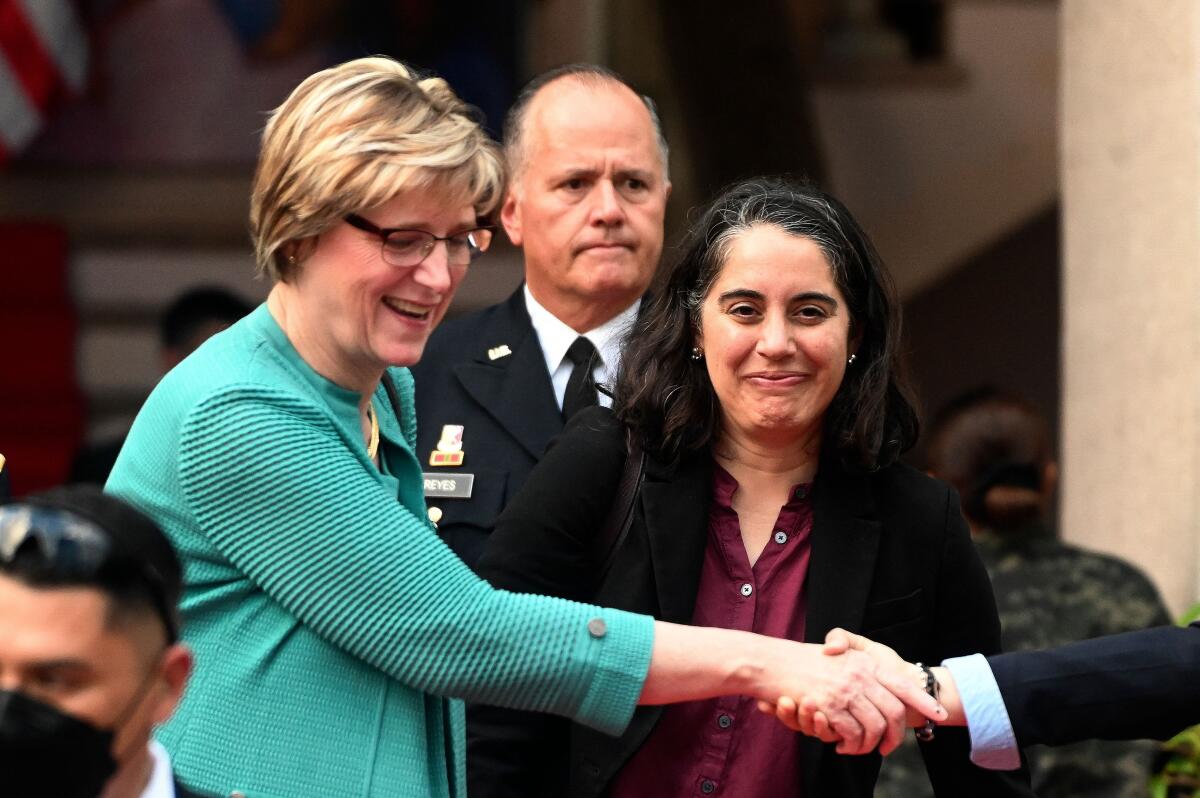
Having accomplished all this, other circumstances and methods now become necessary. This is why Laura Dogu has come to Venezuela. Her objective, as she herself has stated, is to work towards the overthrow of the Chavista government. Of course, she disguises this by speaking of the “return of exiled opposition figures and the holding of free elections”—in other words, impunity for those who ordered the murder of Venezuelans, clamored for an armed attack against the country, applauded the murder of 83 Venezuelans and Cubans who defended the president, and celebrated his kidnapping. These “free elections” would also interrupt President Maduro’s term and violate the National Constitution.
Forget about cooperation and friendship. Given her track record and resume, it’s very clear that she has come to do what María Corina Machado and all the terrorist leaders couldn’t. She is now the head of the Venezuelan opposition.
Laura Dogu orchestrated the unexpected unity of the Mexican opposition. She managed to bring together the PAN, the PRI, and even the “leftist” PRD to prevent Andrés Manuel López Obrador from becoming president. Her “success” led to her appointment as ambassador to Nicaragua, where, in the absence of opposition leadership, she financed, instructed, and organized the failed coup against the Sandinista government in 2018. She was later appointed to Honduras in 2022, where she was instrumental in the electoral fraud of the last elections, when, as Trump openly stated, the president he had chosen to govern the country was imposed from Washington.
A Mexican friend who spent time with her during her stay in the country told me that “she is a very skillful and intelligent woman, pragmatic, non-confrontational, and diplomatic, always looking to open doors to get involved… and she is even respectful.” He added that “you can have a relationship with her without problems, knowing who she is, because she certainly knows who you are. She adapts, extending her network according to her interests; she is gradual and easy to get along with. She has nothing to do with the verbal aggression of Trump and Rubio; she is down-to-earth, laughs, and in private she might even allow herself to say that ‘Trump is crazy.’”
My friend believes it is the smartest choice that could have been made to destabilize Venezuela because it sells out its interests “softly”, seeking a “soft landing” so that Venezuela gradually falls into the hands of the United States.
We must be very vigilant regarding her destabilizing maneuvers. With her, Trump intends to combine his own characteristic verbal aggression, blackmail, pressure, and threats with the “softness” of his representative in order to achieve his objectives. It will be up to the people of Venezuela, their government, their armed forces, and their security agencies to decide whether the country’s fate is that of Nicaragua in 2018 or that of Honduras in 2025. “Killing Me Softly” is Laura Dogu’s favorite film.
Venezuela must respond with unity and more unity, supporting the administration of the interim president, which should translate into more popular power, better economic management, and a stronger link with governors and mayors who know their territory and can serve as a transmission belt between the people and the president and vice versa, to advance the territorialization of defense and achieve the goal of making Venezuela an impregnable country.