

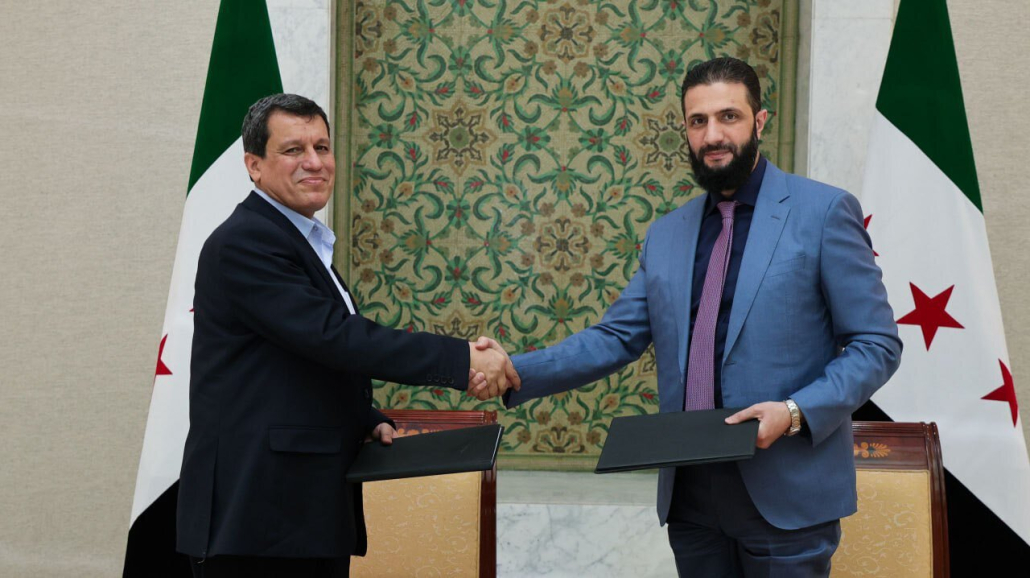
After several preliminary attempts and armed clashes, the Syrian central government and the Syrian Democratic Forces reached an agreement on January 30, which has so far been honored.
Syria experienced a flurry of agreements, cancellations, and military attacks in January, culminating in the January 30th agreement between the Syrian government and the Syrian Democratic Forces. The pact focuses on consolidating the ceasefire, transferring border security to the central government, and preserving the country’s territorial integrity. US ambassador to Türkiye and Special envoy to Syria, Thomas Barrack played a crucial mediating role. The change of position in Washington was crucial, argues Mustafa Caner from the influential Turkish SETA Foundation and also managing director of its monthly magazine Kriter.
“For long years, the Syrian Democratic Forces received arms support and were given political promises during the Obama Administration. Their claim was to fight DAESH, but they were following a different agenda, controlling economic resources, using these for a political transition including assimilation of Arabas in the territories they controlled. But later, the Al Sharaa government established a dialogue with the US via Thomas Barrack, the al Sharaa met with Trump personally. After that, with US support, the Damascus took steps that foiled this political project. Also, within a consensus with Türkiye, the US decided to carry on the process with states, take governments as counterparts. This led to the agreement of January 30, which clearly represents an achievement of the Sharaa government in terms of protecting Syria’s territorial integrity and ensuring that the central administration exercises sovereignty over the entire territory with a nation-state approach.”
With the agreement, the Damascus government suspends the military option for now, while the SDF accepts central authority in the areas they controlled de facto.
“Therefore, Syria will not be divided, nor will it move towards any kind of federation, since the Damascus government has effectively suspended the option of taking these areas by military means”, says Caner.
The most critical aspect of the agreement is military the integration process. Syrian government forces have already made limited inroads into key centers such as Hasakah and Qamishli. However, experts on security and terrorist movements, like Levent Kemal, who follows Syria, warn that implementation will take time.
“Since we are still in the early stages, there is clearly a slow pace. Expecting rapid change or immediate integration would be premature and would harm the process itself.”
The plan envisions the integration of SDF fighters into the Syrian army, where they will form three regional brigades. The SDF will nominate the governor of Hasakah and the deputy defense minister, while local administrations in their region will be restructured in coordination with Damascus.
Kemal says “This will open the door to a degree of local autonomy in the future, considering the executive order published by al-Sharaa, which grants cultural rights. The aim is to establish a balance between municipalities, governorates, and the central government, where the ethnic group governs itself in areas where it holds a majority.”
According to the expert, the agreement will ensure that SDF members will serve in those military forces established in their regions. With the agreement, the drafting of a new constitution returns to the agenda.
“Elections have been held in the rest of Syria; now they will be held in the provinces of Raqqa and Deir ez Zor and Hasakah as well. Once the representatives are elected and sent to Damascus, the process of drafting a new constitution will move forward alongside state-building, with the participation of the Arab and Kurdish peoples and other ethnic groups.”
If the agreement is fully implemented, the US military presence in the region will be up for debate, says Caner.
“With the dissolution of the SDF and Washington’s recognition that state actors, namely Syria and Türkiye, will be the subjects from now on, US soldiers will no longer have a reason to remain.”
On February 6, Al Arabiya TV, citing Iraqi security sources reported that US forces had begun withdrawing from the Al Shaddadi base in Syria’s Al Hasaka governorate, heading toward Erbil in Iraqi Kurdistan.
But achieving national unity in Syria still seems difficult, given that the government of al Sharaa, due to its terrorist origins, lacks inclusive national thinking, and the United States mediated the agreement. Its policies of fragmentation and use of the Damascus government against resistance forces in Lebanon and Iraq indicate that Syria is still far from national and regional stability.
As if they were countering this instability, both the US and regional actors stepped in right after the agreement. Syria signed a memorandum of understanding on Wednesday with US oil firm Chevron and Qatar-based Power International Holding to explore for oil and natural gas in Syrian territorial waters.
“The Syrian political leadership is a cornerstone of recovery and stability, and that investment in the energy sector could open the door to jobs and improved living conditions in Syria,”, commented Barrack.
Then followed Saudi Arabia that signed with Damascus five agreements worth $5.3 billion to support key sectors including aviation, telecommunications and water.
The agreement was closely watched in Ankara. The Turkish government had demanded the disarmament of the SDF and came into conflict with the DEM Party, considered the political branch of the PKK. With the agreement, both sides, the government and the PKK consider possible to advance on the process called “Türkiye free of terror”. The Turkish parliament is expected a commission’s report on the matter, indicating legal and political steps ahead.