


By Mehmet Enes Beşer
In Bangkok, politics of plastic recycling are enacted not in institutional policy arenas or corporate boardrooms but in the urban margins of streets, dumps, canals, and squatter settlements—terrain often ignored in official narratives about sustainability. While Thailand moves to become a regional power in circular economy practice and waste management, the on-the-ground experience of plastic recycling in the capital obfuscates much more contentious and complicated reality. A situated urban political ecology perspective helps us consider the intersection of power, labor, infrastructure, and everyday survival within the plastic economy—not as abstract environmental process but as an essential urban, unequal, and socially embedded one.
The city’s plastic recycling network relies deeply on informal work: waste picker networks, micro-scale aggregators, and street-level recyclers who make up the backbone of a hidden circular economy. These artists perform in broken-up, often precarious places—on the street, on the peripheries of building sites, along filthy canals—where movement and access to materials are regulated by changing market values, police harassment, and spatial marginality. It is ecologically vital yet economically undervalued and politically marginalized labor. State or private initiatives to institutionalize recycling typically exclude such workers or impose technocratic requirements on them that erase local knowledge and survival strategies.
Infrastructure is a major determinant of such dynamics. Bangkok waste management is highly centralized and over-loaded, with very low source separation rates and minimal public investment in recycling technology. Yet, private sector and household dependence on informal recycling networks persists. Collecting, sorting, and reselling’s spatial geography is tied to local economies, gendered divisions of labor, and migratory circuits. To illustrate, a majority of waste pickers are rural migrants or elderly urban poor who navigate everyday constraints of storage space, weather, and police action to amass enough recyclables to maintain a bare existence.
State policies have a tendency to reinforce rather than disrupt such hierarchies. Single-use plastic bans or waste-to-energy incineration have been touted as progressive, but risk recentralizing control over waste streams and replacing existing livelihoods. National and municipal sustainability projects aim at individual behavior change—consumer responsibility, household sorting—without challenging the structural inequalities that are part of Bangkok’s recycling ecology. Political ecology dissent from this by outlining how environmental responsibility is unequally distributed and how urban governance produces exclusion and inclusion in the guise of sustainability.
To a marked degree, Bangkok’s political ecology of plastics cannot be divorced from waste regimes at the regional and global levels. Following China’s imposition of the ban on the importation of plastic wastes in 2018, Thailand—and Bangkok in particular—became a receiving nation for legally and illicitly traded plastic waste. International capital has flowed into new recycling and processing plants, often with weak regulatory oversight and suspect environmental effects. This investment has affected domestic markets, depressing local prices for collected plastics and increasing competition for the material. Bangkok’s recycling complex is thus enmeshed within a transnational political economy of waste, whereby decisions taken in Brussels or Beijing resonate within the city’s most precarious labor markets.
But resistance and adaptation persist. Community-level waste banks, sorting cooperatives, and local NGOs are experimenting with prototypes of labor-valuing, environmentally just, and locally controlled recycling models. These models are all small-scale, but they are demonstrating what a more socially equitable circular economy can be. These processes need to be understood not merely as technical interventions, but rather as political initiatives resisting dominant logics of privatization, dispossession, and vertical reform.
To see plastics recycling in Bangkok as a situated urban political ecology is to provide an alternative explanation: that the city’s waste economy is not a technical problem to be solved, but a negotiated social space shaped by class, migration, informality, and environmental governance. It demands a re-making of sustainability beyond clean numbers and glitzy campaigns—and towards a situated politics that places at its core those who live and work at the fringes of the system.
Finally, Bangkok’s plastic crisis is not just one of consumption or waste—it is one of rights: who gets to decide the city’s resources, infrastructures, and futures. And any meaningful solution will have to begin with listening to those who are already doing the everyday work of recycling, behind the scenes but never quiet, each day.
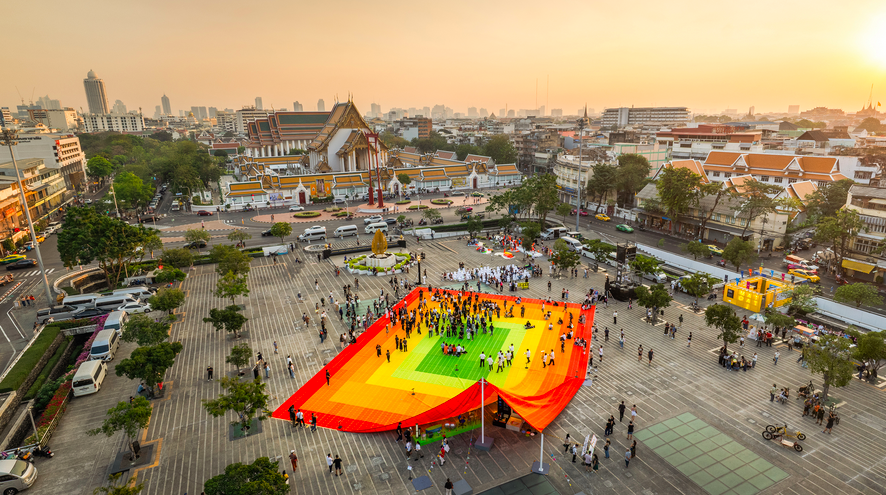
Cover graph: Mega Mat, a temporary installation made of over 500 recycled plastic mats, showcasing the possibilities for using recycled plastic in everyday objects. Located on the Lan Khon Mueang Town Square outside the Bangkok Metropolitan Authority City Hall.