


By Orçun Göktürk, President of the Center for Sino-Turkish Studies, Beijing / China
As we enter a period where increasing US-Israel aggression toward Iran and military options from Washington are being voiced at the highest levels, the stance China will take is a matter of great curiosity. However, Beijing’s attitude during previous US-Israel attacks on Tehran provides a projection. As seen during the US attacks on nuclear facilities in June 2025, China’s response continues to remain at a “discursive” level rather than a military one.
Has the Chinese army taken to the field?
Reports of joint Iran-Russia-China military exercises that have been echoing in the international media for days bring to mind whether Beijing stands behind Tehran as a military bloc. However, it was noteworthy that Iran’s semi-official Tasnim News Agency, while announcing that the exercise was conducted with Russia, did not include any information regarding the participation of the Chinese Navy. No information about the exercise was included in the press release of the People’s Liberation Army of China. This situation brings the following question to mind: Did China decide against participating?
In fact, this uncertainty is a typical reflection of the major transformation in China’s foreign policy after 1978 and the Chinese foreign policy concept called “strategic pragmatism.” While Iran is certainly an important partner for China, this relationship does not hold an existential quality for Beijing. Let’s examine the reasons…
Asymmetric relationship and ‘Strategic Pragmatism’
The relationship between Beijing and Tehran is built on a clear asymmetry. While China is a vital lifeline for Iran under sanctions, Iran is a manageable risk and a mid-level partner for China.
Iran and China established diplomatic relations in 1971. In 2016, during President Xi Jinping’s visits to Saudi Arabia, Egypt, and Iran, this relationship was elevated to the level of a comprehensive strategic partnership. This visit, made during Xi’s first term and nearly ten years ago, was his last official visit to Iran. This time interval contrasts with the number of times he has visited other important countries and states in the region during the same period.
The most important element in China’s view of Iran is based on energy needs. Iranian oil allows China to diversify its resources. On the other hand, the tension Washington experiences with Iran in the main rivalry of this century, the US-China competition, shifts US resources from the Pacific to West Asia. This increases the preparation time China needs and eases the pressure on Beijing. Of course, Iran functions as China’s gateway to Southwest Asia. Tehran’s potential fall would increase the encirclement of China from the Eastern Mediterranean to Hormuz and from there to the South China Sea. Naturally, the issue is a spiral of two opposing but interconnected factors for Beijing.
Economic and limited military support
Beijing and Tehran deepened their economic relations during Chinese Foreign Minister Wang Yi’s visit to Tehran in 2021. Although the 25-year cooperation agreement signed that year, with its promise of $400 billion in investment, was seen as an effort to keep the Iranian economy afloat, these investments did not progress at the expected pace. This has been a source of frustration for the Iranian leadership, particularly because the China-Iran bilateral trade relationship is significantly unbalanced and some promised investments have not materialized (recent statements by Pezeshkian confirm this).
As of 2025, while Iran exports more than 80% of its oil to China, this amount constitutes only 13.4% of China’s total imports. Moreover, the Chinese companies conducting oil trade from Tehran are small-scale refineries that rank low on Beijing’s list of national priorities.
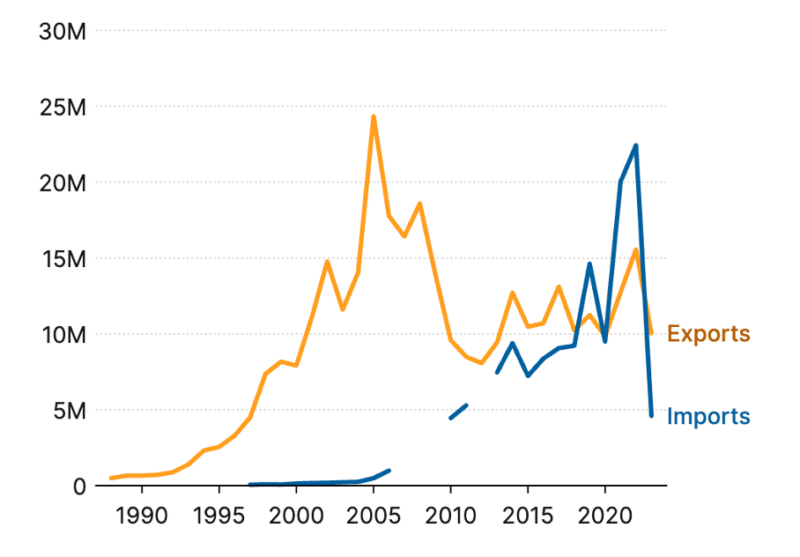
To elaborate: the primary Chinese consumers of Iranian oil are independent small refineries that operate on very low profit margins and depend on discounted oil imports from sanctioned countries like Iran, Venezuela, and Russia to survive. These small refineries are mostly concentrated in Shandong province and are generally not seen as national priorities by Beijing. As clearly seen in Figure 1, Beijing’s trade volume with Tehran, in terms of both exports and imports, has been falling rapidly since 2020.
Figure 1. China’s Total Trade Volume with Iran
Source: World Integrated Trade Solution
In the military field, Beijing follows a strategy based on “dual-use materials and technologies” rather than direct support. Although it is part of the Shanghai Cooperation Organization (SCO) and BRICS, Beijing continues its foreign policy strategy toward all countries and does not offer a security guarantee to Iran. On the other hand, China plays a role in providing critical components (including rare elements) that support air defense systems, anti-ship missiles, and especially ballistic missile guidance systems for Tehran. Although efforts are being made to strengthen logistical ties with projects like the Qom-Yiwu railway line, Iran does not stand out among the countries that benefit most from China’s development financing. Tehran ranks in the middle among Beijing’s overseas loan recipients.
Mediation and Pragmatism
The US effort to place Beijing in an “axis of evil” along with Russia and North Korea oversimplifies China’s sophisticated foreign policy. Instead of entering a direct conflict, China continues its strategy of maintaining ties with both sides by assuming a mediator role. Mediating the normalization between Saudi Arabia and Iran in Beijing in 2023 or establishing the Hong Kong-based International Organization for Mediation can be seen as part of this strategy.
For Beijing, the essential element is stability. This is based on the fact that the country with the world’s largest production and the number one country in exports does not yet see the power in itself and its allies to ensure the security of the world’s maritime trade routes.
China’s interests in Iran will continue to focus on maintaining stability, ensuring continuous access to Iranian oil exports, and preventing the emergence of a pro-American regime in Tehran; however, this will be verbal rather than physical. Therefore, although the fall of Tehran has the potential to create some aftershocks for China, Beijing will try to maintain its influence over a successor government.
China’s foreign policy limitations
China, of course, makes strategic choices when it comes to foreign policy; it builds closer alliances with Russia against Ukraine and with Iran against Israel. However, these ties have limits, and China tries to maintain diplomatic relations with all parties. China does not enter direct conflicts or provide military support. Even though Beijing describes its relationship with Moscow as “unshakeable,” it insists that this is not an “alliance” and does not “target third parties.”
This role of China was tested during the 12-day Iran-Israel war. US Secretary of State Marco Rubio’s request for China to prevent Iran from closing the Strait of Hormuz, and Trump’s statements that seemed to accept China’s continued purchase of Iranian oil, show that Washington also accepts this role on one hand.
In conclusion, this approach prioritizing stability is also clearly seen in China’s bilateral relations with the US. During the numerous trade wars and tariff processes initiated by Washington, China has always shown its willingness to return to the negotiating table and cooperate. It is unlikely that China will provide direct support to Iran beyond advocating for a permanent ceasefire.
What can China do? It will continue to condemn, emphasize the UN Charter, and call for restraint; however, it will not set its own economic and strategic future on fire for Iran. This is the continuation of the “hide your strength, bide your time” (韬光养晦) policy inherited from Deng Xiaoping.