


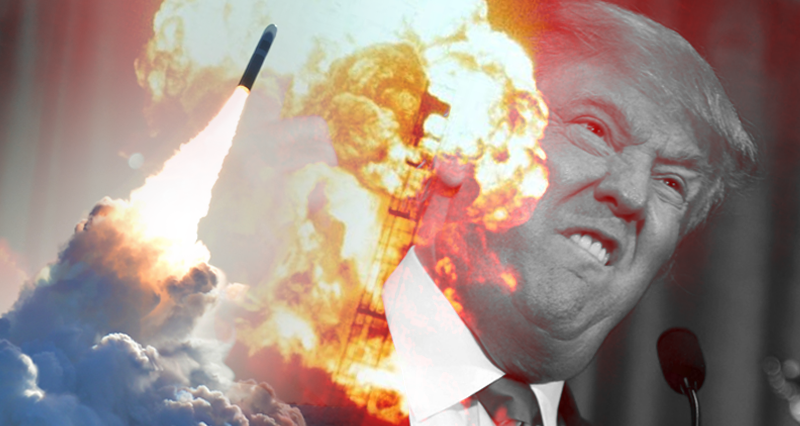
The United States has deliberately incited a war against the Islamic Republic of Iran. Iran’s reactions following the US assassination of Supreme Leader Ali Khamanei came as no surprise to Washington. Contrary to what some argue, I do not share the idea that the US was expecting a “regime collapse” in Iran following the assassination. One does not need deep expertise on Iran to know about the systems stability to overcome that.
Similarly, Iran had announced previously several times that, in case of an attack, it would respond targeting US military bases, and thus, US allies, throughout the region. Washington, which is more than the erratic statements of Trump, must have calculated that beforehand.
The same goes for the interruption and currently de facto closure of the Strait of Hormuz to commercial transport.
The US has not only sabotaged the diplomatic negotiations with Iran, it has also following its attack sabotaged any attempt of de-escalation: On march 7, Iranian president Pezeshkian presented a low voiced apology and announcement of halting attacks to neighbors – to which Trump reacted declaring Iran’s “total surrender”. This, together with domestic Iranian rejection, forced Pezeshkian to step back. Trump’s statements regarding the choosing of the Khamenei’s successor, the bombing of Teheran’s oil depot, the deployment of more and more US military assets to the region all are just some of the overwhelming evidence for one basic fact: The US government did want this war with Iran.
Hence, one needs to explain what their objectives are. Here are some preliminary remarks.
1. Widening imperialist tools: assassination of foreign leaders
The United States government has, together with its ally Israel, assassinated the leader of a foreign country. There have been various cases that US supported groups or assassins had killed foreign politicians, such as Libya’s Muammar Ghaddafi. But historians report that this is the first time in history that the US government itself kills a foreign leader.
The assassination comes just shortly after US forces have hijacked Venezuela President Nicolas Maduro from Caracas. And it is accompanied by Trump’s remarks recently, that the US might target drug cartels with missiles, while adding that the Mexican government is run by cartels.
US imperialism establishes open and direct foreign leader assassination as new policy tool.
2. War of aggression without UN approval – killing UN Charter
The US government has presented the aggression against Iran as “Major combat operation”. But its goal of toppling the Iranian regime, its scope and continuation leave no doubt that the United States has started a war, without declaring one.
This constitutes a clear and widely acknowledged violation of the UN Charter. Still, the UN Security Council as well as the organization in general have failed in both, stopping the aggression or condemning it effectively.
The US government has already been critical of the United Nations and dealt the organization an important blow in one of its main fields of work – the issue of or war and peace.
The US attack has a number of objectives that go far beyond of consequences in Iran.
3. Clarifying transatlantic balance of power: Europe not even informed
The US/Israeli attack took its main global ally, the European Union and United Kingdom, and the latter’s former colonies, such as Canada and Australia, by surprise.
Washington did not bother to develop a global justification, a joint military strategy, burden-sharing and alike.
Resistance of some countries, such as Spain, or hesitation, such as from the United Kingdom, has been met by the Trump Administration with new threats (cancelation of all trade – Spain) or public humiliation (“No Churchill there” – United Kingdom).
The US has demonstrated to its allies that these are no allies but vassals, with no say in beginning such a war. They are obliged to follow the orders coming afterwards, such as deploying military to the Mediterranean to protect Israeli and US assets. Though reluctantly, they seem to follow suit – including Spain and the United Kingdom.
4. Driving a wedge between the Global South and Iran
Iran is a member of the BRICS alliance and the Shanghai Cooperation Organization, both entities that the Trump Administration had targeted before. Though not military alliances in the strict sense of the word, these alliances are considered to be harbingers of a new, multipolar world, with “multipolar” meaning “limiting US power” in favor of other poles.
The United States tests the cohesion and solidarity within these alliances as well as the unity in the so-called Global South generally by attacking Iran.
As previously stated for the example of Spain, it presents to the leaders of the Global South the option to side with Iran – and become a target themselves.
Until now, major actors have reacted by condemning the attack with diplomatic messages. One of Iran’s strongest allies previously, Venezuela, has lamented the attack without naming the culprits and expressing clear solidarity with Iran. Iran’s neighbor, Türkiye, has declared condemnation of both the attack and Iran’s response simultaneously.
Some reports indicate a defense cooperation between Iran on the one side and Russia and China on the other, but no official confirmation was given.
The majority of the Global South, including Russia and China, call for a ceasefire and a return to negotiations, thus maintaining a neutral stance.
The US attack seeks to weaken the idea of multipolarity as a means to limit Washington’s power, and Washington is keen to state its claimed success, as both Trump and the Secretary of War, Hegseth, delightedly state that Russia or others do not play an important role.
This move comes along with Trump’s repeated call to leaders of the Global South to focus on their national interest instead of forging alliances.
5. Placing unsolvable contradiction between the Gulf and pulling monarchies towards Israel
As stated before, Iran had announced it would retaliate against US bases located in Iraq, the Gulf countries and Saudi Arabia. And it did so.
Besides of the oil production and trade, to be discussed below, these attacks led to the halt of air traffic, the closure of US diplomatic representation, the jeopardizing of Western investments, including real estate, in these countries.
Though home to US bases and allied with Washington, the Gulf monarchies had managed to keep up the perception of neutrality in US/Israeli-Irani conflict and achieved being targeted in last year’s 12-Day-War.
With Iran pushed to pass the threshold of attacking bases in these countries and their neutrality and stability thorn into pieces, the US tries to establish an existential contradiction between the Gulf States’ economic survival and Iran.
The purpose is to pull these countries into the front against Iran and approach them to Israel, an old idea previously stated with the formula of an Arab NATO. Already before the attack, on February 22, Israeli Prime Minister Netanyahu had vowed to establish an alliance with them against Iran.
Should any of the Gulf States take the step from defensive actions to active offensive against Iran, he would have achieved a tactical victory, while they themselves would place their bet on the destruction of the Iranian regime.
6. The Oil issue, part 1: Trump places national interest above imperial global order
The attack on Iran and Iran’s response by effectively closing the Strait of Hormuz have, predictably, dried up energy supplies and driven up oil prices. Nothing of a surprise here.
A number of countries are already suffering economic consequences, by rising interest rates, short falls in supply, limiting even weekly workdays to for, as has been reported from the Philippines.
In a way, Trump has taken steps that globalize the oil blockade he enforced on Cuba. He hast established the fact that the United States government does not limit its foreign policy actions or military attacks by taking into consideration the needs of the US-established global capitalist world market – Trump’s forceful critique of globalism.
7. The Oil issue: Part 2: Trump effectively takes control of Asia and China’s oil supplies
The US Department of Energy states that the US has imported 7% of its oil via the Strait of Hormuz in 2024, while 69% of the transport goes to China, India and Japan.
From the Chinese perspective, almost half oil imports come passing the Strait of Hormuz or from Venezuela, in a similar situation, with the remaining imports being from Russia, Brazil, Angola mainly.
Triggering the war, Trump has effectively cut off half of China’s oil imports, and with its daily decision between escalation or de-escalation, accompanied by its measures to support oil transport via the strait, be it insurance policies or military deployment, Trump keeps on exercising sovereignty over China’s energy supply.
8. The oil issue, pt. 3: Trump manages shortcomings in the oil market actively
While effectively cutting off China’s supplies is a negative management of the oil market, the US administration demonstrates its control also positively – by allowing India to import Russian oil.
The imposed sanctions regime against Russian oil imports to India is waivered for 30 days, providing India with a certain relief, while sending a clear message to China. Trump regularly announced these steps in events dedicated to US global energy dominance.
9. The oil issue pt. 4: “Drill baby drill”
The effects of rising, or rather exploding energy prices on the global economy are immense, as oil is the main source of energy and thus material part of any process of capital accumulation.
Rising oil prices lead importing countries to spend more foreign currency on imports, with deteriorating trade and balance of payments. Increasing costs pressure industrial production, reducing competitiveness and fueling inflation. The latter may lead Central banks to tighten monetary policy, increasing interest rates and slowing economic growth.
The more dependent a country from oil import is, the higher these effects will be. The United States is not prone to them.
On the other side, the US is the world’s major oil producer and a net exporter. Oil market observers had reported that the low levels of oil price previously caused disinvestment from the sector, potentially leading to lack of supply in the future.
With its open stated favoring of the oil industry, the Trump Administration welcomes rising oil prices as an additional source of revenue for the US government, additional profitability for US oil companies and strategic advantage in competitiveness against European and Asian companies – while simultaneously being aware of possible domestic inflationary and political costs. Opening up the US strategic reserve to achieve controlled price increase may be the way forward.
10. Liberating the potential of US Imperialism
As previously stated, the US imperialism has crossed thresholds of immunity of foreign leaders and the international law, the consideration of global economy and the position of allies when attacking Iran.
According to US President Donald Trump, these were chains around the neck of US power, represented by himself. Ignoring them is liberating US greatness, and his behavior during the war continues that line.
Publicly distributing videos, where people pray to Trump in the White House, daily changing statements on what the war’s objectives are, all kind of statements regarding determining Iran’s future, repeated emphasis on the presentation of Trump as “who he decides on war and peace” – the attack on Iran is used for a global propaganda on American greatness and limitlessness.
11. Regime change or what in Iran
No one doubts that, after Venezuela, a little interference in Honduras, threats on Greenland, blockade of Cuba, pressure on Mexico, threats against the European Union, a double game on Russia, Iran is just another chapter in Trump’s playbook to Make America Great Again.
After decades of US threats, sanctions, assassinations, proxy wars, sabotages, Iranian public opinion understandably considers the US as “the devil”.
Washington’s stated goals very day to day, but it seems that for the short term, the US is less prone on invading Iran and keener on achieving domestic progress by strengthening forces willing to compromise with the West on issues of nuclear energy, Axis of Resistance, recognition of Israel and abandoning Asian alliances.
Therefore, the US targets opposers of these policies, namely the conservative-radical circles, the Iranian Revolutionary Guards, while pursuing the above stated goals. Within Iran, Washington’s objectives are only of tactical, temporary nature.
In attacking Iran, the US pursues objectives of a global nature. How far it will succeed depends of course on how its adversaries react, starting from the Iranian resistance to the global society.