


By Mehmet Enes Beşer
The global order has experienced rapid geopolitical and economic changes over recent decades. The post-World War II international order dominated by the Western world by institutions such as the United Nations, the International Monetary Fund (IMF), and the World Bank is also challenged to a larger extent by a shifting world order. The third world is not any longer a passive element in this arithmetic. Rather, they are driving themselves in regional and international circles such as BRICS, APEC, and G20, asking for not merely greater voice and participation but even new frameworks of multilateral collaboration better suited to an age of multipolarity.
This dynamism is a turn of global aspirations. While stability, assistance, and membership in traditional Western-led institutions were the overarching imperative in the past, today demands are being made for equality, mutuality, and self-determination. For the billions of people throughout the Global South, conventional multilateralism has not delivered on development’s promise, climate justice, or management of justice. Thus, new spaces are rising to prominence—both as sites of cooperation and as tools to remake the very terms of world rule.
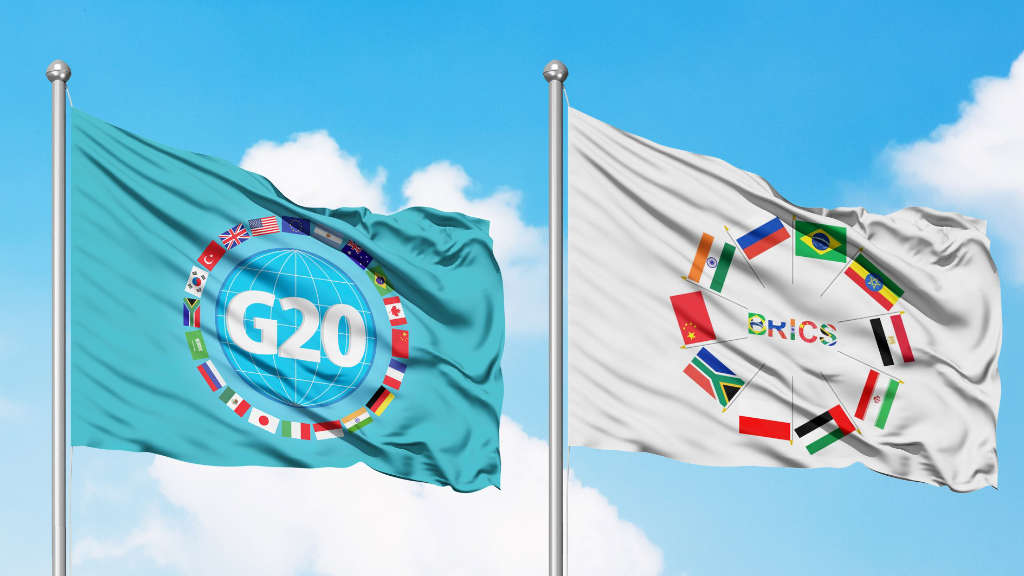
One of the most striking instances of the shift is the emergence and revival of the BRICS bloc. From an informal gathering of rising powers—Brazil, Russia, India, China, and South Africa—the group has become a forum questioning the economic orthodoxy. With the accession of new members such as Saudi Arabia, Egypt, and the United Arab Emirates, “Greater BRICS” has become increasingly diverse and potentially powerful platform. Its call for de-dollarization of finance, unorthodox solutions to development finance, and remolding global institutions is not rhetoric—it is an articulation of collective grievances of most developing countries with current imbalances in the global system.
BRICS creation of the New Development Bank (NDB) and the Contingent Reserve Arrangement is one of the strongest manifestations of the ways countries are moving away from the Bretton Woods institutions. These steps bring in capital and financing to the Third World without conditionality that has typically accompanied IMF or World Bank intervention. Second, the increasing willingness of the NDB to accept non-BRICS members is evidence that its appeal is not anti-Western in nature, but rather one of providing a more balanced and responsive array of finance instruments to the Global South.
Similarly, APEC (Asia-Pacific Economic Cooperation) continues to be a useful economic dialogue and policy coordination platform, particularly for countries with diverse political structures and levels of development. APEC’s consensus-based strategy, capacity development, technology diffusion, and people-centered growth have been most attractive to countries wishing to shape regional trade and digital economy norms without getting entangled in great-power rivalry. Its loose, non-binding nature also allows the member economies to function constructively even in diverse political agendas.
The G20, initially created to assist in guiding financial crises, is gradually transforming increasingly as a forum for politics at the global level of cooperation on all types of issues ranging from global climate action to digital politics. With the sole international institution with developed and developing countries seated as equals, the G20 has now emerged as an important venue for leading shared agendas of the Global South. Principal seats, the agenda to place debt sustainability, global health equity, and reform of multilateral development banks ahead were recently set in summits led by Indonesia, India, Brazil, and South Africa. While as much as the G7 exists because it is the elitist rich countries club, the G20 is more representative global economies and populations.
Developing countries’ revival of interest in multilateralism also reflects increased consciousness that no nation—no matter how significant or powerful—can tackle transnational issues of our time unilaterally. From pandemics, climate governance, and cybergovernance to access to food, they call for shared action, knowledge exchange, and economic solidarity. Revitalized and robust multilateral institutions are the best chance for such a framework—if opened to include priorities and voices of the majority world.
The shift is not problem-free, though. There are inclusiveness and efficiency paradoxes persisting. Aging institutions such as the UN Security Council have not revolutionized and still reflect 1945 power arrangements instead of 2025 arrangements. In addition, intensified rivalry between China and the U.S. periodically locks up multilateral institutions or drives countries into unnatural alliances. In such a situation, new groupings like BRICS and regional institutions like the African Union or ASEAN gain significance—not instead of international institutions, but as a reaction to their inadequacy.
More called-for reform does not mean abandoning multilateralism itself but its current form. Nobody is advocating for the elimination of the current international institutions. In fact, demands are being made for democratic reforms such as greater decision-making powers to the developing world, equitable access to resources, and means for stimulating national development directions rather than generalized measures for all.
Conclusion
The rise of institutions like BRICS, APEC, and the G20 as multilateralist actors is a manifestation of an accelerated shift in political consciousness on a global level. As increasingly more nations assert their claim to shape the rules that bind them, international institutions will have to draw more and more on their ability to adapt in order to survive and continue to be effective and legitimate.
The multilateral transition towards higher equality and inclusiveness is no response to Western dominance—it is a display of sovereignty, of solidarity, and of vision. During an era post-polarization, cooperative stewardship based on convergence of interest and respect for each other is not only amicable—it is a necessity.
If global institutions are to continue being relevant and helpful in the decades ahead, they must come to terms with this fact. The world has changed—and so have the institutions through which it is attempting to organize itself. The future of multilateralism belongs to those with the courage to reimagine it.