


By Yunus Emre Özgün
The global economy is once again exposing its extreme fragility in the wake of the closure of the Strait of Hormuz. As the tension in the Middle East mutates into a global energy shock, the US decision to suspend sanctions on Russian oil for 30 days has brought the deep fractures within the Western alliance to the surface.
In our interview, renowned political economist Dr. Radhika Desai analyzed the recent developments across the Washington, Tel Aviv, and Kyiv axes within a structural framework, moving far beyond superficial political rhetoric. According to Desai, the crises on the ground are not the product of a grand global strategy, but rather the desperate survival spasms of leaders who have lost their legitimacy.
Reflex, Not Strategy: The Hypocrisy of Sanctions
The Trump administration’s decision to temporarily lift sanctions on Russian oil is not the product of long-term statecraft, but rather a move of sheer, momentary panic. Dr. Desai describes this maneuver as a ‘knee-jerk’ reaction aimed at alleviating the global fossil fuel shortages and skyrocketing prices triggered by the closure of the Strait of Hormuz.
Meanwhile, Europe’s stance on sanctions has harbored a massive hypocrisy from the very beginning. Although the European Union has imposed over a dozen sanction packages against Russia, a vast majority of Western Europe (including France) remains heavily dependent on Russian gas. European governments, increasingly strained fiscally and facing the severe risk of deep economic recession due to the energy crisis, will fully exploit this 30-day window of opportunity to stabilize their domestic markets and prevent revenue losses. The reality is that Europe has no viable economic future without some form of reconciliation with Russia.
The Illusion of ‘Leverage’ in Ukraine and Political Suicide
On the Ukrainian front, President Zelenskyy’s rhetoric of using US reliance on Ukrainian drones for Middle Eastern operations as a ‘Trump card’ against Russia is completely detached from military reality. The Ukrainian army has been steadily losing ground for a long time; therefore, the idea that drones will make the difference between victory and defeat is ‘completely nonsensical’.
According to Desai, Zelenskyy’s uncompromising militaristic posture is not a military strategy, but merely a necessity for political survival. Just as center-left governments in Europe try to keep their seats by supporting the war, Zelenskyy will lose his grip on power the moment he pivots to diplomatic negotiations. Indeed, the Ukrainian public now overwhelmingly wants the conflict to end through negotiations, even if it requires territorial concessions. The moment Zelenskyy deviates from his current course, the opposition is waiting to push him aside and bring in new forces willing to sit at the peace table.
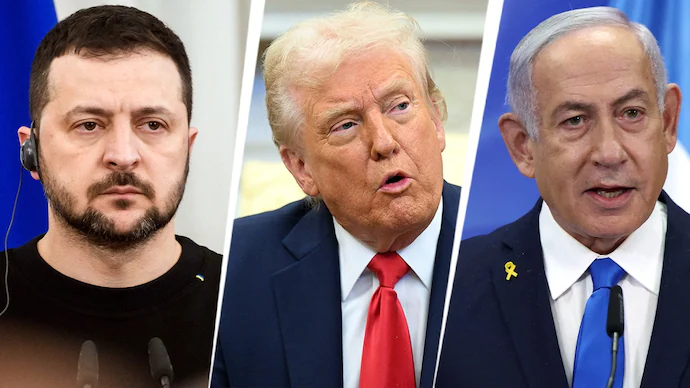
A Crisis of Legitimacy: The Shared Desperation of Three Leaders
This simultaneous chaos on the global stage stems not from the personal obsessions of leaders, but from the massive structural crises within the countries they govern. There is no strategic brilliance behind Trump’s foreign adventures in 2026 targeting Venezuela, Greenland, and most recently Iran. These are all desperate steps taken to salvage plummeting approval ratings and suppress the fear of losing Congress in a critical election year. Having spiraled into a state where voters cannot control the government, and the government cannot control the voters, the US has ceased to be a reliable ally for Europe.
The exact same spiral of structural desperation applies to Israel and Ukraine. The decisions made by Netanyahu and Zelenskyy lead them to take increasingly radical risks just to stay in power amidst domestic crises. Their political positions are so untenable that they are willing to set their regions on fire merely to extend their own political lifelines.
A New Security Paradigm for Eurasia
As it becomes increasingly clear that the NATO axis can no longer protect Europe, Desai issues a historic warning: It is impossible for Europe to defeat Russia by arming itself to the teeth, and attempting to do so will only be a self-destructive enterprise.
Europe’s true security lies not in militarization, but in the strategy -whose foundations were laid during the Angela Merkel era – of building good relations with all its Eurasian neighbors, including Russia and China. This ‘win-win’ strategy, which carries zero cost to society, will not only save Europe from ruin but will also grant the entire supercontinent its true strength.