


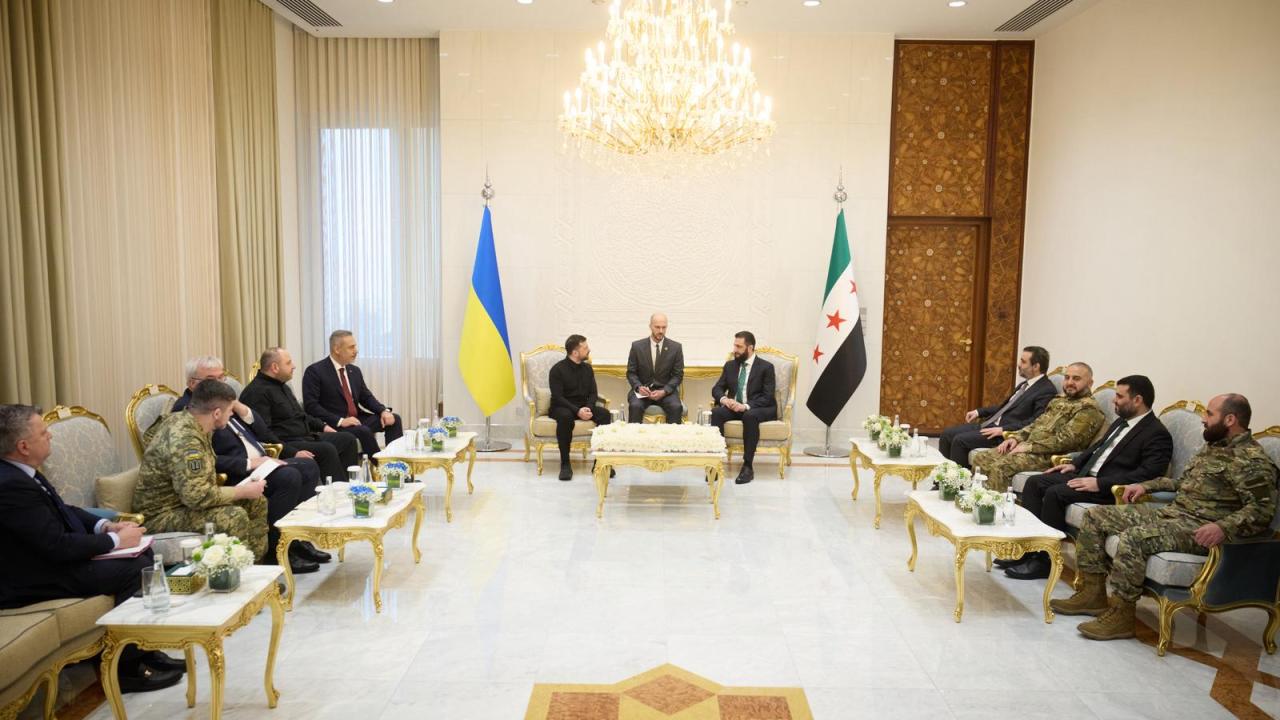
An attention-grabbing, and somewhat “surprising” meeting took place in Damascus. On April 5, Turkish Foreign Minister Hakan Fidan, Syrian President Sharaa, and Ukrainian President Zelenskiy came together. Zelenskiy had visited Türkiye on April 4, where he met President Erdoğan, before flying to Damascus.
The meeting took place at a time of rising tensions in the Black Sea. A Turkish tanker had been targeted, and it was being discussed that it may have been attacked by Ukraine.
UWI author, historian and political scientist Associate Professor Mehmet Perinçek evaluated the trilateral meeting in Damascus.
Special reason required to bring Ukraine, Syria, and Türkiye together
Bilateral relations and bilateral meetings can take place between any countries. Between Türkiye and Ukraine, between Syria and Ukraine, between Türkiye and Iraq, and so on. And trilateral meetings between countries that share regional problems, or joint projects are also common. For example, in the Astana process there were Türkiye, Iran, and Russia. Or, due to shared geographical issues, trilateral talks between Türkiye, Syria, and Iraq are also possible. None of this is surprising. But what is it that brings Türkiye, Ukraine and Syria together in a trilateral format?
A special reason is required to bring Ukraine, Syria, and Türkiye together in a trilateral format at the same table. This is not the kind of meeting that can emerge naturally or spontaneously. When we consider what might connect these three countries, we see their unifying factors: alignment with NATO, the UK, Westernism, and pro-American positioning.
When Turkish tankers are hit
In what kind of context did this trilateral meeting take place? In the Black Sea, Turkish tankers are being targeted. Türkiye’s most important projects are under attack: both Turkish Stream and Blue Stream have been targeted in attacks onshore and underwater. Just a few days ago, Serbian President Vučić stated that various explosives had been found near the Turkish Stream pipeline. It is widely known that Ukraine is behind these incidents. We know it, and the Turkish government knows it as well. Yet despite all this, Türkiye brings Zelenskiy to Syria on its own plane and engages in a joint project.
Sharaa’s recent visit to Germany and the UK
To understand what this project is, one must look at Sharaa’s recent European visit. Just before this trilateral meeting, Sharaa visited Germany and the UK. His main messages during these visits were as follows: Iran is attacking Gulf countries. We condemn Iran. Iran is committing a major crime. By closing the Strait of Hormuz, it is pushing the world into an energy crisis. We can play a role in resolving this energy crisis.
Syria–US Energy Symposium in Washington
A few days before Sharaa’s visit to Germany and the UK, a Syria–US Energy Symposium was held in Washington. There, as seen in the statements of both US officials, including Tom Barrack, the US Ambassador to Türkiye and Special Envoy for Syria, and Syrian representatives, one of the agendas was how to foil Iran’s measures in the Strait of Hormuz.
Now, Türkiye and Ukraine are also being added to this agenda. The aim is to put Iran in a difficult position and neutralize the measures it has taken.
The chronology
Looking at the chronology, the picture is very clear: Sharaa’s visits to Germany and the UK (he also met with the British King), the energy symposium in Washington, Zelenskiy’s visit to Türkiye and his fly to Syria by Turkish plane for the trilateral meeting, and finally Turkish Foreign Minister Hakan Fidan’s meeting with Tom Barrack after returning from Syria. Throughout this entire process, the position and influence of the US and the UK are clearly visible.
Indeed, the Turkish government’s recent pro-NATO policies were also indicative of such an attitude. Today, Türkiye has reached a point where Ukraine is striking Turkish tankers and targeting Türkiye’s energy security, including attacks on Turkish Stream, yet despite this, Türkiye flies Zelenskiy to Syria and engages in new.
Projects against Iran
It is important to note that these meetings are not merely routine economic relations or standard project-based cooperation between countries. The objective is to roll back Iran’s gains and ongoing successes in the region. Indeed, it has also been reported that Syria has requested Ukraine to help strengthen its air defense systems against Iran.
Even more far-reaching scenarios are being discussed. We hope they are not true. There are foreign militants who were once used during the period of Assad’s overthrow and who are now causing problems for Sharaa in the country. It is also being discussed that these forces could be transferred to Ukraine to take part in the war. Such developments would sabotage Turkish–Russian relations, pave the way for Western dominance in the Black Sea and the encirclement of Türkiye.
Behind the convergence of these three countries stand the UK and the US, their projects against Iran, Türkiye, Russia, and the Turkic world. Türkiye’s participation in such an initiative is deplorable and suggests that the Turkish government is increasingly drifting away from Türkiye’s national interests under Western influence.
And Türkiye is doing this at a time when many countries are moving away from NATO, and when Zelenskiy is no longer viewed as a credible figure anywhere in the world. This offers an insight into the government’s capacity to manage Türkiye’s strategic affairs.