


US president Trump claims to reinforce the Monroe Doctrine, exclusion of non-continental powers for the Americas. But Latin American countries have taken a step that might challenge that in the long run.
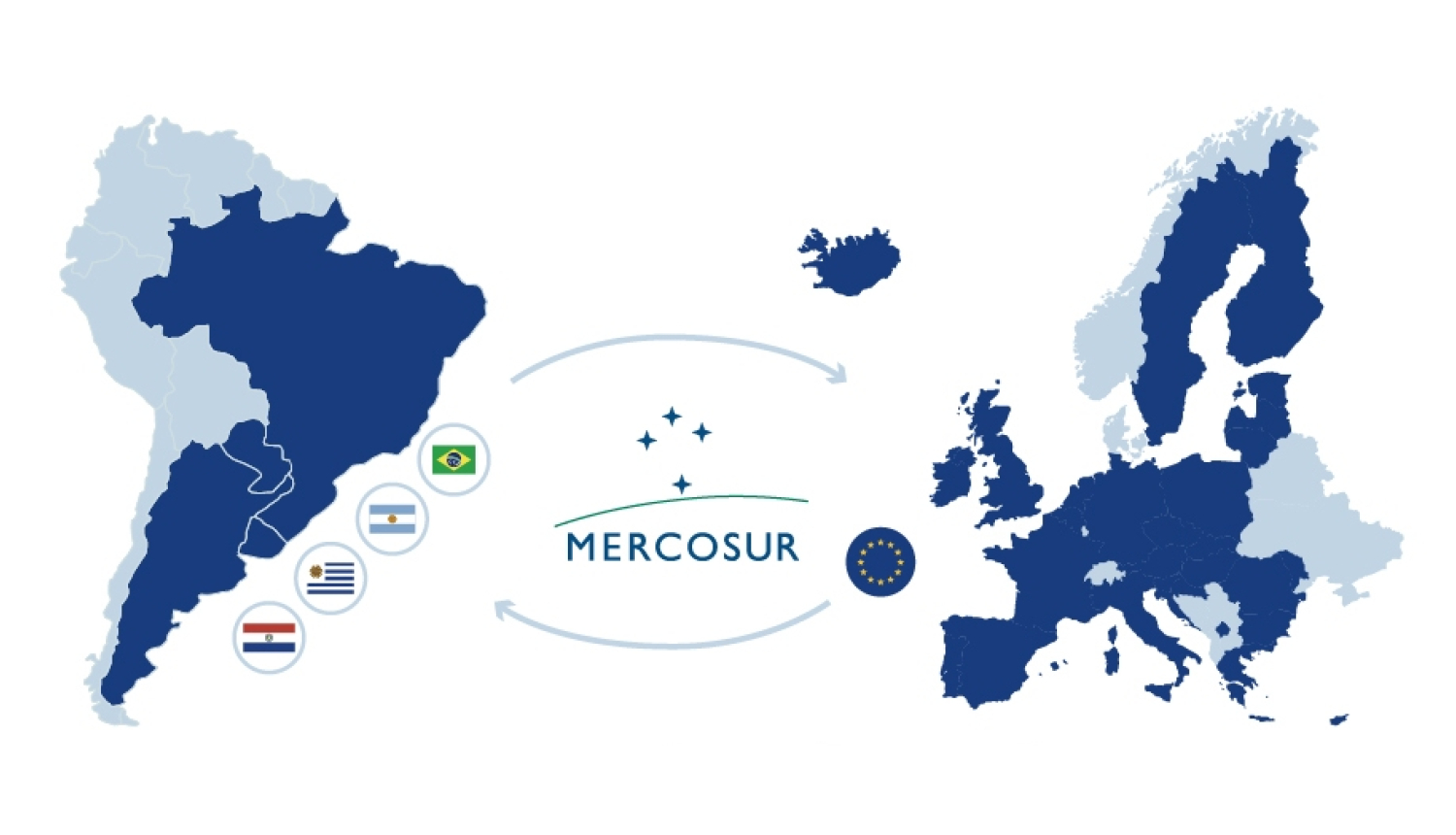
On January 9, a qualified majority of the members of the European Union has approved the free trade agreement with Mercosur, creating the world’s largest free trade are covering over 700 million people.
The Southern Common Market, as it’s translated to English, Mercosur unites a population of approximately 300 million and a GDP of 6.6 billion US dollars, placing it at 6th place among the world’s economies. All major economies of South America, Brazil, Argentina, Uruguay, and Paraguay are members, while others, such as Colombia and Chile, are associated to the common market. Venezuela’s full membership has been suspended since December 2016.
The agreement was in negotiation and debate since not less than 25 years. Opposition rose on both sides of the Atlantic, with European countries such as France, Poland Austria and Hungary resisting till the last minute.
The agreement is both, a traditional free trade agreement that includes tariff elimination and market access, as well as broader partnership regarding sustainability, climate crisis and mechanisms for governance.
Both sides will eliminate more than 90% of tariffs in their bilateral trade, creating a free trade zone that makes up 25% of the global GDP. For certain goods, such as Argentine beef, quotas are established, increasing export potential.
The agreement also facilitates access to government procurement, establishes inclusion of the Paris Agreement on Climate Change as an “essential element”, with leaving the agreement leading to suspension of free trade.
According to the European Union, the agreement will also boost trade and investment on both sides, advancing dispute resolution mechanisms.
Atlantic Council: Trump is to be blamed
US president Trump is to “blame” that the agreement achieved the majority despite long negotiation process and opposition, says the Atlantic Council. The authors argue that Trump’s tariffs against the European Union, his National Security Strategy and his aggression against Venezuela pushed the agreement “over the edge”.
“For Mercosur leaders and their citizens, the contrast could not be starker: In the same week that the United States conducted a military operation against a neighbor, the EU has finally agreed to a significant trade pact based on the rule of law”, says Frances Burwell here.
The US government did not react openly to the agreement. Reactions from US media and organizations were somewhat muted.
A study of the US Trade Commission from 2022 found that the agreement would have measurable competitive effects for specific U.S. export sectors, especially agriculture and processed goods, but does not produce large national GDP or welfare shifts for the U.S. in aggregate according to the USITC model simulations.
Still, today, U.S. trade policy is increasingly transactional, focusing on reshaping global supply chains through tariffs and bilateral leverage rather than negotiating new comprehensive trade agreements with third parties like Mercosur — which creates space for the EU to act independently, argues the Council of Foreign Relations.
“The EU would reach a status comparable to that of the US and China”, predicts the Spanish Elcano Institute.
Besides, conditioning free trade to the Paris Agreement, one that the Trump Presidency has cancelled, indicate a growing leverage of the EU over Latin America.
This is furthermore highlighted by the fact that Argentine President Milei, a staunch Trump ally, has strongly supported the agreement.
Process ahead
The approval by a majority of EU countries is just the most recent steps, more are pending. There is a distinct path for the Interim Trade Agreement, including only EU competences, and the Full Membership Agreement that also touches on national authorities.
On the European side, once the European Parliament approves it, the ITA enters into force conditionally. For the FMA to become valid, national legislations on both sides must approve it.
This process, especially for the complete free trade agreement, might take even years, as happened with the EU’s part trade agreements.
Many on the left have criticized the agreement as part of a neoliberal order, while on the order, especially in Europe, traditional forces such as farmers feared losing ground to competition.
From a geopolitical perspective, though, the advance of the agreement indicates the EU intends to keep and deepen its role on the Latin American continent.
The US armed intervention to maintain supremacy might soon be challenged, after China, by the Europeans as well.