


By Mohammad Reza Moradi, General Director of Mehr News Agency’s Foreign Languages and International News Department, from Tehran / Iran
Strategic analysts know well that the collapse or severe weakening of a key actor in an unstable region such as the Middle East never leads to a simple power vacuum. Such an event is always accompanied by a geopolitical explosion whose shockwaves target the stability of all neighboring states. The potential defeat of the Islamic Republic of Iran, regardless of political positions toward Tehran, evokes precisely such a scenario. For Türkiye and many Arab governments, this situation constitutes a vital and multidimensional threat. The reason for this must be sought in the interwoven nature of Middle Eastern security and Iran’s role in regional equations.
The repeated threats by the United States and the Zionist regime regarding a military attack on Iran are not merely warnings to Tehran. In reality, these threats are an alarm bell for all countries in the region. In an interconnected security environment, insecurity behaves like a contagious virus, and political borders cannot prevent its spread.
The Breakdown of the Deterrence Barrier and the Shift in the Balance of Power
Over the past four decades, Iran has become an important deterrent factor against Israel’s expansionist ambitions. This deterrence is not realized solely through Iran’s long-range missile capabilities. A complex network of regional groups and forces known as the Axis of Resistance, in which Iran plays a core role, has in practice become a strategic barrier against unilateral actions by Tel Aviv. Severe weakening or removal of this central core would mean the breaking of this barrier.
Under such conditions, the Zionist regime would see itself freed from its primary regional obstacle. This release could lead to increased recklessness and aggressive actions throughout the region. Without the presence of a centralized deterrent power, Israel would no longer need to calculate the costs of intervention in Lebanon, Syria, Iraq, or even within the occupied Palestinian territories. Scenarios that today are discussed only in extremist Israeli right-wing circles could be transformed into operational plans.
The deep concern is that, according to statements by Zionist officials themselves, after Iran is contained, the turn will come for other regional countries, including Türkiye. This is an ambitious yet explicit threat.
Transboundary Instability and the Approaching Security Storm
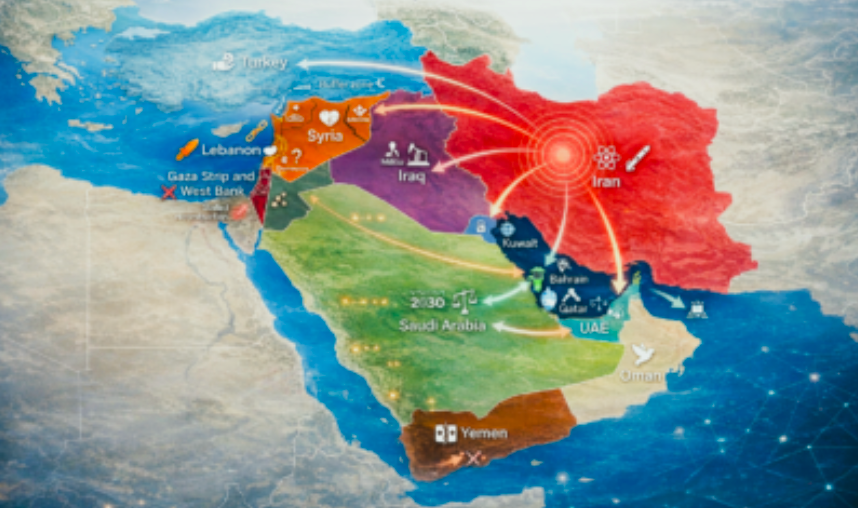
A large-scale attack on Iran would never remain limited to a bilateral confrontation. Iran’s leader has clearly stated that the response to such an attack would be a regional war. The meaning of this declaration is entirely explicit. U.S. bases in Iraq, Syria, and the Persian Gulf littoral states; vital energy facilities; the Strait of Hormuz and international shipping; and the regional allies of the attackers could all be exposed to retaliation.
This expansion of the conflict means the ignition of a fire that recognizes no borders. The Arab states along the Persian Gulf, due to geographic proximity and absolute dependence on maritime routes and energy infrastructure, would be severely vulnerable. A regional war would mean the suspension of trade, disruption of energy lines, maritime insecurity, a new wave of terrorism, and large-scale population displacement. No country in the Middle East would be able to preserve itself as a safe island amid this storm.
Radicalization and the Crisis of Sectarian Identities
Iran’s political structure is based on a Shiite ideology that stands in opposition to Salafi and Wahhabi currents. The existence of this state has, in a sense, created a balance within the Islamic world. The collapse or severe weakening of the central government in Tehran could lead to deep internal chaos and separatism.
Under such circumstances, extremist ethnic and sectarian paramilitary groups inside Iran would find room to emerge. These groups could, by establishing cross-border links with similar groups in Afghanistan, Pakistan, Iraq, and Syria, create a vast and uncontrollable belt of instability. For Iran’s neighbors, this situation would be a nightmare.
For the Arab states of the Persian Gulf region, which see themselves in ideological confrontation with Iran, the emergence of stateless, unpredictable extremist groups could be more dangerous than a negotiable central government. The radicalization resulting from this situation would threaten the internal security of all these countries.
Intensified Competition and Escalated Proxy Warfare
Iran today is one of the principal parties in regional equations. The sudden removal of this party would create a power vacuum that regional and extra-regional actors would rush to fill through intense and dangerous competition. Türkiye, Saudi Arabia, and Israel each possess different visions and interests in this space.
This competition could lead to direct confrontation or to broader proxy wars across Iraq, Syria, Lebanon, and Yemen. A region already worn down by proxy wars may witness an unprecedented intensification of these conflicts. In this context, the Zionist regime would attempt to exploit the emerging situation to consolidate its hegemonic position and weaken its regional rivals.
This situation would constitute a destructive scenario for Türkiye, which seeks leadership of the Islamic world, and for Saudi Arabia, which seeks to consolidate leadership of the Arab world.
Energy Crisis and Economic Disintegration
The Persian Gulf is the world’s energy artery. Any large-scale conflict involving Iran would turn the Strait of Hormuz into a critical flashpoint. Iran could temporarily or permanently disrupt traffic through this vital strait. Even if such action were not taken, increased insecurity and rising insurance costs for shipping would push oil prices to unprecedented levels.
Developing economies that are heavily dependent on imported energy would come under unbearable inflationary pressure. Although the economies of oil-exporting countries might benefit in the short term from higher prices, long-term instability would drive away foreign investment and destroy their development plans.
In addition, Iran is an important market for the goods and services of countries such as Türkiye and several Arab states. War and the sanctions that would follow would destroy these economic relations and intensify unemployment and recession across all neighboring countries.
Conclusion
The strategic threats arising from the potential defeat of Iran for its neighbors are rooted in a simple reality: in today’s Middle East, security is an indivisible commodity. One cannot draw a border and declare that instability will remain on one side. Crises cross borders.
Iran, despite all disagreements, has become part of the region’s complex and fragile security architecture. The sudden destruction of one component of this architecture would cause the entire structure to collapse. Understanding this shared fate is the first step toward avoiding catastrophe.
Weakening Iran is not a strategic victory for its neighbors; rather, it marks the beginning of an era of deeper instability, bloodier competition, and the uncontested hegemony of the Zionist regime. The future of Arab countries and Türkiye is tied to the relative stability of the region, and regional stability is inconceivable without considering Iran’s role. Therefore, the rational approach lies not in further weakening this actor, but in managing differences and striving to create a collective security order that, as far as possible, secures the interests of all stakeholders. Ignoring this reality is a prelude to full-scale chaos, whose primary losers will be all the peoples of the Middle East.
A very important point is that Israel and the United States have for years been attempting to create division and fragmentation among key countries in the region. From this perspective, Iran, as a pivotal power in the Middle East, is a natural target of these plans. The collapse or severe weakening of Iran would not only lead to internal instability and transboundary crises, but would also pave the way for the realization of unwritten extra-regional objectives, including the creation of a Kurdish state, or what is referred to as a “second Israel.”
This scenario would place Türkiye directly under threat—a country that is geographically, economically, and politically one of the region’s key actors—and any fragmentation or instability in Iran could lead to a wave of internal pressures and ethnic challenges within Turkish territory. For this reason, the scenario of Iran’s disintegration is not merely an internal crisis, but a strategic threat to regional security and to the stability of major actors such as Türkiye as well.