


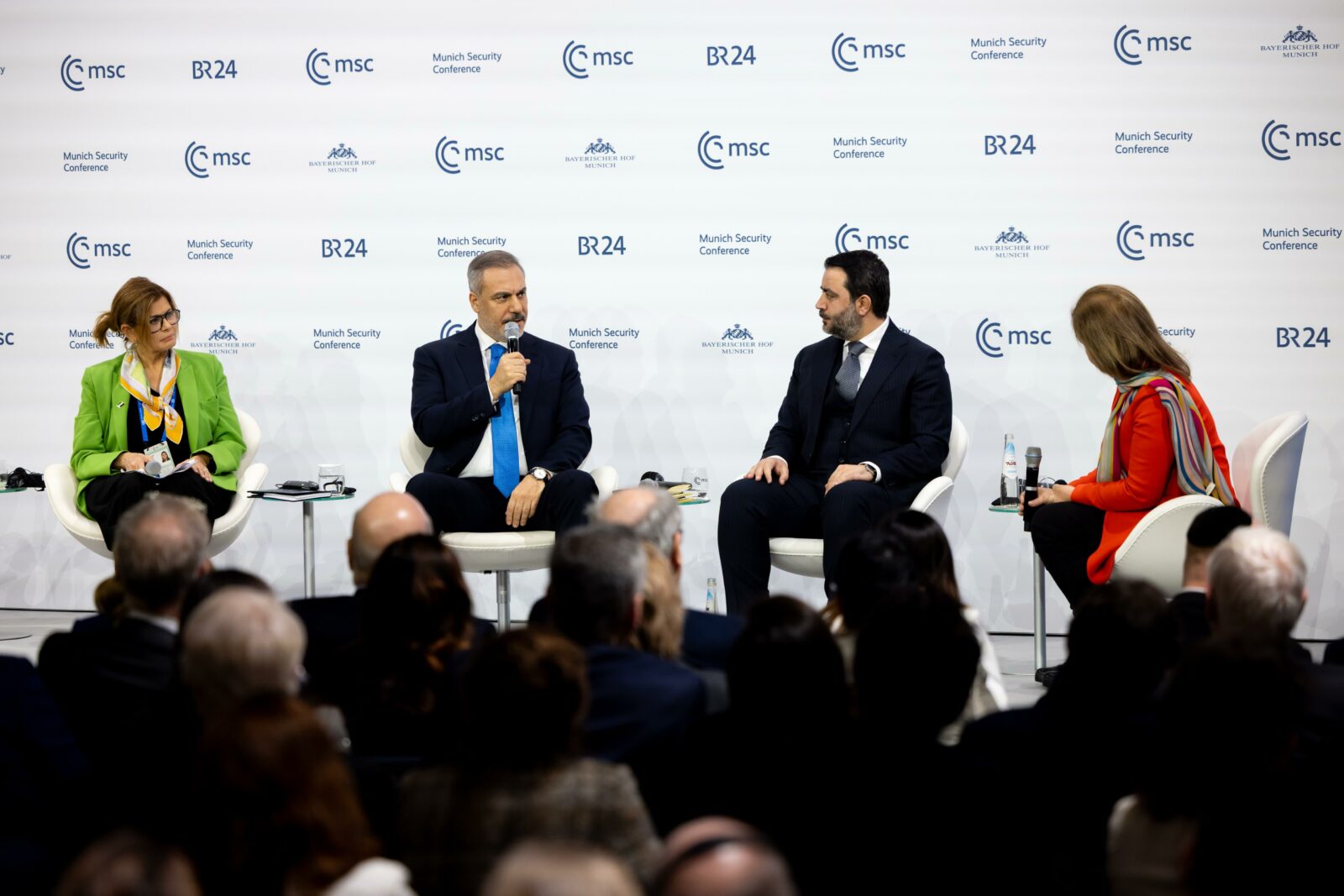
By Adem Kılıç, Political Scientist
The Munich Security Conference, held in Germany and considered one of the most critical meetings in Europe in recent years, was a turning point not only in terms of the war in Ukraine or the future of NATO, but also in terms of showing the critical threshold reached in discussions on Europe’s defense independence.
Statements made throughout the conference and messages from leaders revealed that Europe’s military dependence on the US remains at a critical level, while also clearly showing that Türkiye’s defense industry and military power are becoming increasingly central to European security.
Discussions on “European security” at the Munich summit
The headline that dominated the conference was undoubtedly the future of the US’s role in European security.
The US’s demand in recent years, under Trump, that its European allies shoulder more of the defense burden is not actually a new situation.
However, the Trump administration’s transformation of this demand from rhetoric into a strategic pressure tool has led to a serious crisis of confidence in European countries and has become an existential problem for a continent already facing economic and structural problems.
Indeed, while the common emphasis of many European leaders in Munich was the imperative to strengthen European defense, the second striking reality in these leaders’ speeches was that this goal is not achievable in the short term without the US.
In particular, it became clear that Europe’s dependence on the US in areas such as US weapons, intelligence, satellite networks, missile defense, electronic warfare, and air superiority cannot be overcome in the short term.
Obstacles to Europe’s defense independence
Although European countries have consistently voiced similar sentiments over the past four years since the Russian war and have taken certain actions, serious structural obstacles remain in the way of Europe’s goal of strategic autonomy in the defense sector.
Europe’s technological dependence on the US in the defense industry is at the top of the list. Although European countries can produce many platforms, they remain dependent on US technology for critical components.
Another major problem is the politically fragmented structure in Europe.
For example, while Eastern European countries view the Russian threat as existential, countries in Southern Europe consider instability and migration in the Mediterranean to be a greater risk. This difference in threat perception also complicates joint defense investments.
Another major obstacle is the issue of defense industry production and financing.
This is because the defense budget and production volume of the US alone produce much more effective results than Europe’s total capacity.
At the Munich Conference, this problem, which was clearly expressed by many leaders, notably French President Macron, revealed that Europe’s defense independence cannot be achieved in the short term.
The reality of Türkiye in European security
Although Türkiye was not directly on the main agenda at the conference, it was brought up as a critical actor in many sessions.
Türkiye’s role was particularly prominent in the areas of NATO’s southern flank security, Black Sea balance, counterbalancing Russia, and defense industry cooperation.
Leading publications such as Politico, Foreign Policy, and Reuters published analyses stating that European officials described Türkiye’s military capacity within NATO as “indispensable” in closed-door meetings.
However, this time, these assessments were not solely based on Türkiye’s geographical location, as they had been for decades. At the same time, the realities of Türkiye’s growing defense industry power, operational capability, combat experience, and defense production capacity began to be voiced.
This is because, especially after the Russia-Ukraine war, Türkiye’s superiority in unmanned aerial vehicles, ammunition production, and its increasing capacity in land platforms began to be examined more closely by Europe.
In other words, until just 5–10 years ago, these countries, despite Türkiye being a NATO member, imposed sanctions on Türkiye in the field of defense industry. Following these developments, they have become more aware that Türkiye is an indispensable actor and a partner that should not be lost. Türkiye’s ability to produce in accordance with NATO standards, develop non-US technology, possess mass production capacity, offer cost advantages, and have tested its systems in real combat environments has increased its strategic value for Europe
Considering that one of Europe’s biggest problems is its low production speed and its inability to quickly implement mechanisms within the union in this regard, the importance of Türkiye’s position has become even more apparent.
During the war in Ukraine, after transferring ammunition from their stockpiles in the early years of the war, European countries faced a crisis in increasing their production speed in order to replenish their stockpiles and provide more support to Ukraine, clearly demonstrating this reality.
During this process, Türkiye proved to be one of the few NATO countries capable of producing quickly and increasing its production.
At this point, the level Türkiye has reached in the defense industry now carries strategic meaning and importance for Europe as well.
This is because its emerging capacity in unmanned aerial vehicles, ammunition, missile systems, naval platforms, armored land vehicles, electronic warfare solutions, and air defense has elevated Türkiye from being merely a market to a position of being a strong producer.
On the other hand, cooperation with Türkiye has begun to offer significant opportunities for European defense companies in terms of both cost reduction and production acceleration, and this situation has become vital for a Europe seeking to break free from its dependence on the US.
Conclusion
The Munich Security Conference clearly revealed the reality that Europe cannot achieve an independent security structure without the US in the short term.
In addition to all this growing defense industry power, Türkiye is located at the center of NATO’s southern flank and forms a strategic bridge between the Black Sea, the Middle East, the Caucasus, and the Mediterranean.
At the same time, Türkiye, which has NATO’s second-largest army, is almost the only European country with real operational experience.
Of course, discussions on Europe’s defense independence will continue in the coming period.
However, in light of all this data, the following observation will always remain valid.
European security can never achieve strategic autonomy without Türkiye, and Türkiye, with its identity as both a regional power and a strong defense producer, will now emerge as both a regional power and an indispensable partner.