

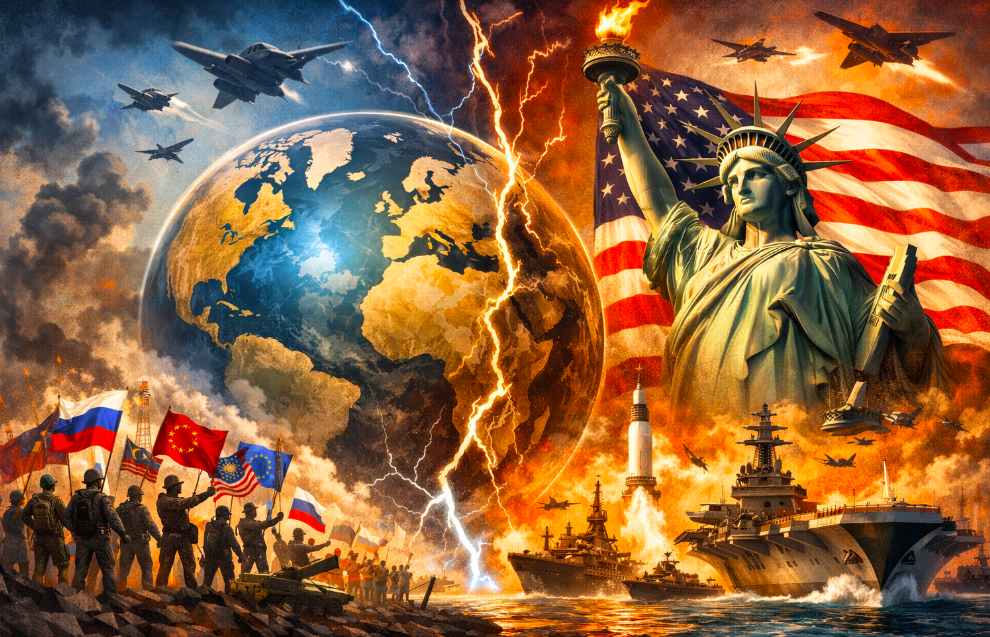
The far-right, neo-fascist sector that has seized control of the US administration and imposed its expansionist logic and ambition for global domination has begun to make its plan public. The fascist unipolar international system that has been imposed on the world is producing a regression of the international order unlike anything ever seen before. Not even the previous version of unipolarity established by George W. Bush in 2001, which held sway until 2008, had the current characteristics. On that occasion, Washington set out to, and succeeded in, bringing the entire world under its control through the fight against terrorism.
But now the conservative backlash has not only brought back unipolarity but has done so tied to the Nazi-fascist ideology that permeates the White House without apparent opposition, at least in the short term. Although many strive to maintain that we are in a multipolar phase of the international system, the truth is that, under Donald Trump, at the end of his first year in office, it is clear that the world order built by the United States itself after World War II has collapsed. International law no longer exists, and the UN is an empty building, devoid of any relevant role beyond that dictated by the Security Council and its veto power.
In the process, Trump dismantled the Western alliance, brought NATO to the brink of collapse, restored ties with Russia, and led his country to withdraw from approximately 70 multilateral organizations and agreements. All of this occurred after the far-right sector, which rejects democracy, promotes violence and a cult of personality around Trump, and champions an exclusionary and expansionist nationalism, assumed control of US foreign policy.
Led by Marco Rubio and Stephen Miller among others, the fascist far right is pointing the way for the United States’ ideological path towards building and strengthening a unipolar world in which Washington is the only active power making decisions in the world while others are preoccupied with serious existential problems in their environment.
In an interview with CNN, Stephen Miller, Donald Trump’s deputy chief of staff, bluntly explained the armed intervention in Venezuela: “You can talk all you want about international details, but we live in a world, the real world, that is governed by force, by power. The United States uses its military power to unapologetically guarantee our interests in our hemisphere. We are a superpower, and with President Trump, we are going to behave like one. It is absurd that we would allow a country in our backyard to supply resources to our adversaries, and not to us.”
At the end of the last century, when the structure that the world should acquire after the end of the Cold War was being managed, the debate revolved around multipolarity and unipolarity, which ended up being imposed after September 11, 2001. Today, although the discussion is similar, the reality is that – for different reasons – the trend is towards the construction of a Balance of Power system.
The United States seeks confrontation because it knows that through force it can destroy the planet, but not China or Russia. China, because it manages its foreign policy on a different timescale than the West and believes the conditions for confrontation are not right; moreover, it prefers—for philosophical reasons—the pursuit of harmony and balance. And Russia, because despite its extraordinary military power that allows it to preserve itself and prevent its rivals from overwhelming it, needs to rebuild its economy, for which it must conclude the special military operation and reshape its alliances. Furthermore, other powers have emerged that aspire to a more prominent role within the international system.
The most sensible course of action for the three powers is to establish a balance of power. In his ruthless pragmatism, Trump knows he cannot maintain total hegemony and attempts to take refuge—successfully so far—in controlling Latin America and the Caribbean, trying to guarantee his country’s predatory and consumerist lifestyle. To achieve this, he needs to devastate the planet to satisfy his current or future needs, especially those related to energy. They do not believe in multipolarity or multilateralism because they need impunity to commit their misdeeds. Their logic is that if Russia carries out its special military operation in Ukraine and China publicly demonstrates that it will not allow Taiwan’s secession, they can bomb Venezuela and kidnap its president. Likewise, they consider it acceptable to seize the Panama Canal or Greenland and starve nearly 10 million Cubans to death.
And Europe? It no longer plays on this chessboard because it is not independent: its economy depends on China, its energy on Russia, and its security on the United States. Having lost the latter two, it clings with disgust to the first because it has no other option. Within a few years, Europe will cease to be a relevant international actor and will no longer be able to play a role in the balance of power.
All of this was clearly demonstrated at the recent Munich Security Conference held between February 13 and 15, where the foundations of the existing unipolar system were laid out and some hints were made about the Balance of Power.
The destruction of the international system established in 1945, largely due to the actions of the United States government, which has set out to dismantle everything in place, has made it clear that peace as an option is slipping further and further away from the international system. Trump, who has proclaimed himself a messenger of peace, has in reality been adding fuel to the fire.
The instructions for his actions appear to come from Marco Rubio, who, already in the midst of an election campaign, is setting the guidelines for his country’s foreign policy. His speech in Munich established the model for the new Nazi-fascist unipolar system that has begun to prevail in the world. Rubio’s pathological resentment, which leads him to imagine himself as white and blue-eyed, drives him to propose a global reorganization based on civilizational, hierarchical, and supremacist criteria.
To that extent, his speech focused on the unequivocal leadership of the United States and the West, portrayed as a supreme power threatened by migration, multilateralism, and the redistribution of global power. He even went so far as to send a message to Europe, stating that “the United States is prepared to act alone, but ‘prefers’ to do so alongside its allies.” In this way, he established a vertical relationship even with his European partners, who have yet to awaken from their subordinate status. Similarly, Rubio proposes to reform the UN to make it more manageable for US interests; otherwise, it would simply have to be eliminated. This task was already initiated by Washington with the creation of the Peace Council, welcomed even by Russia, in an apparent gesture toward the balance of power.
In this context, Rubio’s proposal to maintain dialogue with China and negotiate an end to the conflict between Russia and Ukraine should also be considered, as it seeks to preserve the harmony necessary for a potential balance of power. Thus, the Secretary of State only mentioned Ukraine once during his speech, and that was to emphasize American leadership in bringing Russia and Ukraine to the negotiating table.
For Rubio, all options are on the table. These signs indicate that if—as everything suggests—the United States, just as at the beginning of the century, fails to maintain unipolarity, the Balance of Power is an option. But even multipolarity has been considered as an alternative, but only as a space for controversies to maintain and deepen Washington’s power. As analyst Federico Pita points out in the Buenos Aires-based Página 12 website, in that context the United States would try to “buy time, rebuild alliances, and reorganize production chains to preserve its technological and military primacy.”
However, Rubio also does not dismiss the possibility of a return to a bipolar world in which ideology plays the organizing role in international relations. In his speech in Munich, he introduced the notion that the West was a “victim” of its own decline and that the United States must prevent it by fighting the new enemy, which, according to him, is the Communist Party of China. He even went so far as to say that decolonization had been a “communist plot” that destroyed five centuries of hegemony that had allowed the West to bring civilization and a superior culture to the world, thus denying what history itself has demonstrated. It is worth noting that at this point he received fervent displays of support and continuous applause from the European delegations, who bowed before him.
The impact of this speech reverberated across the globe. Norwegian geopolitician Glenn Diesen stated that this address manifested “an open ideological war against multipolarity” and added that Rubio’s rhetoric was an expression of “a declaration of war against sovereign equality,” noting that such language revives 19th-century mentalities in a 21st-century world.
For his part, Kanwal Sibal, former Indian Foreign Secretary and Chancellor of Jawaharlal Nehru University in New Delhi, declared conclusively that: “This is effectively an ideological attack against the rest of the world,” given that “Rubio is building a new kind of empire where Washington would be the absolute master of the international order.” Sibal said that Rubio’s diagnosis outlines a dangerous strategy in which the United States intends for “the world to accept its single version of history, completely ignoring other perspectives.”
With this speech, Rubio definitively postponed cooperation to give way to hegemony as the main instrument of diplomacy, also dragging the world into unipolarity as a system in which only subordination and submission to Washington are valid.
In another distinctive feature of unipolarity, the BRICS group, which was supposed to be the main alternative to the current international system, has also shown complete ineffectiveness. Although it has expressed opposing views, it has remained completely silent in the face of the imperialist aggression of the Nazi-fascist government of the United States against two of its members, Iran and Cuba, limiting itself to individual actions by some of the group’s member countries.
Thus, the planet is once again grappling, for the fourth time in the last 35 years, with systemic instability that reflects the inability to make the planet a place of peace, harmony, and concord. The existence of the United States as the sole hegemon, threatening the world with its expansionist ambitions and its desire to dominate and subjugate the planet, offers only war, destruction, and death.
The alternative is the struggle for life and for peace, and to ensure that the goodwill of the majority of the world’s peoples defeats, just as it did in the middle of the last century, these predatory and destructive ambitions emanating from Washington today, as they did from Berlin yesterday.