


By Ismet Özçelik Ankara correspondent of Aydınlık newspaper, from Tehran / Iran
Invitation to the 47th anniversary events
The 47th anniversary of the Iranian Revolution was February 11. I was invited to attend the anniversary events in Tehran. I was there from 10th to 12th February.
Before leaving for Iran, I received many warnings. “The US and Israel could strike at any moment. Bombs could start falling while you’re there. The airspace could be shut down. Flights might be suspended. What will you do then? You could be stuck there, unable to return,” they said.
I had concerns as well. Could Washington launch an attack right in the middle of the celebrations? What would I do if the airspace closed? And what if CIA or Mossad agents attempted to turn the commemorations into a bloodbath? Of course, those possibilities crossed my mind.
But his year’s anniversary was particularly important. since it was the first since the “12-Day War” and the bloody street protests. How would public participation be? From a journalist’s perspective, observing it firsthand was a big opportunity.
In the streets of Tehran
We landed in Tehran at night on February 10. Early the next morning, we were in the streets.
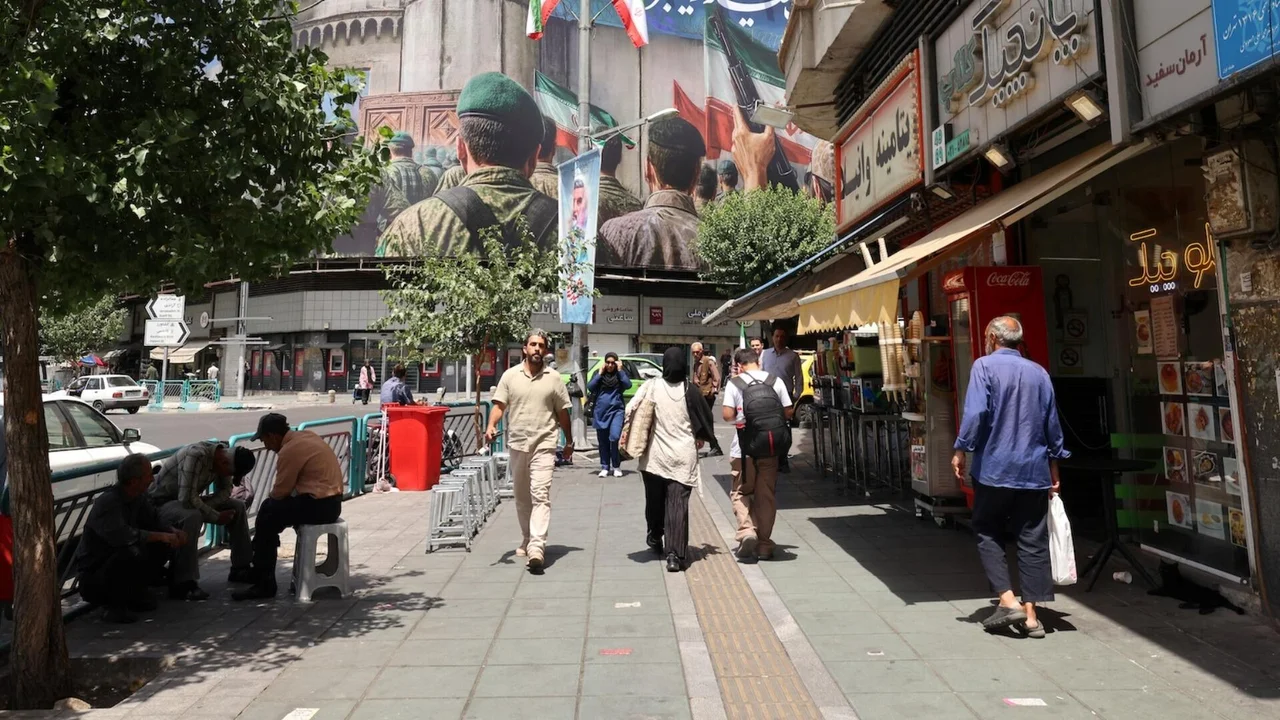
And all our concern evaporated. People were in their daily routines. Shopkeepers had opened their stores. Traffic was alive. It felt no different from Ankara or Istanbul. Life was in its usual rhythm.
We spoke with people in the streets and to shopkeepers. They voiced their economic distress.
But when it comes to the possibility of a US or Israeli attack, their tone shifts immediately: “We may have different political views,” they say. “But on this issue, we are united. We won’t give up an inch of our land to the US or Israel. We’ll do whatever is necessary for our country.”
Before arriving, I had been especially curious about one thing: Were people anxious? Were they able to sleep peacefully at night? I can say this clearly now: Iranians are not afraid of the US or Israel. Not at all.
The headscarf issue
Women have a strong place in Iranian society. Within the family their voices carry weight.
As for the headscarf issue, frequently instrumentalized by the West, I found that it is already settled. Women walk in the streets without headscarves, even in some neighborhoods, the ratio of women having headscarves was fifty-fifty. No one appears to be judging anyone else.
Palestine Square
We made our way to Palestine Square.
Hanging above the square was a massive map of Israel. Across it a message read in three languages: “You start it, we finish it.”
We saw specific targets were marked on a map. In the event of an attack, these were said to be targets. How were those targets chosen? No one offered details. The standard reply was “Netanyahu knows it”, with an implied message to Israel: We know everything about you, and we have targets right in our grasp.
There is also an illuminated countdown clock in the square symbolizing the time they take to be Israel’s remaining lifetimes. During the 12-Day War, it was reported to have been struck. Yet it still stands.
What do they say about the assassinations of commanders?
Will there be an attack? How prepared is the government? These were the questions we sought answers to most.
We say that many of the vulnerabilities during the 12-Day War had since been addressed. Metro stations and parking garages have been prepared as potential shelters in the event of airstrikes.
It seems that most CIA and Mossad networks have been dismantled. Air defense systems have been reinforced. Missile production has been increased to three shifts per day.
As for the assassinations of senior commanders, we were told they had only hardened their resolve. They say: “For a soldier, martyrdom is the aim. We are not afraid of it. But now the situation has changed. Our priority is no longer to become martyrs. It is to avenge our friends.”
“Dash hopes of the enemy”
The commemorations were held nationwide. Before, Ali Khamenei issued a public call. His message was: “The people’s resistance is stronger than missiles. The people must take to the streets and dash hopes of the enemy”.
And the day February 11. The march was scheduled to begin at 9:30 a.m. We were in the streets an hour earlier. The starting point was Enghelab (Revolution) Square and the main stage had been set up at Azadi Square.
It was a long stretch. Too long to walk. We took the metro. It was packed. We got off three or four kilometers before the square. From there on, the avenue was a tide of people. Women and men, young and old. Families everywhere, and babies in their parents’ arms.
There were stages along both sides of the road, almost one every fifty meters. Students performed shows. Artists recited elegies. Military bands played marches. Thousands were involved in organizing the event. Tea and soup were distributed to the crowd. People shared food they had brought from home. Here and there, you could see speeches delivered.
The crowd kept swelling. “Azadi Square and its surroundings are completely full, it stretches over ten kilometers,” people told us. Millions of people, I suppose. It took us three hours to cover three or four kilometers. Reaching the square became impossible. Eventually, we climbed onto the balcony of a municipal building and watched the square from 200 to 300 meters away.
No police or soldiers in the Square
We were not stopped even once by police control. So how was security maintained? There were no police officers or soldiers. What if a provocation occurs? Watching the crowd, I saw no sign of worries. The celebrations attended by millions concluded without a single negative incident.
President Masoud Pezeshkian, the Chief of Staff and senior commanders, the head of the judiciary, Foreign Minister Abbas Araghchi, and other ministers walked to the square together with the public. After the event, they reportedly left by metro. This can be noted as a sign of unity between government, people, and armed forces.
President thanks Türkiye
The speeches delivered during the celebrations were noteworthy. In his address, President Pezeshkian emphasized in sum: We apologize to our people regarding the economy. The government is ready to listen. We must stay united. Regional problems should be solved by regional countries. The West has unjust demands, and Iran will not bow to them.
He also thanked countries that have been supporting Iran in this process. Türkiye, Saudi Arabia, Qatar, and Egypt. Notably, when expressing gratitude to Türkiye, he mentioned both the President and the Foreign Minister together. I think it didn’t go unnoticed by Iranians.
The missiles displayed in the Square
There were missiles displayed in the Square. Among those, the ones designed for land-to-sea strikes were given particular prominence. The implied target was the “USS Abraham Lincoln”, the US aircraft carrier deployed off the coast of Oman.
During the recent war against Israel, once Iranian missiles began striking Israel, both Washington and Tel Aviv panicked and pushed for a ceasefire. In Iran, there were voices calling for the offensive to continue. But the political leadership opted to prioritize diplomacy.
Israel had relied heavily on its Iron Dome system, but Iran managed to strike the targets. This became a major topic of discussion worldwide. How had Iranian missiles, UAVs, armed drones, and other systems managed to achieve this? Now the US and Israel are pressing hard on the missile issue in the negotiations. Israel is focusing more on missiles than nuclear weapons and demanding that their production be halted and ranges restricted.
“We have new surprises in store”
We were also curious about this topic. In Tehran, we sought answers. We visited a missile, UAV, UCAV and drone museum. A wide array of systems was on display. They explained each to us in detail. We paused in front of one missile in particular. “This is the Fattah missile,” we were told. “One of the missiles that struck Israel, the missile that ended the war.”
Another missile caught our attention. They explained: “We have tested this one, but it has never been used. It is far more effective.”
In every conversation we had in Tehran, the missile issue came up. “If the US and Israel attack,” they say, “we have new surprises in store.” Many citizens have confidence that their missiles could hit US warships and Israeli targets.
Views on China and Russia
The stance of China and Russia was also a widely discussed topic, and it came up frequently in conversations with ordinary citizens.
Some claimed that these countries did support Iran during the war. Many others disagreed, arguing: “Western-leaning academics are trying to drive a wedge between us and Russia and China. They spread anti-Russia and anti-China propaganda. China purchases the majority of Iran’s oil and provides the biggest support to our economy. We are in solidarity with Russia as well.”
Many people recounted similar accounts: After the 12-Day War, numerous cargo flights came and went from China, Russia, and Belarus. This is still ongoing.
When we asked what is being carried with these flights, they said they don’t know.
The Iranian public closely observes Türkiye’s stance against the war and its diplomatic efforts. In a conversation with a citizen, he said: “During the celebrations, our President Pezeshkian first thanked Türkiye. This got my attention.”