


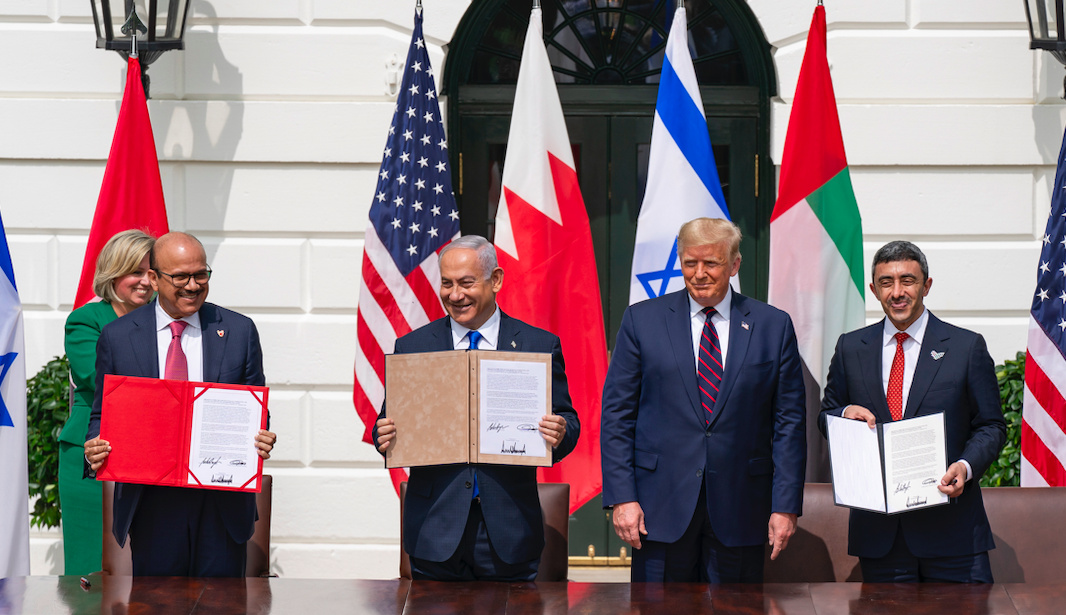
Like everything in the Middle East, the Abraham Accords are being tested by time, the weight of past conflicts, open-ended disputes, and seemingly endless wars. What began as a promise has one day turned into a mirage in the shifting desert of the Middle East. Are we witnessing the curse of the Middle East afflicting the Abrahamic agreements?!
A promise that was not fulfilled
When US President Donald Trump sponsored the signing of the Abraham Accords in 2020, he presented them as one of the most important diplomatic achievements in the Middle East in decades, emphasizing that they were not merely peace agreements between Israel and several Arab states, but a new framework for reshaping the region economically, militarily, and strategically. Upon his return to the White House, Trump repeatedly affirmed that expanding the Abraham Accords was a central priority in his Middle East policy. In recent weeks, he even linked any potential settlement with Iran to expanding the circle of countries joining the agreements, suggesting that their success could pave the way for a new, more stable regional order.
An Unprecedented Test
But five years after their launch, the Abraham Accords are facing an unprecedented test. The war in Gaza, the escalating Israeli-Iranian confrontation, and the growing division within Arab public opinion have all prompted international research centers to reassess the future of these agreements. While researchers at The Washington Institute believe the agreements have demonstrated considerable resilience, and that economic and security relations between the signatory states and Israel have persisted despite political turmoil, they also point out that expanding the agreements to include major regional powers, particularly Saudi Arabia, requires ending the Gaza war and establishing a political horizon for the Palestinian issue.
Other studies concur with this partial assessment but go further, warning that the agreements are built on shaky ground because they bypass the Palestinian issue without offering a sustainable settlement. Several researchers argue that the continuation of the war and the deteriorating humanitarian situation in the Palestinian territories have made normalization more politically costly for many Arab governments, especially given the decline in public support for the idea of open relations with Israel.
The most pressing question today is: Could the Abraham Accords become a casualty of a war with Iran? The answer offered by most research centers is not definitive. Some researchers argue that the Iranian threat was originally one of the main drivers that pushed several Gulf states toward rapprochement with Israel. Therefore, the continuation of the Iranian threat may lead to enhanced security cooperation rather than its dismantling. Conversely, others warn that any large-scale or protracted regional war could make Arab governments more cautious about publicly displaying their relations with Israel, especially if the war leads to economic turmoil or a surge in popular anger in the region.
At A Historic Crossroads
Accordingly, the Abraham Accords appear to be at a historic crossroads. While they haven’t collapsed despite the Gaza war and regional instability, they also haven’t yet achieved the significant expansion the Trump administration hoped for. Their future remains tied to three key variables: the course of the war with Iran, the outcome of the Palestinian issue, and the ability of regional actors to transform shared economic and security interests into a lasting foundation for cooperation that transcends transient crises. Between the optimism of the Trump administration and the caution reflected in research centers, the question remains: Will the Abraham Accords become the cornerstone of a new regional order, or will they become one of the casualties of the turbulent Middle East?
Al-Faisal: Netanyahu’s Blindness is Clear
Saudi Prince Turki al-Faisal asserted that Israel attempted to drag Riyadh into a war with Iran, but Saudi Arabia wisely and prudently avoided this confrontation.
In an article published in Arab News, Prince Turki al-Faisal accused Israel of trying to drag Saudi Arabia into a war with Iran to impose its regional hegemony. Al-Faisal echoed a conspiracy theory currently prevalent in the Middle East and expressed his concern about the Israeli government’s adventurism.
Prince Turki al-Faisal praised Saudi Arabia’s policy in dealing with the repercussions of the war waged by the United States and Israel against Iran, noting that the Kingdom played a pivotal role in preventing a wider regional escalation.
No Longer a Security Pillar
In the article, Turki al-Faisal explained that “for Saudi Arabia, Israel is no longer a security pillar, but rather a source of problems and a threat to the Prince’s strategic vision.” According to Saudi Arabia and Oman, which strongly opposed the war from the outset, “Israel dragged Trump into this dangerous adventure. Saudi Arabia’s message in this case aligns with the prevailing opinion in the United States, which holds that Netanyahu is the one who led them into the war. Even if Netanyahu and Trump were full partners, Israel is perceived by the world as the source of the problems.”
He pointed out that “Netanyahu’s strategic blindness is quite evident. Saudi Arabia had assessed, perhaps even before the war broke out, that Trump and Netanyahu would not achieve their desired goal of toppling the Ayatollah’s regime.”
Saudi Arabia is not part of the game
In his article, Al-Faisal accused Israel of being immersed, from the very first day of the war, in the illusion of a regional alliance against Iran. The media has been constantly debating the issue of Saudi Arabia and the Gulf states joining the military alliance against Iran, but the Saudi leadership is sending a clear message to Israel and the world: “We are not part of your game.”
A destructive policy that hinders normalization
Saudi Prince Turki Al-Faisal emphasized that “the policy led by Netanyahu, which Saudi Arabia considers destructive and dangerous, not only hinders normalization but also destroys what remains of the bridges of communication.”
Strengthening the alliance with Türkiye and Pakistan
At the same time, Prince Turki Al-Faisal affirmed that “the Kingdom is now pursuing quiet diplomacy with Tehran and strengthening its alliance with Pakistan and Türkiye. For Crown Prince Mohammed bin Salman, the economy and stability take precedence over normalization with a country that seems to be hurtling towards endless war, whether in Iran, Lebanon, or the Gaza Strip. It is no coincidence that Saudi Arabia pressured Trump to proceed with a ceasefire in Lebanon, and it was also behind the mediation efforts undertaken by its ally.” Pakistan.
The article also stated that “contrary to what Netanyahu and his partners have been promoting to the public, their policy is not pushing Saudi Arabia to side with Israel; on the contrary, instead of building a broad regional security alliance, Netanyahu and Trump’s move is having the opposite effect.”
The False Expectations
The writer, Danny (Dennis) Citrinovic, former Israeli Defense Intelligence official, argues that the false expectations surrounding Israeli-Saudi normalization must end.
Let’s start with the semantics. Anyone familiar with the relationship between Saudi Arabia and the Gulf states, and the broader regional order, knows that if normalization between Israel and Saudi Arabia occurs, it will not be described as an extension of the Abraham Accords.
From the Saudi perspective, this is not a matter of form or semantics. Riyadh will insist on its own framework, its own conditions, and its own political narrative.But this is the least important issue.
To understand how disconnected the current talk of normalization is from regional realities, it is worth examining the recent arguments put forward by Prince Turki al-Faisal and other influential Saudi figures.
Source of Regional Instability
In short, the Saudis today view Israel as a major source of regional instability, even, in some respects, more destabilizing than Iran. At the same time, it is unlikely that Crown Prince Mohammed bin Salman, who sees himself as a pivotal leader of the Arab world, will proceed with normalization without tangible and clear progress on the Palestinian issue.
The Reality of The Region
The truth is that a renewed Saudi-Iranian rapprochement is more likely in the near term than Saudi-Israeli normalization. Many in Washington and Jerusalem may find this difficult to acknowledge, but it reflects the reality of the region as it is, not as some policymakers wish it to be.
Saudi Arabia will not agree to normalization in exchange for cooperation on Iran alone while the Palestinian issue remains unresolved. Contrary to the hopes of some in Israel and the United States, there has never been a realistic path to bypassing the Palestinian issue on the way to broader regional normalization.
For this reason, comprehensive peace agreements between Israel and countries like Lebanon or Syria remain highly unlikely under the current circumstances. Much of the regional diplomatic architecture runs through Riyadh, and Saudi Arabia is unwilling to legitimize a regional order that marginalizes Palestinian aspirations.
From the Saudi perspective, Israel cannot continue to hold the reins indefinitely, deepening its control over the West Bank while simultaneously expecting the political and economic gains of normalization with the Arab world. The sooner policymakers recognize this reality, the more robust and effective regional diplomacy will become.
This applies not only to the current Israeli government, but likely to future governments as well. For this very reason, it is irresponsible to continue peddling illusions to the Israeli public on this issue. There is no serious regional path to normalization with Saudi Arabia that completely ignores the Palestinian issue. Repeating this promise over and over may serve short-term political narratives, but it does not change the strategic reality in the Middle East.
A Fundamental Truth
At some point, Israeli policymakers and the public alike will have to confront a fundamental truth: normalization with the Arab world, and especially with Saudi Arabia, will inevitably require concrete action on the Palestinian track. Not mere symbolic gestures, but substantive political steps.
Pretending otherwise may be politically expedient, but it only widens the gap between expectations within Israel and the diplomatic realities shaping the region.
The Limits of Normalization
The book “The Abraham Accords: The Gulf States, Israel, and the Limits of Normalization” was published in November 2024, at a time when the Abraham Accords still represented one of the most controversial developments in the Middle East. Its author is Bahraini researcher Elham Fakhro, a specialist in Gulf affairs, regional security, and Gulf-Israeli relations, whose research has focused on studying political and strategic transformations in the region. The book is particularly significant as it is one of the first academic studies to address the Abraham Accords from a comprehensive critical and analytical perspective, moving beyond conflicting political narratives to understand the true motivations behind normalization, its limits, and its future.
The book seeks to answer a pivotal question: Do the Abraham Accords represent the beginning of a new Middle East based on regional cooperation, or are they merely a temporary realignment of political and security alliances? Fakhro argues that the agreements cannot be understood in isolation from the geopolitical shifts the region has witnessed over the past decade, most notably the escalation of regional tensions and the changing priorities of US policy in the Middle East. From this perspective, the author views normalization as part of a strategic repositioning process for the Gulf states, rather than an ideological or cultural shift in their perception of Israel.
The study emphasizes that the Abraham Accords resulted from political decisions made by the ruling elites, not from a gradual shift in public sentiment. Despite the governments’ success in establishing diplomatic, economic, and security relations with Israel within a short period, public opinion in many Gulf societies has not undergone the same transformation. Therefore, Fakhro argues that one of the most significant challenges facing the agreements is the gap between official normalization and popular acceptance—a gap that could affect the sustainability of these relations in the future.
Palestinian Issue
The author devotes considerable space to the Palestinian issue, considering it the most influential factor shaping Arab attitudes toward Israel. Despite changes in the region’s strategic environment, Palestine remains a central issue in the collective Arab consciousness. Fakhro points out that any escalation in Gaza or the West Bank immediately impacts Israel’s image in the Gulf, revealing that bypassing the Palestinian issue in political calculations does not equate to ignoring it in the hearts and minds of the people. Therefore, in her view, normalization will remain limited unless it is accompanied by tangible progress toward a just settlement of the Palestinian-Israeli conflict.
Exaggerated Expectations
On the economic level, the author offers a realistic assessment, far removed from the exaggerated expectations that accompanied the signing of the agreements. Economic relations between the UAE and Israel have witnessed rapid growth, with bilateral trade rising from near-zero levels before 2020 to more than $2.5 billion annually in the following years. Dozens of agreements have also been signed in the fields of advanced technology, cybersecurity, energy, and financial services, in addition to the Comprehensive Economic Partnership Agreement, which aims to increase non-oil trade to more than $10 billion in the coming years. The tourism sector has also seen remarkable growth, with hundreds of thousands of travelers moving between the two countries. However, Fakhro believes that these figures, despite their importance, remain modest compared to the scale of Gulf economic relations with major partners such as China, the United States, or the European Union. Thus, the economic value of normalization lies more in opening new avenues for cooperation than in representing a radical economic transformation in the region.
Security Dimension
Conversely, the author asserts that the security dimension is the true and most influential driver behind the Abraham Accords. The challenges posed by Iran, and the attacks targeting energy facilities and infrastructure in the region, have prompted several Gulf states to seek new security arrangements. In this context, Israel has emerged as a partner possessing advanced expertise in defense, technology, and intelligence. Therefore, Fakhro argues that the agreements cannot be interpreted solely through the lens of bilateral relations, but rather as part of a broader attempt to reshape the regional security architecture in the Middle East.
This Shift Remains Fragile
However, the author cautions that this shift remains fragile. The new relationships have yet to be tested amidst protracted regional crises, and the ongoing Palestinian-Israeli tension continues to exert pressure on the normalization process. She believes that the absence of a broad popular base supporting these relations makes them more vulnerable to political and regional fluctuations. Consequently, she describes the Abraham Accords as a clear diplomatic success, but one that has not yet succeeded in building genuine societal reconciliation or in changing deeply entrenched perceptions among large segments of Arab public opinion.
In the book’s conclusion, Fakhro presents her central idea, which lends the work its title: that there are “limits to normalization” that official agreements cannot easily transcend. Governments can sign treaties, launch economic projects, and exchange ambassadors, but they cannot single-handedly alter the historical memory of nations or erase the impact of the Palestinian cause on Arab consciousness. The author thus concludes that the Abraham Accords represent a significant shift in the structure of regional relations, but they are neither the end of the conflict nor the beginning of a comprehensive peace. Their future will remain contingent on their ability to move from the level of official normalization to a deeper level of social and political peace—a goal that remains elusive in a region where alliances are rapidly shifting, while its core issues remain unresolved.
Iran War Undermines Abraham Accords
The American-Israeli war has undermined the foundations of the Abraham Accords, raising many concerns and doubts about Washington’s goals and Israel’s intentions to dominate the region. It also contradicts its refusal to return occupied land in exchange for peace, as well as the agenda of stability and development for the Gulf states and the rest of the Arab countries.
Many Arab sources believe that the primary objective of the Israeli-American war on Iran is to empower the Israeli project in the Arab region and West Asia, removing one of the most significant obstacles to this project.
Afterward, the focus will shift to other adversaries and rivals in Türkiye and Egypt, ultimately subjecting the rest of the region to Israeli hegemony.
These sources argue that the war’s fundamental aim was to change the political system in Iran and topple the Iranian state in a way that would weaken key countries like Pakistan and Türkiye, plunging them into chaos due to the collapse of the Iranian state. This, in turn, would strengthen Israel’s position and increase its influence and ability to shape the regional restructuring process.
The objective was indeed to overthrow the regime in Iran in a way that would disrupt the region’s security and stability, draining countries like Saudi Arabia, Türkiye, and Pakistan.
Israel as Washington’s proxy
Jordanian political analyst Hazem Ayad believes that the war is fundamentally linked to the security of the Israeli entity and its expansionist ambitions in neighboring countries, aiming for regional dominance. As for the United States, it sees Israel as a reliable and trustworthy proxy for managing the region should it focus on its conflict with China or pursue its strategy of consolidating its power in the western Atlantic.
The United States wants Israel to manage the region by proxy and at a low cost; this is what the US believed it would achieve through the Israeli project and by countering Chinese and Russian influence in the region.
Change Under The Pressure
In conclusion, the Abraham Accords appear on the verge of collapse, facing existential tests that will determine their shape and future in the coming years. Despite their fragile existence, they are beset by a series of successive crises, even as they attempt to create a network of economic and strategic interests that are difficult to dismantle. However, their ability to expand and evolve into a comprehensive regional framework remains contingent on the trajectory of three interconnected issues: the future of the confrontation with Iran, the outcome of the war in Gaza, and the possibility of achieving a more stable political horizon for the Palestinian cause.
Therefore, the question is no longer whether the Abraham Accords will survive or disappear, but rather how they will change under the pressure of the major transformations sweeping the Middle East. If the parties involved succeed in containing the current conflicts, these agreements could become a pillar of the new regional order heralded by the Trump administration. But if the circle of wars and polarization widens, the agreements may remain officially in place, but they will enter a phase of stagnation and gradual erosion, becoming a testament to the limitations of diplomacy when it fails to keep pace with the changing realities of geopolitics. Between these two possibilities, the future of the Abraham Accords stands as a mirror reflecting the future of the Middle East itself: a region seeking stability, but still held captive by unresolved conflicts.