


By Dure Akram
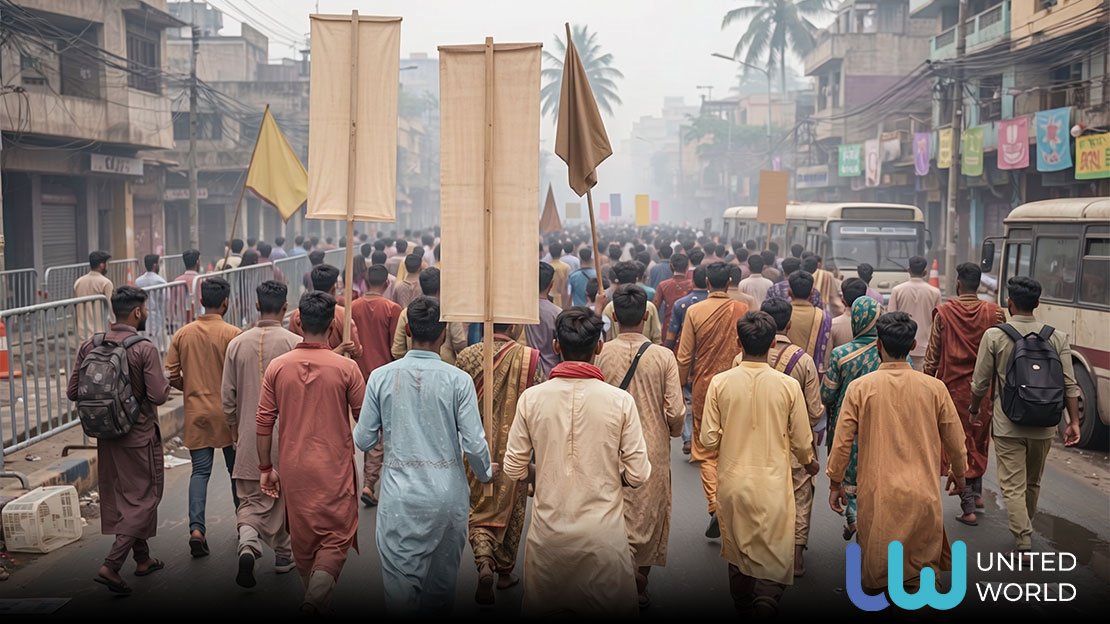
For quite some time, a sequence of images has begun to define South Asian politics. Young Sri Lankans wandering through a presidential residence that had once seemed untouchable. Bangladeshi students carrying coffins through Dhaka after their classmates were killed. Teenagers in Kathmandu filming themselves outside parliament while a government tried to shut down the very social-media platforms on which its privileges were being dissected. In New Delhi this summer, protesters wearing cockroach masks turned an insult aimed at unemployed youth into a political identity. And now, in Pakistani-administered Kashmir, another movement born from grievances over flour, electricity and governance has collided with the state over elections and political power.
Calling all this South Asia’s Arab Spring is tempting. It is also too easy.
There is no regional headquarters coordinating these movements, no common ideology and certainly no single revolutionary script moving from Colombo to Dhaka, Kathmandu, Delhi and Rawalakot. While Sri Lanka’s uprising emerged from economic collapse; Bangladesh’s from a fight over public-sector employment quotas; Nepal’s from corruption, nepotism and a social-media ban and India’s Cockroach Janata Party from examination scandals and jobs anxiety, the Joint Awami Action Committee predates this latest Gen Z conversation altogether and represents traders and civil-society groups as well as younger protesters.
Yet something important does connect them. It is less an organization than a political grammar: a generation that was once told education would create mobility, technology would open the world and hard work would eventually be rewarded, only to discover that the ladder often ends at a locked door.
Study harder. Sit another examination. Earn another degree. Wait another year. Watch someone with better connections move ahead.
That status quo seems to be at the breaking point.
Numerous analyses have identified economic distress, demographic pressure, corruption, nepotism and political dysfunction among the common currents running beneath the upheavals in Sri Lanka, Bangladesh and Nepal. Social media has magnified them by allowing young citizens to see both how others live and how their rulers live. The resulting anger is not simply unemployment. It is the distance between effort and reward — between what young people were promised and what their political economies can actually deliver.
Sri Lanka offered the first spectacular demonstration of what happens when that distance becomes unbearable. The Aragalaya of 2022 was much larger than a youth rebellion: trade unions, professionals, families and citizens across social classes joined it. But young protesters supplied much of its cultural energy, turning Galle Face into GotaGoGama, a makeshift civic republic of tents, art, food, speeches and dissent. Economic collapse had made abstract failures painfully physical: blackouts, inflation, fuel queues and shortages. By July, the then president Gotabaya Rajapaksa had fled the country.
Entering the presidential residence was the easy part.
Sri Lanka’s real lesson came afterwards. The old political class initially found a way to survive through Ranil Wickremesinghe. It took elections in 2024 for the rejection expressed on the streets to become an electoral upheaval, with Anura Kumara Dissanayake and the National People’s Power breaking through dramatically. Even now, the exhilaration of “system change” must coexist with debt, an IMF program, administrative constraints and the decidedly unromantic business of governing. Even as the protestors occupied the presidential palace in a single afternoon, they too know that rebuilding the institutions that produced the crisis will take years. That too, if things go well.
Bangladesh sharpened that distinction. What began in 2024 as a student revolt over government-job quotas became a scathing judgement on Sheikh Hasina’s political order after repression dramatically widened the confrontation. In a country where secure public employment could mean mobility, respectability and protection from economic precarity all at once, a dispute over recruitment rules was never only about percentages. After protesters were killed, the argument changed both its tone and its demands. So did the coalition confronting the government. At the end, Hasina was forced to flee to India in August 2024.
But when Bangladesh finally voted in February 2026, the movement’s political children learned an uncomfortable lesson. The Bangladesh Nationalist Party swept back to power, while the National Citizen Party created by activists associated with the uprising won only six seats. Organizational weakness, limited resources, uncertain policy positions and controversial alliances are routinely touted as factors behind the result. Those six seats may turn out to matter. For now, however, Bangladesh demonstrates how quickly movement legitimacy can collide with organizational reality. Being trusted to overthrow an order and being trusted to run one are different political achievements.
Nepal has travelled even further in the opposite direction.
The government’s decision in September 2025 to block more than two dozen social-media platforms was the detonator, not the explosive. Long before the ban, young Nepalis were circulating images under hashtags such as #NepoKid and #NepoBaby, contrasting political families’ lifestyles with a society in which migration had become one of the most plausible routes to economic advancement. When police fired on protesters, the crackdown crossed what governments throughout the region should recognize as a dangerous threshold: coercion stopped frightening people away and began recruiting more of them into the revolt. More than 70 people were eventually killed, and the then prime minister KP Sharma Oli resigned.
Then came something neither Sri Lanka nor Bangladesh had produced quite so directly. In March, Balendra Balen Shah’s Rastriya Swatantra Party won 182 of 275 parliamentary seats. Shah was subsequently sworn in as prime minister. Nepal therefore offers the strongest evidence so far that the energy of a Gen Z uprising can be carried from phone screen to street and then to ballot box. It also makes Nepal the most demanding test of the thesis. Anti-corruption slogans are now budget decisions. Promises about jobs must become jobs. Outsider politics has acquired ministries, bureaucrats and responsibility.
In India, the Cockroach Janata Party began this year as online satire after India’s chief justice referred to unemployed youth as “cockroaches.” It found a ready constituency in anger over a leaked medical entrance examination involving more than two million candidates, repeated testing scandals and a labor market unable to absorb the ambitions created by India’s immense education machine. Protests spread from Delhi as images of heavy-handed policing circulated online. The government eventually met key demands and the education minister resigned.
Nevertheless, it would be extremely naive to spin regime-changing comparisons with Nepal or Bangladesh: like it or not, Prime Minister Narendra Modi remains organizationally formidable and the protestors’ immediate program was far narrower.
That is precisely why India belongs in this story. Similar grievances do not produce similar outcomes. Political systems bend or break according to the breadth of the protesting coalition, divisions within ruling elites, economic severity, the behavior of security institutions, the strength of organized opposition and what protesters are capable of building when the march ends. India’s protesters extracted a concession. Nepal’s changed the government and then conquered the ballot box. Bangladesh removed a government but saw a traditional party dominate the political aftermath. Sri Lanka took more than two years to convert street rejection into electoral realignment.
For a Pakistani watching this sequence, the history feels unusually close.
Pakistan has been here before, long before anyone coined the term Gen Z. In 1968, student unrest following police firing in Rawalpindi expanded into a much broader mobilization of workers, political parties and other constituencies against Field Marshal Ayub Khan. By March 1969, Ayub was gone. Scholarship on that movement describes exactly the coalition-building that today’s digital revolts can struggle to reproduce: student mobilization acquired greater power once it intersected with organized political and social forces.
Pakistan subsequently travelled in another direction. Student organizations became increasingly enmeshed in party politics and campus violence, and military dictator General Zia-ul-Haq banned student unions nationwide in 1984. The legitimate problem of violent, partisan campus politics was never really solved. The institutional arena in which young people might have learned elections, coalition-building, negotiation and accountable representation was instead drastically narrowed.
That history came rushing back in Lahore in 2019. It is difficult, as a Pakistani, to forget the clip of Arooj Aurangzeb in a black leather jacket, surrounded by students at the Faiz Festival, leading a revolutionary Urdu verse as the crowd beat drums around her. The original couplet, written by Bismil Azimabadi, reads: “Sarfaroshi ki tamanna ab hamare dil mein hai / Dekhna hai zor kitna baazu-e-qatil mein hai.”
(The desire for revolution is in our hearts
Let us see what strength there is in the arms of our executioner)
The video became a precursor to the Student Solidarity March, which demanded, among other things, restoration of student unions, lower fees and protection from harassment. Soon afterwards, activists supporting the march faced charges that included sedition.
Pakistan’s recurring problem has therefore not been an absence of politically energized young people. It has been the difficulty of allowing independent youth politics to acquire an institutional life of its own. Student energy has repeatedly been absorbed into established parties, filtered through larger ideological disputes, securitized when it crosses certain lines, or allowed to dissipate once the immediate mobilization ends. Removing violent politics from campuses was a legitimate objective. Removing democratic apprenticeship, however, came with costs of its own.
That makes the unrest in Azad Jammu and Kashmir (AJK) important, but it also demands caution. The Jammu Kashmir Joint Awami Action Committee is not a Gen Z organisation and should not be retrofitted into one. Created as a grassroots umbrella of traders and civil-society activists, it first mobilized around subsidized flour, electricity prices and official privileges. Its present confrontation increasingly revolves around 12 AJK Assembly seats reserved for refugees from Indian-administered Kashmir living elsewhere in Pakistan. JAAC argues that they distort political representation and defenders say the seats are constitutionally embedded in AJK’s peculiar political history and cannot simply be abolished.
What makes AJK relevant to the regional pattern is the widening constituency of grievance and the consequences of repression. The local government proscribed JAAC in June under anti-terrorism laws. Communications were heavily restricted, and deadly confrontations followed. Residents and rights groups have put the subsequent death toll above 50, including law-enforcement personnel, although the government had not issued a consolidated official figure as of early August. The UN human rights chief has called for an investigation into deaths and expressed concern over the use of counterterrorism measures against peaceful political activity.
And yet elections have continued. After two phases, the ruling PML-N had won 23 of the first 32 constituencies decided, according to preliminary results, despite JAAC’s boycott campaign and rival parties’ allegations of irregularities. Poonch — the movement’s strongest base — votes on August 10.
What all this means, at least in Pakistan, is that street alienation and electoral participation can exist simultaneously. AJK may ultimately teach something quite different from Nepal.
This is where the Arab Spring comparison becomes useful again. To a certain degree. Tunisia and Egypt also contained young, educated populations confronting unemployment, corruption, ageing elites and something harder to quantify: humiliation. Mohamed Bouazizi’s self-immolation became politically explosive because millions recognized the indignity behind one man’s encounter with authority. And while Facebook helped transmit that anger, it did not invent it.
The same distinction applies today. TikTok did not create unemployment in India. Discord did not create corruption in Nepal. Facebook did not bankrupt Sri Lanka. Internet platforms only serve to accelerate exposure, comparison, and coordination. They make elite consumption visible. They allow violence by authorities to acquire an audience before any official statement can define what happened. They also allow Kathmandu to watch Dhaka and young Pakistanis to watch both.
But horizontal movements have a structural weakness. The architecture that makes them difficult to decapitate can also make them difficult to govern through. The Council on Foreign Relations notes that today’s diffuse, digitally organized protests often struggle to turn demands into legislative priorities and durable political institutions. A hashtag can bring thousands to a square. It cannot pass a budget.
South Asia is therefore confronting something more interesting than another Arab Spring. Its young people are renegotiating the social bargain itself.
The most politically combustible citizen may no longer be the person with nothing to lose, but the person who did everything he or she was told: studied, competed, acquired credentials, waited — and discovered that effort does not reliably purchase opportunity. Bangladesh’s coveted government jobs, India’s examination labyrinth, Nepal’s migration economy and Pakistan’s educated underemployment are variations of the same high-effort, low-reward problem.
Governments that interpret this only as a law-and-order challenge risk repeating another regional mistake. Bangladesh and Nepal both demonstrated a backfire threshold at which repression enlarged the constituency of revolt. Pakistan’s experience suggests another danger: if representative youth politics has too few legitimate institutions in which to mature, anger does not vanish. It migrates–into established parties, online communities, emigration, political withdrawal or the street.