

By Prof. Dr. Semih Koray, President of the World Civilizations Initiative Research Center (DÜNYA-MER)
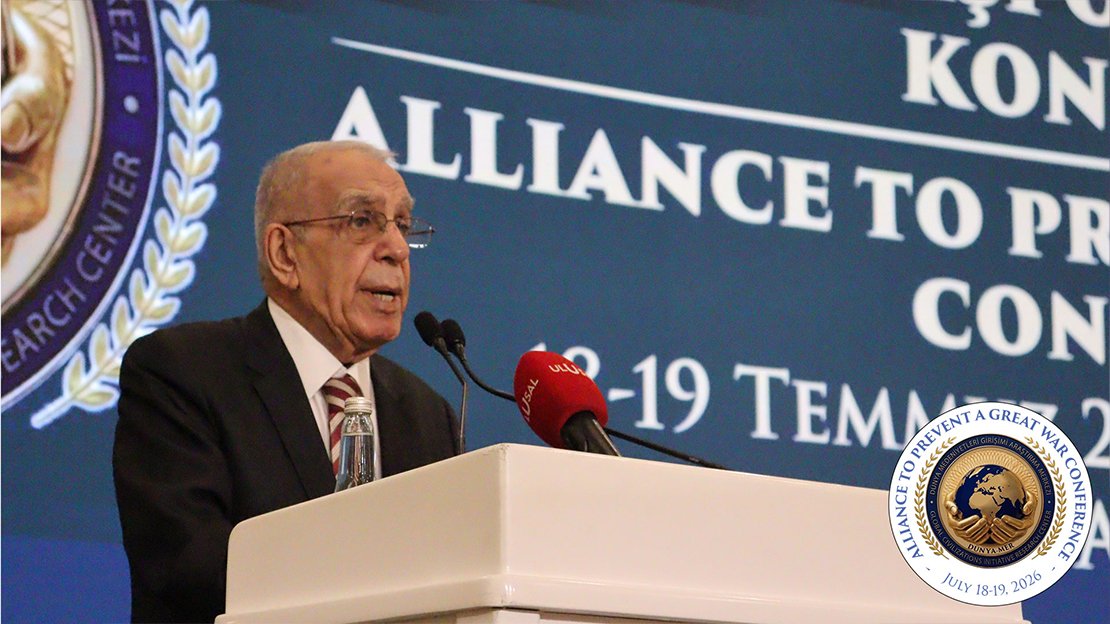
The international conference entitled “The Alliance to Prevent a Great War,” organized by the World Civilizations Initiative Research Center, was held at the Meyra Palace Hotel in Ankara on 18–19 July 2026.
UWI will present the speeches held on the conference during the coming days.
The conference, which featured presentations by speakers from Azerbaijan, Belarus, France, Germany, Greece, Iran, Italy, Japan, Russia, the Sahrawi Arab Democratic Republic, South Africa, Spain, Switzerland, the Turkish Republic of Northern Cyprus (TRNC), Türkiye, the United Kingdom, and the United States, was attended by approximately 200 distinguished invited guests.
Ministers, members of parliament, ambassadors, retired generals, scholars, politicians, diplomats, military officers, and experts examined the question of the “Alliance to Prevent a Great War” from a wide range of perspectives.
Below, we present the speech of Prof. Semih Koray. The title was set by UWI.
Distinguished Guests, Esteemed Participants, Ladies and Gentlemen,
On behalf of the World Civilizations Initiative Research Centre, I welcome you to our meeting, “The Alliance That Will Prevent the Great War,” and extend to you our warmest regards.
Our meeting represents a Eurasian Summit in response to the NATO Summit held in Ankara on 7–8 July. If the Great War breaks out today, it will be a war waged by the hegemony-seeking United States, with the rest of the Atlantic System in tow, against yesterday’s Oppressed World and today’s Rapidly Developing World. Our meeting aims to identify the ways of creating the power capable of preventing this war.
The dissolution of the Soviet Union cleared the way for US hegemony. Rather than fading away after losing its function, NATO underwent its fastest eastward expansion since its establishment. This was because NATO was not a defensive pact but an instrument of US hegemony. Through NATO, the United States also exercised hegemony over the other countries of the Atlantic System. Therefore, the constant across the classifications of NATO 1.0, NATO 2.0 and NATO 3.0 is the US objective of hegemony; what has changed is the world itself. The need to alter the architecture of the US hegemonic organization arises from the rapid transformation taking place in the world.
The US dream of making the twenty-first century an “American Century” collapsed in a very short time. Following the dissolution of the Soviet Union, the United States believed that no serious obstacle remained before it. This was because its calculations did not account for the power of the nation-states of the Developing Oppressed World. Yet today, the center of gravity of productive power—not only in the economy, but also in science, technology, culture and, in short, every sphere of life: the POWER TO BUILD—has shifted from West to East and from North to South. It is this continuing process, which shows no sign of losing momentum, that has made the world multipolar once again. Multipolarity has blocked hegemonic ambitions. This blockage is the main cause of the deep divisions now emerging within the United States, the Atlantic System and NATO. Within the United States, there are many searches for a way to become the ruler of the world again, but few answers.
The final declaration of the “World Security and NATO” meeting that DÜNYA-MER organized in Istanbul on 26–27 June stated that “it would not be surprising if the Ankara Summit proved to be NATO’s final summit, and that the United States’ attempt to reorganize NATO so that it can serve its hegemonic aims more effectively constitutes the most significant threat to world security.”
These are objective assessments. Alongside multipolarity, the successive failures suffered by the United States in the attacks it has launched over the past twenty-five years have caused deep cracks and divisions in the foundations of the Atlantic System. Today, the Russian Federation is successfully fighting on humanity’s front line in Ukraine against the military concentration assembled by NATO through the mobilization of all its forces. Iran’s successes against US-Israeli attacks, achieved despite the loss of martyrs at every level, have demonstrated—and continue to demonstrate—that America’s destructive power cannot achieve its objective.
Despite all the threats it makes, the United States can no longer dictate to its European partners as it wishes.
The fractures and cracks in the Atlantic’s load-bearing columns run very deep. Rather than genuinely strengthening those columns, the function of the NATO Summit in Ankara was to apply a cosmetic layer of plaster and conceal the cracks and fissures.
The fact that the AK Party government in Türkiye signed the NATO Summit’s Final Communiqué, which places Russia and Iran in the crosshairs, undoubtedly reflects a serious weakness. As DÜNYA-MER, we drew attention to this weakness at the “World Security and NATO” meeting held before the Summit, stating the following:
“The view that NATO’s disintegration and weakening will clear the way for Türkiye within the organization and offer it new opportunities is a grave misconception. Securing a larger share in a collapsing organization can lead to nothing other than assuming a larger share of the burden of that collapse.”
This weakness of the AK Party government certainly does not represent Türkiye’s ultimate position on NATO. The NATO Summit’s Final Communiqué places Russia and Iran in the crosshairs. The threats to Türkiye originate from neither Russia nor Iran. The security threat comes directly from the United States and NATO themselves. The barrels of NATO bases in the Aegean and the Eastern Mediterranean are pointed at Türkiye. From the US perspective, the strategic alliance in the Eastern Mediterranean is not one that includes Türkiye, but one that targets it: the alliance among the United States, Israel, Greece and the Greek Cypriot Administration of Southern Cyprus. The United States dreams of turning the Black Sea into a NATO lake. Its aim is not only to encircle Russia from the south but also to encircle Türkiye from the north.
NATO has a shameful record in our country. Counter-revolutionary coups, instigated bloody conflicts, separatist terrorism, the Ergenekon conspiracy targeting the Turkish Armed Forces and the Patriotic Party, and finally the FETÖ coup attempt jointly crushed by the army, the state and the people on 15 July 2015 are the destructive activities of NATO’s Turkish Gladio. This reality also resonates strongly within the Turkish state. Therefore, the process that will define Türkiye in the coming period will not be submission to the United States and NATO, but the intensification—across the state apparatus as well—of the struggle between opposition to NATO and support for NATO over the independence of the country.
Türkiye is being suffocated within the Atlantic System not only in security but also, above all, in the economy, as well as in science, technology, art, morality and culture—in short, in every field that forms the building blocks of a civilization. The decline of the Atlantic System is structural. Türkiye, by contrast, possesses significant structural potential in every field. The geography capable of providing the conditions necessary to turn this potential into material reality is not the Atlantic but Eurasia. It is both realistic and important to foresee that the impact of this objective necessity on Türkiye will continue to grow, increasingly and rapidly.
In the twentieth century, it was not possible to prevent wars of redivision arising from the imperialist system. Humanity emerged from those wars, which caused losses on an unprecedented scale, through great revolutions. Above all, the Russian, Turkish and Chinese Revolutions brought broad sections of humanity outside the sphere of imperialist hegemony. Today, Iran’s cooperation with Russia and the People’s Republic of China has also made an important contribution to the success of its resistance against the US-Israeli attack.
Although the United States and NATO have been reduced to forces of pure destruction, no power can launch a war that it knows in advance it cannot win. Moreover, the outcome of a war is not determined solely by who possesses how many weapons or what kinds of weapons.
It is therefore possible to prevent the Great War today. A strategic alliance to be established and consolidated on the Eurasian Front has the power to deter attacks against world security. A Türkiye–Russia–China–Iran alliance is a candidate to form the backbone of such a partnership. The axis formed by these four countries would also serve as a foundation for other forms of regional cooperation.
Beyond that, world security also matters to the countries and peoples of the Atlantic System. This axis would also form the core of a Humanity Front. If Trump were to withdraw from NATO today, it would merely show that NATO can no longer fulfil the role assigned to it as an instrument of hegemony. But if Türkiye were to leave NATO, the world would change. It would trigger a global realignment that would add momentum and strength to the establishment of a Grand Alliance against the Great War—a Humanity Front.
Humanity is today experiencing the birth pangs of a new civilization rising from Asia. Throughout history, civilizations have existed through their capacity to reveal humanity’s latent power to create and to direct it towards the construction of a common future. The Alliance Against the Great War is therefore a development that will determine the fate of all humanity. As DÜNYA-MER, we stand ready to fulfil our responsibilities in establishing and developing lasting cooperation beyond this important meeting.
I conclude my remarks by once again expressing our gratitude and respect to all our speakers, whose participation in this meeting contributes to the cause of humanity.