


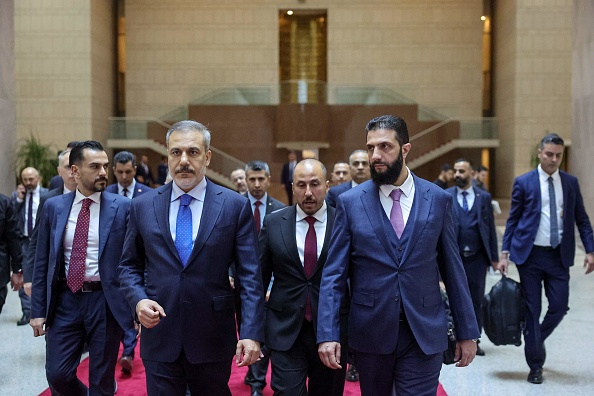
The March 10, 2025, agreement between the SDF and the Damascus government included provisions on overcoming religious and sectarian divisions, officially recognizing the Kurds and securing their constitutional and citizenship rights and establishing a ceasefire across all of Syria.
Regarding the country’s territorial and administrative structure, the most important article concerned the integration of the region under SDF control and administration into the Syrian state. Here, the SDF’s armed forces are the focal point.
Since March 10, 2025, the Turkish state has consistently insisted on implementing this agreement and continues to do so. However, in the year following the fall of Assad, the course of developments, and thus the future of the March 10 agreement, remains uncertain.
One manifestation of this uncertainty occurred on December 7. The Turkish Armed Forces entered Syria at three separate points. Some sources claim that Damascus was also showing military activity. Some say that Al-Sharaa’s participation in the morning prayer on December 8, dressed in military uniform on the anniversary of Bashar al-Assad’s overthrow, was a signal of this.
To understand Türkiye’s stance on the March 10 agreement and the country’s territorial and administrative structure, one should take the ongoing “Terror-free Türkiye” process into account. In February 2025, PKK leader Öcalan called for the PKK to disarm and dissolve in order to integrate with the “state and society”. In May 2025, the PKK officially announced its dissolution, and the disarmament process began. This process is ongoing.
In Türkiye, journalists, analysts, columnists, and even public opinion widely agree that the “Terror-free Türkiye” process and the situation in Syria are deeply intertwined. Both must be understood within a single, comprehensive framework that encompasses all parties involved.
We interviewed about this complex, multifaceted situation with Fikret Akfırat, the author of the books “Puppet State: How the US Created Kurdistan” and “Erdoğan’s Syria Campaign” and a well-versed in the Türkiye-Iraq-Iran-Syria nexus.
———————————————————————————————————————————————-
How to interpret contradictory statements of PKK/SDF
How seriously does the Turkish leadership take the contradictory signals coming from the Kurdish camp: on one hand, talks about integration with Damascus, and on the other, Salih Muslim’s statement that integration with a “non-democratic regime” is impossible?
I don’t think it’s accurate to interpret seemingly contradictory remarks by different PYD/SDF officials as “contradictory signals coming from the Kurdish camp.” The PYD/SDF leadership is essentially an extension of the PKK, and we’ve repeatedly seen, and are seeing PKK officials issuing diverging statements. This has become almost characteristic of the PKK’s style of politics. At the behest of competing countries in the region, alongside the imperialist countries that ultimately pull its strings, the PKK has long used this method to deliver “messages” to parts of the game. In the end, the country with the upper hand inevitably asserts primacy over PKK leadership. So, today too, the statements that appear to contradict one another are essentially like raising the stakes in negotiations.
What is the novelty today?
But there is something novel today: The political will that enabled PKK’s rise and survival, the US, is objectively speaking withdrawing its backing. Thus, in the face of Türkiye, the PYD/SDG has now no anchor to rely on other than Israel. For that reason, its room for resisting the Al-Sharaa government has narrowed dramatically.
A fairy tale: “Democratic autonomous administration of the freedom fighters”
One point is worth emphasizing: neither the PYD nor the SDG represents all Kurds in Syria. There are other Kurdish organizations in the country. PYD/SDG is an organization that imposed its dominance over Syrian Kurds largely through coercion and tyranny under the US’s military umbrella. Many of the SDG militants Western outlets portray as “freedom fighters” were forced into the organization at a young age often without their families’ consent. This was documented also in UN reports.
Likewise, the so-called “autonomous administration” that various Western institutions, many operating under Atlantic intelligence networks, present as a model of “democracy” has little to do with democracy, even in the procedural sense. Decisions are made by PKK cadres and simply rubber-stamped by the so-called autonomous administration. The appearance of “communes”, “assemblies”, and various “democratic bodies” is nothing more than a carefully crafted PR exercise.
The PYD/SDG also pressures other ethnic groups in the region, denies political space to other Kurdish organizations, and most importantly has built an suppressive dictatorial order over the very Kurdish population it claims to represent.
“CIA and the Special Operations Command nurtured the SDF”
This organization was nurtured and expanded by the CIA and the Special Operations Command (SOCOM) after the unrest in Syria began in 2011. Unfortunately, in the past, the Assad government also turned a blind eye to the group’s takeover of settlements along Türkiye’s border, relying on its previously close ties with the organization. Over the last seven to eight years, they have expanded their territory under the protection of the US’s military.
Meanwhile, in the areas under SDF control and nominally governed by the so-called The Democratic Autonomous Administration of North and East Syria (DAANES) the population is overwhelmingly Arab. Raqqa and Deir ez-Zor are entirely Arab, and al-Hasakah is largely so.
For all these reasons, the way Western media frames the issue under the headline “the situation of the Kurds in Syria” is categorically misleading. What we are actually discussing is the process by which a US- and Israeli-backed terrorist organization is expected to hand over its weapons, the territory it controls, and its public institutions to the emerging Syrian state being shaped through a broad international consensus that includes countries on opposing sides of the conflict.
Öcalan’s call and the SDF
Does Türkiye regard the eight-month delay in implementing the 10 March 2025 agreement between the SDF and the al-Sharaa government as proof that the Kurds never intended to fulfill their obligations regarding disarmament and integration? Is Ankara planning in the near future to intensify pressure on the SDF (military, diplomatic, or economic) if the integration process keeps on being delayed or derailed?
The YPG structure that forms the backbone of the SDF is not independent from the PKK leadership. The SDF’s key figures, including its leader Mazloum Abdi, are PKK cadres. At this point in time, these individuals belong to an organization that has been formally dissolved.
Also, PYD/YPG anchors the organization’s entire ideological and practical framework in Öcalan’s theses and founding leadership. And in the document called “Perspective”, which Öcalan sent to PKK’s 12th Congress held in May, he says the following:
“Similar processes will also apply to Iraq, Iran, and Syria. In my view, Türkiye taking the lead in this is rational and conforms to reality. That is how it should be, and how it is happening. For that reason, this step being taken is one that must be taken seriously.”
With this, Öcalan emphasizes that the process is not limited to Türkiye alone, but across the region, and that his decision for the PKK to “dissolve and end armed struggle” applies not only to Türkiye, but also to Syria and elsewhere.
“Terror-free Türkiye” process and Syria
The March 10 agreement between the SDF and Damascus is directly connected to the “Terror-free Türkiye” process. Ankara is applying pressure both internationally and within Syria to ensure that the SDF complies with the terms of this agreement. The core of the agreement is establishing a single military and administrative authority in Syria. For Türkiye, the most sensitive point regarding the implementation of this agreement is that PKK members outside Syria don’t become part of the Syrian Army when the SDF is integrated into it. Türkiye has outlined its conditions through Foreign Minister Hakan Fidan as follows: “Foreign terrorist fighters must leave Syria, the PKK leadership cadre must leave the country, and the SDF members must lay down their arms and integrate into the new system. These are the conditions for a smooth, bloodless transition.”
How these conditions are implemented will depend on both the “Terror-free Türkiye” process and the broader process in Syria.
Is the US sabotaging the process?
Do officials in Ankara believe that the US is deliberately sabotaging the integration of the SDF into the Syrian army by continuing to supply weapons and funding under the pretext of “fighting ISIS”?
One thing should be kept in mind: without US military backing, the SDF has no capacity to partition Syria. Taking into account regional and international dynamics, Washington has been forced to abandon its earlier policy. Moreover, there is no demographic basis for establishing a separate autonomous region. Already unrealistic demands like autonomy or decentralization will effectively lose their foundation once the SDF joins the central Syrian Army and hands over the state institutions back to Damascus.
Is military operation possible?
In the event of further delays, does Türkiye plan to obtain Damascus’s support to launch military operations against non-compliant SDF units?
Türkiye’s principal leverage, including the period after Assad’s downfall on December 8, 2024, is that the areas of northern Syria controlled by the “Syrian National Army” effectively remain under Turkish military oversight. Ankara prefers a resolution without a military operation, but by maintaining its military weight on the ground, it shows that the military option remains available if necessary.
Everyone, including the SDF and its backers the US and Israel, recognizes that Türkiye is the strongest military power in the Syria. From a purely military standpoint, if Ankara concludes that an operation is necessary, it has the capability to resolve the issue on its own terms. However, unlike the 2016, 2017, and 2019 operations, such an operation would probably take the form of Türkiye supporting Damascus in reclaiming its own territory.
Different factions within the US state
SDF’s backers’ strategy is to avoid a direct military clash on the ground, while applying pressure on Türkiye in other domains. The fact that even though the US has vacated some of its bases in northeastern Syria, it still keeps a military presence is meaningful in this strategy. The significance of that presence is political, not numerical.
Since 2019, it is known that the Trump administration favored withdrawal from Syria, and Trump and other officials have reiterated this multiple times. However, within the US there are factions closely aligned with Israel that resist withdrawal. Their current goal is to undermine, or at least keep fragile, the integration of SDF into the Damascus government. In the immediate term, they aim to maintain a US foothold in the region and prevent Israel from becoming isolated.