


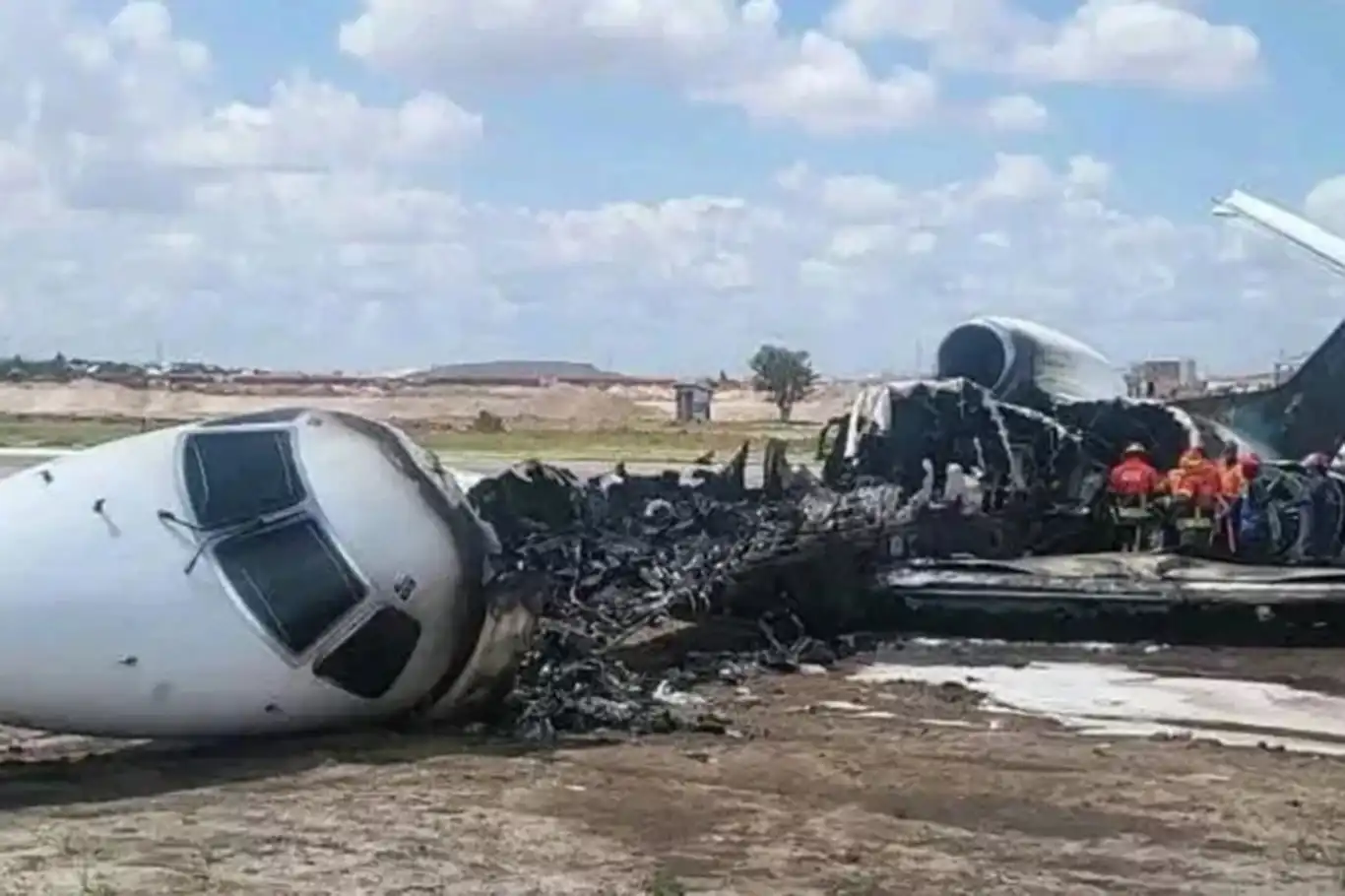
A plane crash close to the capital city of Ankara has caused wide debates and speculations in Türkiye. On December 23rd, a private plane crashed, killing all its crew members together with the Chief of Staff of the Libyan Armed Forces, Mohammad al-Haddad, accompanied by a delegation of four.
According to official sources, the pilot reported electrical problems and requested an urgency landing. Shortly after, communication stopped, and the plane crashed. While the investigation of the crash reason is ongoing, many experts have hinted to the geopolitical circumstances. The leader of the Nationalist Movement Party MHP, coalition partner of President Erdoğan, indicated publicly that a sabotage may have occurred.
We spoke about these possibilities with Dr. Fahri Erenel, retired general of the Turkish Armed Forces and professor at the Istinye University, Istanbul.
There is a debate whether the crash was an accident or a sabotage. What is your evaluation of that?
There is divided political structure in Libya today. One leadership is in the West, the capital Tripoli, the other is in the east, led by Hafter. Since May, Türkiye has been pursuing a policy to approach these two centers of power to each other in order to overcome the division.
In that process, the Libyan Chief of Staff was a key element. He had provided important military support to the Tripoli government to defend the city and was also working hard to deepen defense and military cooperation between Türkiye and Libya in the recent years. He had great influence in military circles, obviously. His death is surely a great loss for Turkish-Libyan relations, though those replacing him will fill the void.
Now, as you know, Türkiye has signed a maritime exclusive zone delimitation agreement with Libya, which has upset very much Greece, and also to a certain degree Italy. This agreement limits Greece’s maneuver space in the Mediterranean seriously.
Meanwhile, the Chief of Staff travelled various times to Türkiye and signed many agreements. Simultaneously, the son of Haftar, Saddam, also travelled to Ankara. Türkiye has advanced cooperation with Haftar’s side, with Saddam even visiting a ship of the Turkish navy publicly. Hence, there was a reproachment between the sides during the last year.
Additionally, the Libyan general’s last visit to Ankara, the one that ended with the crash, occurred exactly when the Turkish parliament was to vote on prolonging the Turkish military deployment in that country by two years. Thus, probably, the visit was planned accordingly as an acknowledgement of the parliament’s decision and an expression of Libya’s welcoming of it.
On the adversary side, we see that Greece, Israel and the Greek Cypriot Administration of Southern Cyprus are advancing ever more to an alliance including a military structure, clearly targeting Türkiye.
The leaders of these three countries have gathered just days ago, made a number of statements targeting Türkiye, both in the Mediterranean and in Syria. All this occurred in days, and this creates a question mark regarding the plane crash.
How can the crash affect Turkish-Libyan relations and domestic Libyan politics?
Now, back in May, the leader of a group was killed n Tripoli. That resulted in serious clashes, with many losing their lives. Libya has not yet established a structure capable to deal with inner-group conflicts. There is instability.
On the other side, if you ask me who’s going to be happiest about the accident, the answer is clear: Greece. Türkiye has already signed the maritime agreement with Tripoli, and when the parliament in Tobruk, the East, approves it, it will enter into force, strengthening Ankara’s hand vis-à-vis Athens seriously. In my opinion, this process will continue.
But I do fear that this accident might fuel domestic conflict in Libya once again. There might be an anti-Turkish discourse spreading around, with some political actors positioning accordingly. This is something we need to be prepared for.
Of course, the general direction of Turkish-Libyan relations will not change. One also needs to wait for the final report on the crash. Still, finding the truth may be difficult if foreign services and sabotage are involved. The Mossad for instance never announces having taken a certain action.
There are a number of technical doubts about the crash, hopefully to be answered by the final report. Despite that, it is clear the geopolitical context is one of increased tensions.