

The map in Syria has changed.
The PKK/SDF, backed by the US for decades, has been forced to pull out of key strategic positions it has been controlling in northern Syria following a military operation launched by the Damascus government. Control over oil fields, border areas, and fertile agricultural land has now shifted to Damascus.
So what happened? Why did the US suddenly abandon the PKK/SDF which it had supported politically, financially, and militarily?
The following statement made by Tom Barrack, US Ambassador to Ankara and Special Envoy for Syria, in a post on X provides a clear answer to this question:
“Historically, the US military presence in northeastern Syria was justified primarily as a counter-ISIS partnership. The Syrian Democratic Forces (SDF), led by Kurds, proved the most effective ground partner in defeating ISIS’s territorial caliphate by 2019, detaining thousands of ISIS fighters and family members in prisons and camps like al-Hol and al-Shaddadi. At that time, there was no functioning central Syrian state to partner with—the Assad regime was weakened, contested, and not a viable partner against ISIS due to its alliances with Iran and Russia.
Today, the situation has fundamentally changed. Syria now has an acknowledged central government that has joined the Global Coalition to Defeat ISIS (as its 90th member in late 2025), signaling a westward pivot and cooperation with the US on counterterrorism. This shifts the rationale for the US-SDF partnership: the original purpose of the SDF as the primary anti-ISIS force on the ground has largely expired, as Damascus is now both willing and positioned to take over security responsibilities, including control of ISIS detention facilities and camps.”
In short, Barrack is saying that after the fall of Assad, the new leader they installed, al-Sharaa is safeguarding US interests in the region. So, Washington no longer needs the SDF or the like.
This also makes it clear that the Sharaa government’s military operations have been carried out with US approval and consent.
Let’s move on to the next question: What did the US get in return for allowing the elimination of the SDF?
One day before the Sharaa government launched its operation against the SDF/PKK, on January 6, 2026, representatives of the al-Sharaa and Netanyahu governments met in Paris under US “auspices”.
The meeting was attended by Syrian Foreign Minister Asaad al-Shaibani, Israel’s Ambassador to Washington Yechiel Leiter, US Special Envoy for Syria Tom Barrack, and Trump advisers Steve Witkoff and Jared Kushner. The US State Department released a joint statement summarizing the meeting.
According to the statement, the parties held “President Donald J. Trump’s leadership in the Middle East enabled productive discussions centered on respect for Syria’s sovereignty and stability, Israel’s security, and prosperity for both countries” “under the auspices of the United States”, The document also announced that the sides had agreed, “under supervision of the United States,” to “establish a joint fusion mechanism—a dedicated communication cell—to facilitate immediate and ongoing coordination on their intelligence sharing, military de-escalation, diplomatic engagement, and commercial opportunities under the supervision of the United States”.
Thus, the Sharaa government, only one year after having been brought to power in Syria, which has been at war with Israel since 1948, signed onto an agreement that includes intelligence sharing with Israel.
Along this deal, it also appears likely that Sharaa will make “official” concessions to Israel regarding Syrian territories under Israeli occupation, particularly the Golan Heights and Suwayda.
In short, it would not be inaccurate to say that, in exchange for a deal with Israel, the US gave Damascus the green light to carry out military operations against the SDF/PKK.
So what is the plan of the US?
To answer that question, let me quote a passage from my article dated November 1, 2025, titled “Tom Barrack’s “peace”: Greater Middle East Project 2.0”:
“The US is preparing to take steps to ensure normalization between its regional allies, Türkiye and Israel through Syria. For this, Washington envisions the “integration” of the SDF and similar terrorist groups into the Damascus government. This would, on the one hand, strengthen the Shara administration, and on the other, temporarily ease Türkiye’s security concerns. Note here that a smooth continuation of the ongoing “peace process” in Türkiye also fits US’ interests. Once the process in Türkiye and the integration project in Syria are completed, Türkiye would continue its activities in Syria in coordination with the US, which in turn would limit Iran’s influence in the region.
In parallel, a permanent peace would be established between the Shara government and Israel, thereby reinforcing Israel’s “security”.
In short, Türkiye and Israel will maintain their spheres of influence over Syria without stepping on each other’s toes, and the US will act as the guarantor of this balance.”
Let’s continue…
In exchange for Syria–Israel normalization, the US allowed the elimination of the SDF/PKK. In the next phase, Washington is likely to focus on the following steps:
1.Implicitly or explicitly pushing for the normalization of Türkiye-Israel relations in Syria and other areas.
2. Seeking to drive a wedge between Türkiye and Iran with various provocations (bringing the two into confrontation over Syria and Iraq, inciting sectarian tensions between Sunni and Shia).
In this context, the US may offer Türkiye new concessions as well, much as it did in the case of the SDF/PKK. These could include:
1. Supporting Türkiye’s activities in Syria (economic and military joint projects),
2. Türkiye–Syria–US joint energy projects (There are claims that new agreements are to come between Türkiye and Chevron in the Eastern Mediterranean… Following the elimination of the SDF/PKK, Syrian Petroleum Company CEO Yusuf Kablawi announced that Damascus could cooperate with Chevron on oil facilities in northern Syria.)
3. The revival of CENTO-like formations involving Türkiye, Syria, the US, and other regional countries. (CENTO, or the Baghdad Pact, 1955–1959, was a cooperation framework organization led by the British between Türkiye, Iran, Iraq, Pakistan, and the United Kingdom to break Soviet influence.)
In the short to medium term, the objective of the US–Israel is the neutralization of Iran, which they view as an obstacle to their regional interests and Israel’s “security”.
In the long run, Washington is seeking to establish a regional structure/organization including Israel that would complicate Chinese and Russian activity in West Asia, block the extension of the Belt and Road Initiative into the region, and reshape the strategic landscape accordingly.
Before picking up with the next week’s article from we left off now, let us recall that while the US and Israel have made a habit of devising intricate plans for the region, anti-imperialist forces in the region have just as often made a habit of consigning those plans to the dustbin of history.
All it takes is will and vigilance…
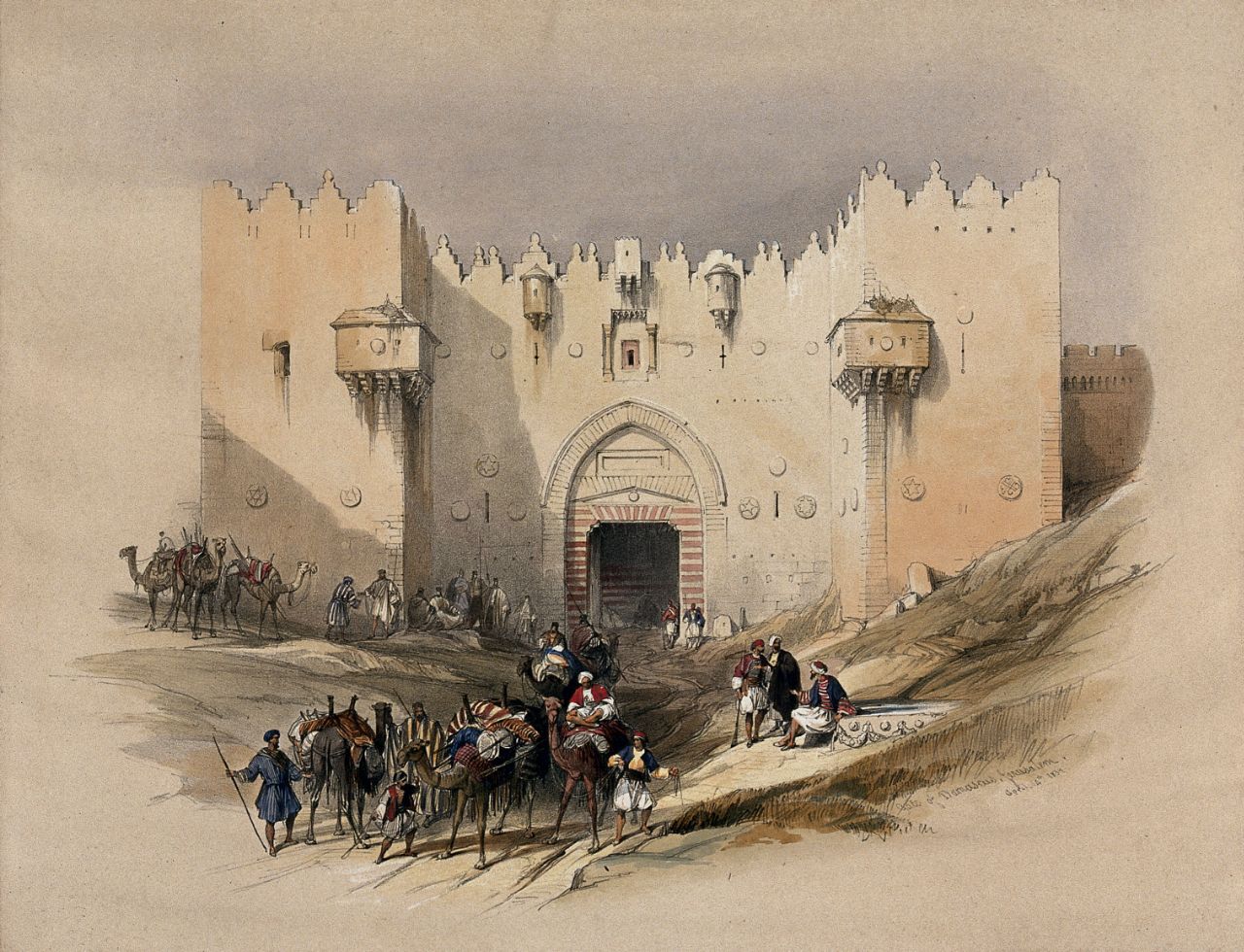
Cover graphic: Gate of Damascus, Jerusalem. Coloured lithograph by Louis Haghe after David Roberts, 1839.