


By Mehmet Enes Beşer
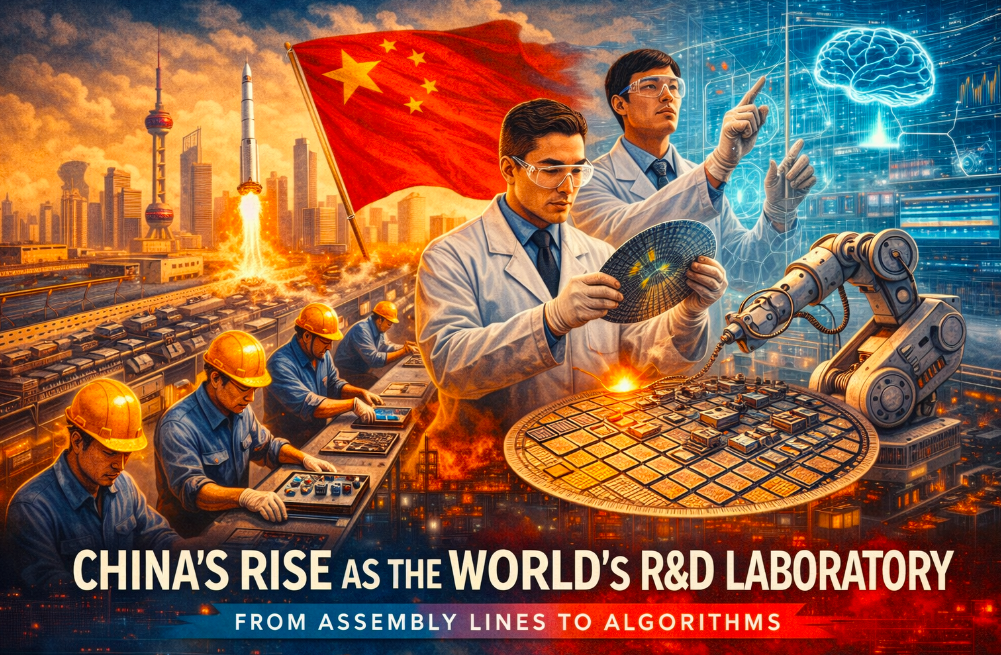
China has traditionally been defined in the world economy as the “world’s factory” – a manufacturing giant which offered size, velocity, and price discounts to global value chains. With the growth of its market, the script was rewritten: China emerged as a giant market where foreign firms competed with one another to sell their products and domestic companies readily expanded in tandem. But something more profound is happening today. China no longer wants to manufacture other folks’ designs or consume other folks’ production. It is transforming itself into the world’s research-and-development (R&D) workshop—a center not just for production of goods, but for developing next-century technologies.
This transformation is not accidental. It is the consequence of conscious policymaking, huge investment, and purposeful structural rebalancing. China already spends more on R&D than everyone except the United States, and in a couple of years will surpass it entirely. The state has put innovation high on the agenda as the fulcrum of state strategy, that is, identifying cutting-edge technologies such as artificial intelligence, quantum computing, biotech, advanced materials, and renewable energy as the areas in which China must lead, not follow. China’s innovation system has been on the move.
Having previously been accused of plagiarism, Chinese firms now lead in 5G, electric cars, and clean energy patents. Chinese patent filings now surpass filings from any country annually, and their universities are approaching world-class status in the science, technology, engineering, and math fields. Moreover, their industry competitors like Huawei, BYD, CATL, DJI, and Alibaba DAMO Academy are leaders in research globally in telecommunication, battery technology, drone technology, and AI. They are not only producers—they are trend setters. The scale of this shift is matched by an enormous and expanding reservoir of human capital. China already produces more STEM graduates for the yearly workforce than the U.S., India, and EU combined. In addition, government incentives, industrial policy coordination, and public-private collaboration have developed successful clusters for innovation in Shenzhen, Beijing, Hangzhou, and Chengdu. They are now no longer simply production platforms—they are now global innovation clusters.
China’s emergence as a global R&D center also reflects a broader shift in the geography of innovation across the world. Declining North Atlantic dominance of research publication and funding innovation is being replaced by a multipolar world order in which the emerging markets are increasingly contributing to cutting-edge progress. China isn’t closing the gap—it is raising new standards, establishing new norms, and building ecosystems within which new discovery is anchored in industrial exploitation.
Aside from this, China is also aggressively pursuing international collaboration. From global innovation competitions and cross-border incubators to co-location research institutes with European universities, China’s R&D is facing outward. Its participation in global standard-setting organizations and support for open-source research in green tech and AI ethics reflect an eagerness to lead—not just follow—the international research agenda.
Still, challenges remain.
Issues of data governance, IP, and academic freedom continue to hover over the story of Chinese innovation, especially in Western perceptions. Moreover, rising tensions between great powers—most notably regarding semiconductors, AI, and biotech—risk dividing scientific collaboration across the globe. But with effective management, none of these problems need divert the progress from its path. The science community in China, as with its economy, is increasingly part of international networks based on open sharing, peer review, and cross-border collaboration. Conclusion
China’s change to the world laboratory for research and development is a reversal in full of its global image. No longer defined by size and consumption, yet no longer delineated by them alone, China is on its way to being the producer of new ideas, new technology, and new innovation paradigms. This is more than an issue of national achievement—it’s a period of change for the world.
Since the world is confronting common challenges—climate change, health crises, digital transformation—China’s innovation potential will drive the thought and action behind solutions.
From Factory Lines to Code: How China became the world’s R&D Lab
Since the past half century, China has been portrayed as a force of globalization in commerce as the “world’s factory,” the manufacturing giant with scale, speed, and economics to provide on the factory floors of the globe.
When its gates opened to the market, the script was reversed: China was a massive market where foreign firms competed to sell to it and domestic firms expanded rapidly in the process. But now, a revolution in its origin is occurring. China is no longer satisfied to be the one who imitates what another produces, or purchases what another produces. It’s becoming the world’s research-and-development (R&D) center—a center of not just production, but creation of the kinds of technologies on which the next century depends. This is no accident. It is the result of conscious policymaking, massive investment, and conscious restructuring. China invests in R&D more than any country except the United States and will soon pass it in absolute terms as well. The state has positioned innovation at the center of national ambitions, and identified frontier technologies—artificial intelligence, quantum computing, biotech, advanced materials, and green energy—as sectors where China cannot lag behind but has to lead.
China’s innovation system has performed according to schedule.
No longer at fault for cloning, Chinese corporations now lead the way on patents in 5G, electric vehicles, and clean technologies. Chinese filings annually now exceed that of any country, and its universities narrow global rankings on STEM education. Moreover, manufacturing conglomerates like Huawei, BYD, CATL, DJI, and DAMO Academy of Alibaba are fueling the world’s communications, batteries, drone system, and AI buildout. They are no longer just manufacturers—but manufacturers in their essence. The scope of this shift is supported by a staggering and expanding talent reservoir. China alone now exports more STEM graduates yearly than the U.S., India, and EU combined. Also, subsidies, industry support via policy, and public-private initiatives have created highly successful innovation clusters in Shenzhen, Beijing, Hangzhou, and Chengdu. They’re not simply manufacturing centers anymore—these are hubs of innovation across the globe.
China’s emergence as an international R&D hub also registers a deeper shift in innovation diffusion across the world. North Atlantic historical dominance of research yield and investment in innovation is being eclipsed by a multipolar world where fast-industrializing nations are betting larger and larger bets on breakthroughs. China is not inheriting a void—it’s setting new heights, establishing new benchmarks, and building platforms where discovery and industrialization converge.
Besides, China pursues global collaboration actively. Starting from cross-border incubators and global innovation contests, to cooperative research centers that are international in scope and collaborated with European universities, China’s R&D landscape is increasingly oriented outward. China’s accession to international standards associations and open-source research on green technology and ethics of AI exemplifies its disposition to establish rather than to track the world R&D agenda.
There are stumbling blocks, of course. Issues of data governance, IP safeguards, and issues of academic freedom still bedevil China’s tale of innovation, especially for partners in the West. In addition, emerging geopolitics—primarily semiconductors, AI, and biotech—stand poised to shatter worldwide scientific collaboration. But if adequately managed, stumbling blocks need not hijack progress. China’s scientific community, like its economy, is steadily becoming part of global networks built on open dialogue, peer assessment, and inter-border collaboration.
Conclusion
As the world’s R&D lab is China’s existential transformation as a nation within the global order. To be big and to have much to devour limits its options no further since China is remaking itself as a source of new ideas, new technology, and new forms of innovation. This is more than being an internal victory—it’s an international watershed.
Because the world is faced with common issues—climate change, health challenges, and technological disruption—China’s innovation strengths will be at the hub of how they design and deliver solutions.
The world factory is increasingly an ideas factory, and its research labs belong to the world brain trust that designs the future. Whether green tech or AI or life sciences, China’s contribution is now one of choice—but one of necessity. Its factory is now not a factory, but an ideas factory, and its labs are not labs but the world’s brain trust mapping out the future. Whether green technology, AI, or life sciences, China’s position is no longer an option anymore—it is a necessity.