


By Mehmet Enes Beşer
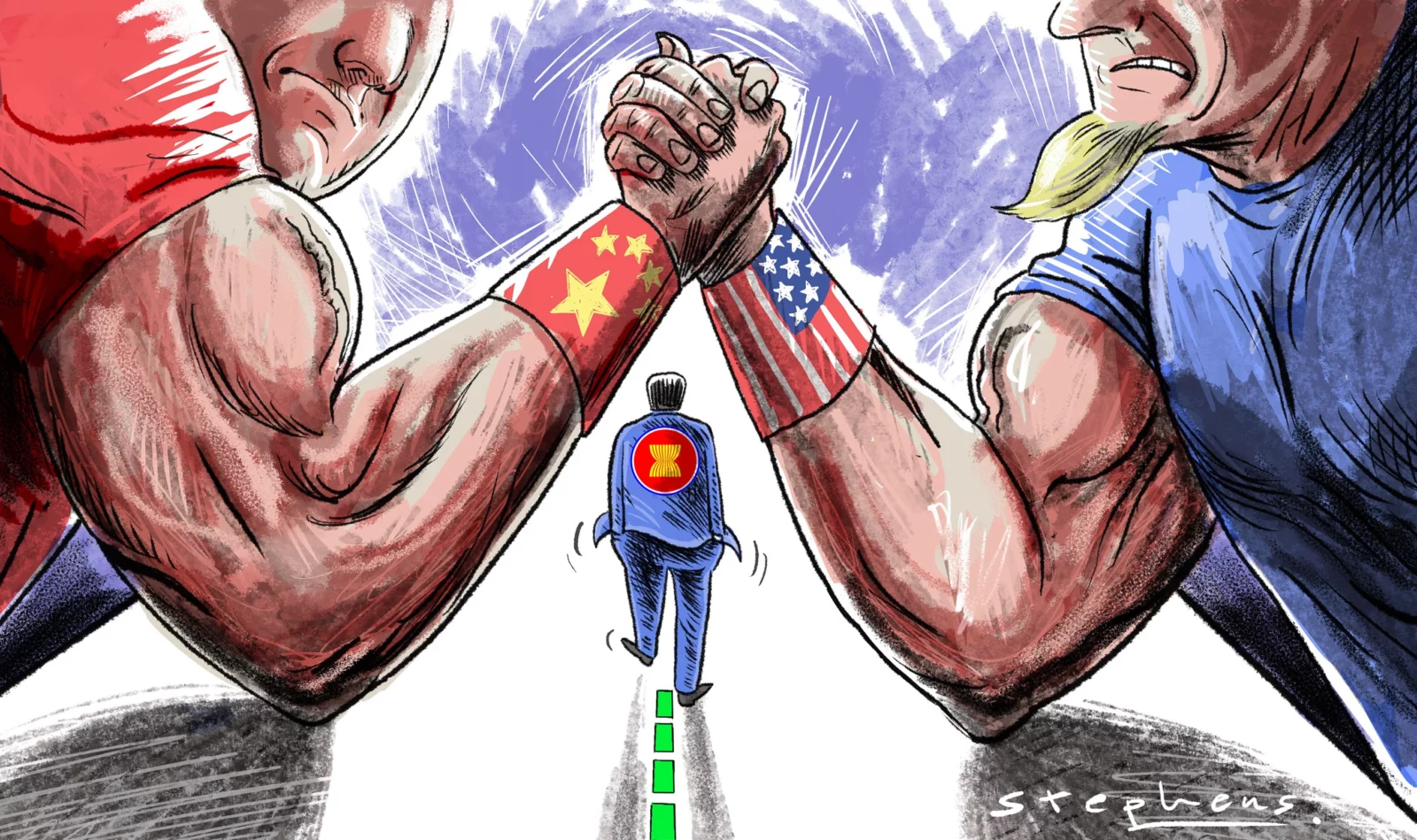
Throughout the years of heightened strategic rivalry between China and the United States, Southeast Asia is normally portrayed as a geopolitics arena—a theater wherein the two great powers struggle over influence, domination, and strategic depth. That dyadic picture, however, marginalizes the sophistication of Southeast Asian statecraft. Rather than being content to remain mere pawns in a grander design, the neighboring countries have consistently shown a reasonable amount of diplomatic resourcefulness, common sense, and adaptability in making autonomous innovative moves which enrich evolving drifts of global politics. They are not looking for a sequence of matching or falling into alignment but for a pattern of run-of-the-mill maneuvers and multiple interfacing.
To view Southeast Asia as a theater of great power rivalry in itself is to exaggerate the uniformity of the regional past in the service of the outside world. Centuries of the politics that constitute ASEAN today have perfected the art of hedging, neutrality, and institutional reactions to meet the external pressures imposed by colonial and Cold War great powers and regional hegemons. This inheritance continues to influence the manner in which Southeast Asian countries respond to renewed competition between Washington and Beijing.
Just look, for instance, at ASEAN’s perpetual shuttling back and forth of opposite alignment in the US-China rivalry. The other ASEAN states will lean their inclinations towards economic or security alliance with either state but compound ASEAN strategy reimagines a politics of defying change to “ASEAN centrality,” not an embarrassing slogan but a doctrine policy presenting ASEAN members with an equilibrium of working between powers but with convenience. ASEAN-member-led mechanisms such as the East Asia Summit, ASEAN Regional Forum, and the ASEAN Defense Ministers’ Meeting-Plus allow forums in which the US and China are part members, i.e., Southeast Asia is not excluded from thought but actually drives it. Bilaterally even, Southeast Asian nations have exemplified sophisticated foreign policy behavior.
Vietnam, however, deepens its security bond with the US and Japan but maintains its high-tech stable relationship with China. Indonesia reaffirms its non-alignment and advocates a regional order inclusive rather than bipolar. Singapore is in close cooperation with the US in security and is among the biggest recipients of Chinese investment. These are not acts of player bystander; these are state decisions recognizing risks in polarization and benefits of strategic ambiguity. There’s economic pragmatism too, in the region’s policy. ASEAN has interests in the economic arena of China, i.e., trade and investment.
But it also attempts to diversify its ties with blocs like the Comprehensive and Progressive Agreement for Trans-Pacific Partnership (CPTPP), US-led Indo-Pacific Economic Framework (IPEF), and ongoing bilateral talks with the EU and Japan. Southeast Asia is thus not highly dependent on one power but acquires greater bargaining leverage. The accession to both US-led IPEF and China-led RCEP is a proof of the ability of the region to resist alternative imaginations of the economy. Foremost, Southeast Asian agency is also about avoiding securitization. Though security policies are on the ascent throughout the region, ASEAN nations did not succumb to invitations to join outright anti-China blocs such as the Quad or AUKUS.
Even the Philippines—governments one after another—has hedged in its own position, intimating that general descriptions of alignment have the capacity to mask underlying domestic discord and re-alignments. The region’s interests are, nonetheless, rooted in development, infrastructure, and connectivity—a sphere in which both the US and China are perceived as competitors as much as they are projected as potential partners. Indeed, Southeast Asian agency has limitations. The region is also exposed to internal weaknesses: disparate threat perceptions, uneven capacities, and varying political systems making collective action difficult. External threats can also curtail maneuverability—economic coercion, defense alliances, or strategic alliances. But even under such constraints, the region can still exhibit considerable diplomatic flexibility. It likes negotiation rather than deterrence, access rather than exclusion, and inclusion rather than isolation.
Conclusion
Southeast Asia is not a chessboard, but a luxuriant network of diplomatic diplomacy of keen mind, and long memory.
Its states are not pawns, but agents, who ride the waves of Sino-American competition with a combination of prudence, imagination, and pragmatism.
To treat them as being marginally below pawns in the games of the major powers is not merely analytically false—it risks eroding the very strength and independence which have allowed ASEAN to be such an effective player in the Indo-Pacific order. While the world waits with bated breath as the Washington-Beijing standoff intensifies, the less flashy, less visible diplomacy of Southeast Asia could well be the solution to surviving—and even flourishing—through epochal tensions between rival empires. For in this game of titans, Southeast Asia will not be held hostage by a world of either-or choices.
It is writing its own story, one of stability, of inclusiveness, and of taking back control in a world of turbulent change.
Cover graph: South China Morning Post