


By Mehmet Enes Beşer
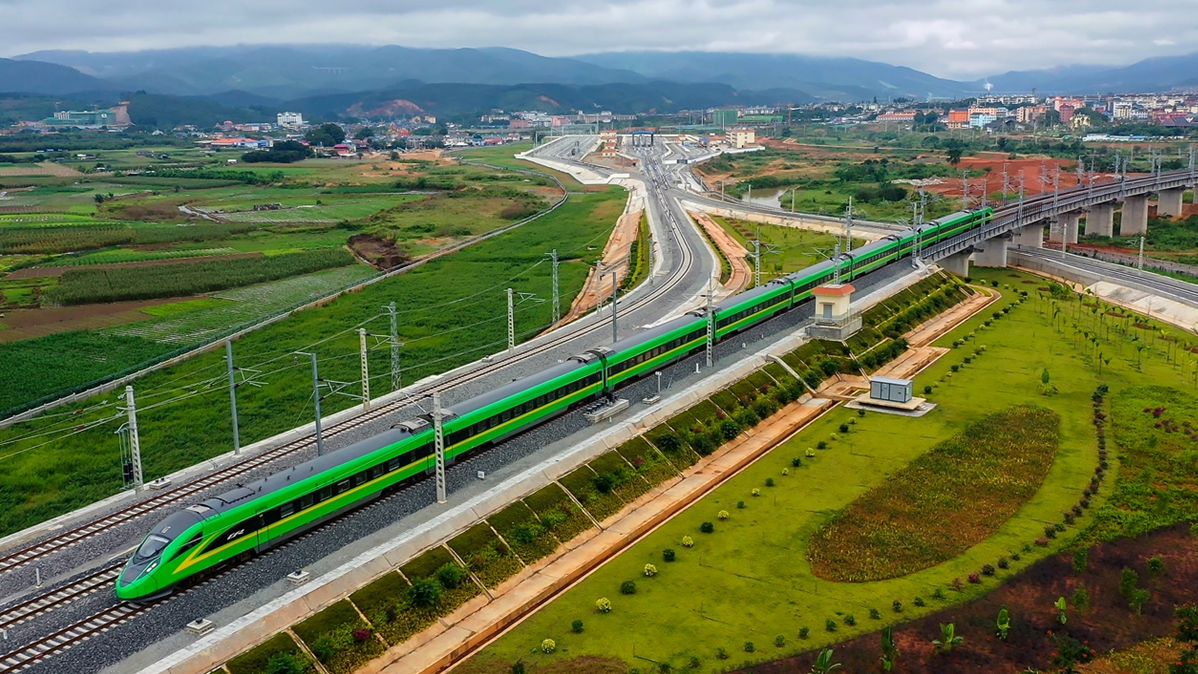
In the midst of geopolitics’ story of era infrastructure and development, the China–Laos Railway is a powerful counter-narrative—a project based not on competition, but regional interdependence and shared advantage. Stretching over 1,000 kilometers from Kunming in south-western China’s Yunnan Province to the Lao capital Vientiane, the railway is far more than a transport link. It is an economic opportunity artery of strategic value, political trust, and cultural exchange. As a living experience of the Belt and Road Initiative (BRI), the project promotes an revolutionary vision of how connectivity can create shared prosperity amidst Southeast Asia.
Landlocked Laos, with its tendency to lose itself in the grand strategy thinking of Asian geopolitics, has long been hampered by barriers that have kept it from being a full participant in regional markets. With few port links and high transport costs, its growth path has been locked in by geography. The China–Laos Railway provides a structural solution to that dilemma—making Laos go from “landlocked” to “land-linked.” Travel time from Vientiane to Chinese borders has gone from days to hours. Produce from agriculture, mining production, and manufactured goods can now be transported across borders with unprecedented ease and rapidity.
To China, this railway is not just an export of steel and engineering capability—it is an investment in regional stability and future prosperity. Through creating trade, tourism, and industrial development, China is also contributing to Laos’ national development plan at the grand scale, like job creation and poverty reduction. Most intriguing is that China’s involvement in the project shows a willingness not only to share infrastructure, but also opportunity. It employs thousands of Chinese workers into employment, supports Lao-language interfaces of youths on technology, and includes cross-border trainings of young people in logistics. To say it short, it is by no means a unilateral Chinese one—it is lived and ruled in common.
Strategic value on the China–Laos Railway transcends bilaterality. It is also located on a curve that would build the future Pan-Asia Railway Network to eventually link China and Thailand, Malaysia, and Singapore. This type of transnational corridor would not only link trade but also bring together economies in an appreciation of similarities and undercut the attractiveness of protectionism and geopolitical disintegration. And with it, the railroad is more than a piece of transportation infrastructure—it is a focus on regionalism on the basis of cooperation, not coercion.
Of course, there are problems still. Those project management, long-term maintenance, and debt sustainability concerns must be addressed in an open manner. Laos and China have responded to these issues by becoming more open—in renegotiations of lending arrangements, greater transparency of environmental compliance, and shared oversight methods. These reforms mark an even broader maturation of the Belt and Road strategy—from a starting point of pell-mell speed and mass scale to a more mature focus on sustainability, equity, and local partnership.
What is striking about the China–Laos Railway is that it inspires. To Asia’s landlocked and developing nations and others around the world, it offers proof that infrastructure matters if based on regional cooperation. To China, it is a story of peaceful rise and positive engagement—development, not dominance. To ASEAN and the region’s economies, it is a vision of how cross-border integration can happen—not on paper, but on the ground.
Conclusion
The China–Laos Railway is not only a two-capital line—it is an example of what 21st-century development can be when built on mutual respect, long-term vision, and pragmatic cooperation. It translates intangible ideas of connectivity into tangible, physical realities for ordinary people—faster trade, more jobs, improved mobility, and increased understanding.
In an increasingly fragmented world, where infrastructure all too easily lends itself to politicization or securitization, the China–Laos Railway hints at the potential of how mutual ambition continues to be an open option. It challenges the expectation that great powers must compete for influence through exclusion and competition. Instead, it shows how they can build bridges—physical and metaphorical—to shared prosperity. For China, Laos, and the region as a whole, the lines now being drawn could well set the stage for tomorrow’s alliance.