


By Mehmet Enes Beşer
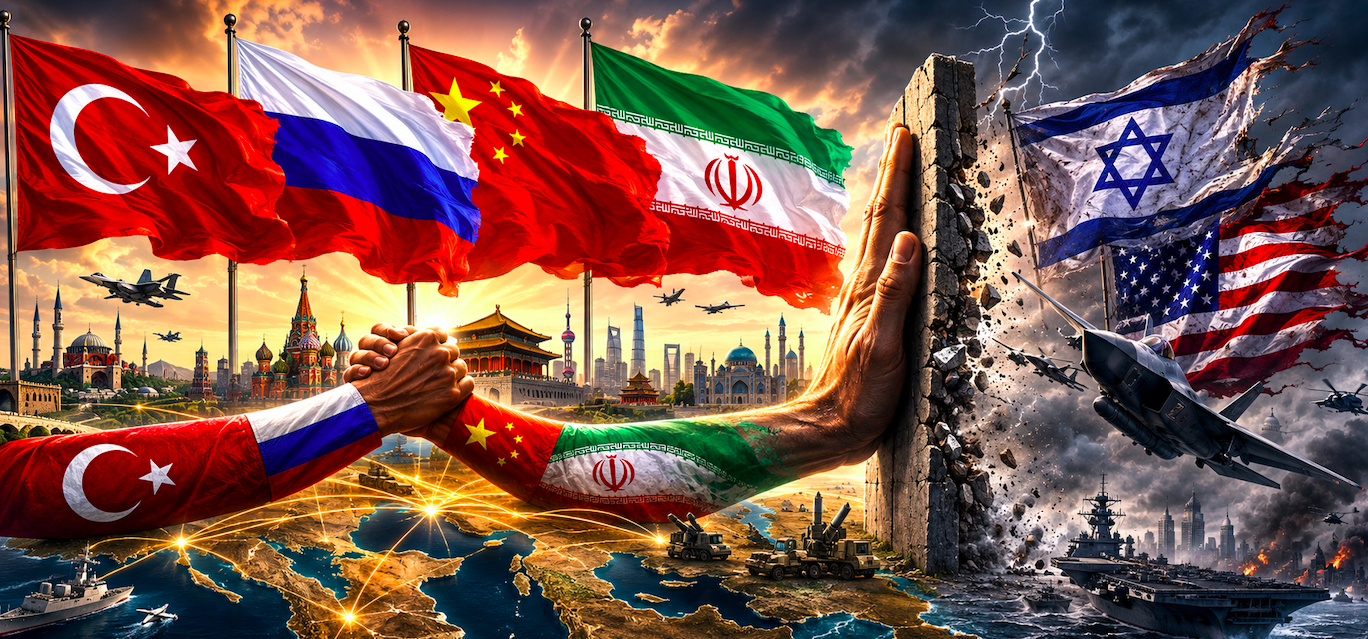
An alliance of Türkiye, Russia, China, and Iran (TRCI) is usually seen as mere rhetoric or as an idealistic pipe dream—an “anti-West bloc” concept that oversimplifies the complex geopolitical reality. At the same time, there is nothing wrong with the fundamental idea behind the proposal: West Asia is characterized by chronic instability fueled both by internal factors and external meddling; fragmented security structures and a lack of a common mechanism ensuring effective de-escalation in the region. Under such circumstances, an entente among these four consequential powers might become an instrument of stabilizing influence despite being far from a perfect formula.
The concept of “peace” in West Asia does not require a grand solution. What is needed is something modest yet meaningful: a mechanism that ensures limited conflict, prevents escalation into regional conflagration, and creates the necessary predictability for economic interactions and reconstruction. The problem in West Asia has been the “domino effect” where one conflict zone is transformed via sanctions, proxies, and maritime threats into another one. A structure that is capable of introducing routine practices of managing crisis and setting up red lines can produce great stabilizing results without solving underlying tensions.
A Türkiye–Russia–China–Iran entente matters due to combining different types of influence which are rare to find in one construct. As a mediator between West Asia, Black Sea, and Europe, Türkiye enjoys wide operational capabilities, able to work with partners who cannot communicate directly. Russia is a security power with solid networks and considerable military capabilities important for West Asian dynamics. China plays the role of a global economic power with interests in energy security and stability in maritime regions. And Iran is a regional player which cannot be excluded from the process by means of sanctions.
Thus, there is no need for these four to have similar goals. It is enough to be concerned about the issue of limiting war and have capabilities for either facilitating or disrupting the process. That is why there is no lack of actors in West Asia; what the region lacks is coordination of restraint efforts.
A thoughtfully constructed entente could bring solutions that the current approaches have not found. First, it could introduce an effective mechanism of de-confliction of overlapping theaters. All the conflicts in West Asia are mutually linked: the situation in Syria influences Iraq; Gulf security affects energy prices and maritime safety; Eastern Mediterranean and Red Sea connect to broader naval competitions; and Caucasian theater constitutes an adjacent area of pressure. An institutionalized consultative body operating on the level of national security councils and not foreign ministries could minimize the probability of turning tactical incidents into strategic ruptures.
Second, such a concept could facilitate the stabilization of energy and maritime security, recognized as major systemic issues in the region. Infrastructure and maritime routes in West Asia are extremely fragile and susceptible to both deliberate and accidental actions. There are economic interests of China that are threatened by energy insecurity, Türkiye that is affected domestically by potential disruptions, Russia that cares about both security and markets, and Iran that has its interests due to sanctions pressures. Common interest in avoiding transformation of energy security problems into a bigger conflict means nothing but practical cooperation aimed at ensuring restraint, signaling, and avoiding crises in the context of critical infrastructure.
Third, it could encourage the formation of sovereignty-centered approach to conflict resolution which would resonate with societies tired of regime change attempts. One of the reasons behind chaos in West Asia is constant degradation of state systems and the ensuing struggle over control over void spaces. An agreement which focuses on the principle of integrity and negotiating of internal settlement instead of maximalist interventions could help to maintain the conservative model of security: no abrupt border changes, no prolonged occupations, and no humiliation-based escalation ladder.
Fourth, there is the aspect of development. Stability is ensured not only with deterrents but with incentives. The combination of Türkiye’s manufacturing industry, China’s money, Russia’s special knowledge, and Iranian connections and internal market could create a powerful basis for reconstruction and connectivity projects producing stability and economic growth at the same time. If such projects are based on clear rules and create economic benefits for people living in dangerous territories, they can make the peace architecture much more stable by making violence financially irrational for key players.
But the statement that TRCI will be “the key” to stability in West Asia has to overcome some strong objections. Firstly, a TRCI entente itself can turn into a reason for creating a coalition against Türkiye and other participants and provoke an artificial division of West Asia into two confronting sides—an approach known to increase the risk of miscalculation.
Secondly, an effective and long-lasting TRCI structure should be explicitly non-expansionist and non-ideological. Its task would be crisis management, de-escalation, and opening channels for negotiation—not promotion of some kind of “anti-Western agenda.” Moreover, it needs to be flexible and able to cooperate with other regional countries on particular matters—so as not to exclude anyone from this process.
Thirdly, it has to be free from contradictions between different members of the alliance. Türkiye competes for influence with Iran in the region, which does not necessarily mean that the two parties are sharing the same perceptions of threats. On the other hand, China and Russia have different priorities; China is mostly economic actor while Russia is a security one; moreover, China tends to refrain from getting involved in complicated geopolitical games. And Türkiye’s relations with Russia can hardly be called harmonious. These are important structural issues that cannot be ignored by a peace architecture.
Fourthly, an entente has to focus on common areas of interests without getting distracted from controversial topics. Namely, it should provide crisis management and de-escalation mechanisms in cases of mutual interest; coordinate counter-terrorism actions without using proxies; set up rules for avoiding attacks on critical infrastructure.
Fifthly, there is a question of legitimacy. Any architecture that ignores the social component and is based on the elites’ bargaining will prove to be unsustainable and unstable. In fact, West Asia is already experiencing the decline of many externally designed “orders” failing whenever meeting people’s wrath. Thus, to become a sustainable structure, the proposed alliance should have a commitment to humanitarian de-escalation, non-extractive reconstruction projects, and opportunities for political engagement by local communities.
If TRCI is not considered as an alliance but rather as an entente promoting restraint, it requires some practical tools. Among them will be regularized security dialogues with established crisis hotlines; agreed upon principles about non-attacks on energy and civilian infrastructure; coordination of de-escalation processes and crisis management in overlapping theaters; joint counter-terrorism efforts and agreements to stop manipulating proxies. Furthermore, economic instruments are necessary such as trade settlement frameworks and reconstruction finance mechanisms.
Finally, TRCI alliance could be seen as a key to peace only metaphorically. That is, it could provide some missing architecture of stability and reconstruction that West Asia currently lacks.