


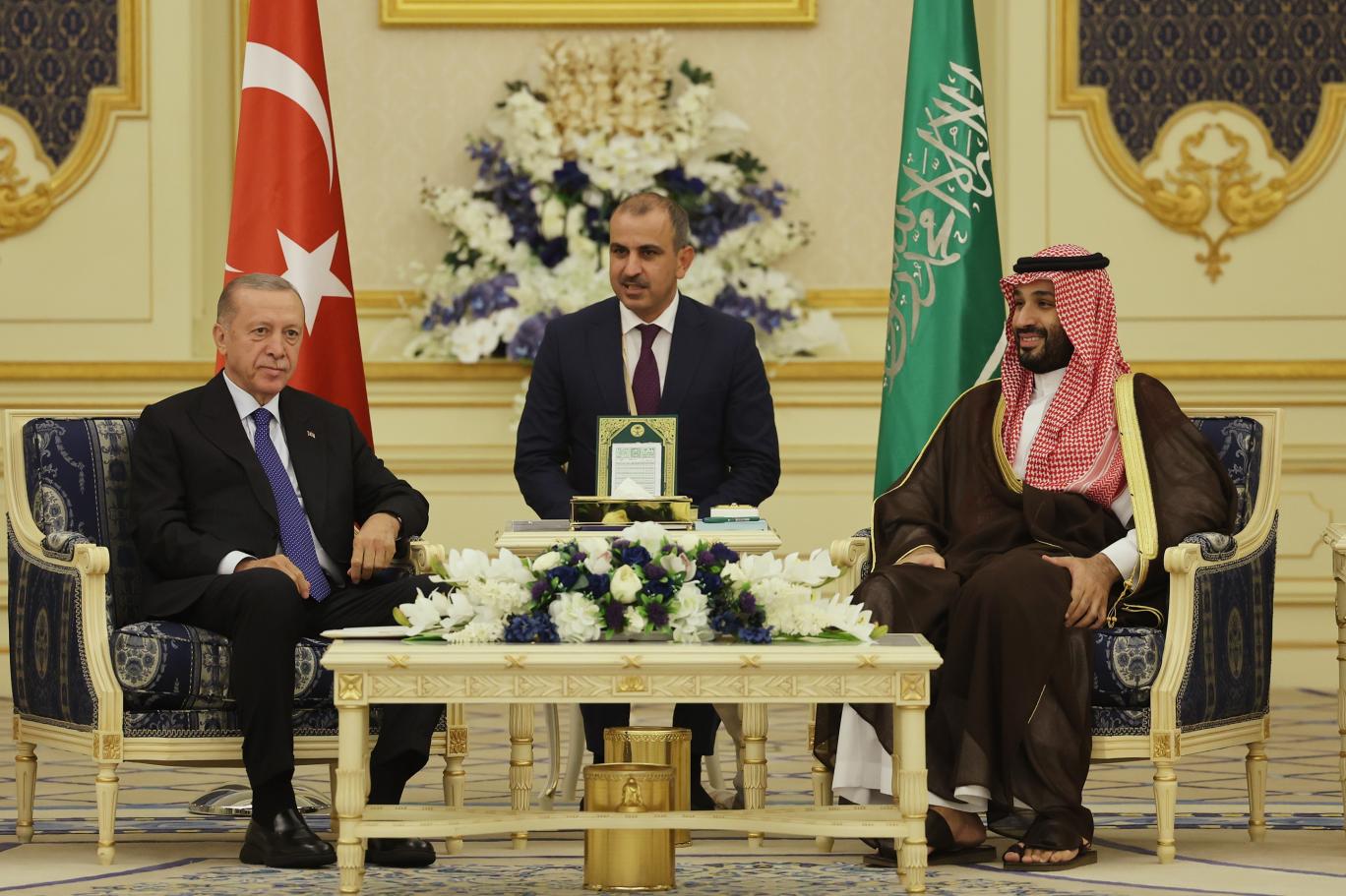
In Türkiye last week, President Recep Tayyip Erdoğan’s visits to Saudi Arabia and Egypt topped the national agenda.
Another major talking point came from Foreign Minister Hakan Fidan who made remarks on Iran during a television program.
And the Epstein Files, together with the whole world, was a topic of the Turkish public.
Erdoğan’s visit to Saudi Arabia and Egypt
President Erdoğan paid a critical visit to Saudi Arabia last week.
He was formally welcomed in Riyadh by Crown Prince Mohammed bin Salman with an official ceremony.
Erdoğan and the accompanying delegation held talks with senior Saudi officials led by Crown Prince Mohammed bin Salman. Following the meetings, Türkiye and Saudi Arabia released a 31-point joint statement.
The statement emphasized the “brotherly” ties between the two countries and underscored the need to strengthen cooperation in the fields of economy, trade, and investment.
It noted that both sides agreed to capitalize on investment opportunities offered under Saudi Vision 2030 and the Century of Türkiye Vision for the mutual benefit of their economies. The statement praised the current level of trade while stressing the importance of continued joint efforts to expand non-oil trade, intensify reciprocal visits between public and private sector officials, and organize commercial events in both countries through the Türkiye–Saudi Arabia Business Council. Enhanced cooperation in the construction sector was also highlighted.
The energy sector featured prominently in the statement as well. “Both sides agreed to strengthen cooperation in the supply of oil, petroleum derivatives, and petrochemicals,” the statement said.
It further underlined the significant role both countries’ contribution to the energy supply of the regions and global markets. The statement reads, “The Turkish side emphasized the Kingdom of Saudi Arabia’s leading role in enhancing the reliability and stability of global oil markets in a manner that serves the interests of producers and consumers alike and supports global economic growth. Both sides agreed to bolster cooperation in the supply of oil, petroleum derivatives, and petrochemicals, work together to explore investment opportunities in the petrochemical and agricultural nutrients sectors, and collaborate on innovative uses of hydrocarbons.”
The statement also included plans for cooperation in renewable energy. Saudi Arabia is expected to invest approximately $2 billion in solar energy projects in Türkiye.
The statement noted that both sides agreed to strengthen cooperation in the exploration, extraction, and processing of mineral resources.
The wide-ranging statement also addressed cooperation in defense and security. It stated that the parties had reached an understanding on implementing existing security and defense agreements and included language signaling an expansion of collaboration in this field. Saudi Arabia is expected to broaden its procurement of defense equipment from Türkiye.
The statement addressed Gaza and Palestine too. Alongside an emphasis on bilateral and regional cooperation, the statement emphasized efforts aimed at ensuring the establishment of an independent Palestinian state. The statement reported both sides’ “deep concern over the deteriorating humanitarian situation in the Gaza Strip”, “the ongoing Israeli attacks”, and the “obstruction of humanitarian aid and border crossings”.
Referring to the initiative of Trump on Gaza, the statement said: “Both sides welcomed each other’s participation in the Board of Peace. They also welcomed the launch of the second phase of the comprehensive peace plan for Gaza and the commencement of the Independent National Committee’s work to govern the Gaza Strip, expressing appreciation for the international efforts undertaken in this regard.”
The situations in Yemen, Somalia, and Sudan were also addressed in the statement.
On Yemen, the parties reaffirmed their support for the legitimate Yemeni government represented by the Chairman of the Presidential Leadership Council and his administration. Regarding Somalia, the statement underscored sovereignty and territorial integrity while condemning and rejecting Israel’s attempts to destabilize the region through Somaliland.
The statement likewise emphasized stability, territorial integrity, and sovereignty in Sudan.
It also highlighted that the administrations of Erdoğan and bin Salman voiced full support for the government in Syria and condemned Israel’s occupation in this country.
Following his visit to Riyadh, President Erdoğan traveled to Cairo, where he met with his Egyptian counterpart Abdel Fattah el-Sisi. The two leaders later held a joint press conference.
At the conference, Erdoğan stressed the “brotherly” ties between Türkiye and Egypt, recalling that officials from both countries had met numerous times over the past 17 months. He said: “Our foreign ministers have met seven times. When we include our other ministers and senior officials, the number of reciprocal visits is approaching 50. With the joint statement and various documents, we adopted today, we are, Inshallah, further strengthening the foundation of our relations.”
Erdoğan reminded that Egypt is Türkiye’s largest trading partner in Africa and stated that Ankara aims to increase bilateral trade volume to $15 billion from the current volume of around $8–9 billion. He also noted that Turkish companies’ investments in Egypt have risen to $4 billion.
President Erdoğan added that Türkiye and Egypt, as two neighboring countries with the longest coastlines in the Eastern Mediterranean, seek to enhance cooperation in bilateral maritime trade, freedom of navigation, and maritime security.
Like in Riyadh, Palestine was also on the agenda in Cairo. President Erdoğan said that Palestine “remains at the top of the joint agenda”:
“Although a ceasefire has been established, the humanitarian tragedy in Gaza continues. Since October 11, over 500 Gazans have lost their lives in Israeli attacks. Last week alone, 30 of our brothers and sisters, including children, were martyred. We reject these attacks and violations aimed at sabotaging the Sharm el-Sheikh Declaration. We are working with Egypt on initiatives to make peace possible in Gaza. We will do our utmost to contribute to the reconstruction of Gaza, which has been devastated by Israeli attacks. On this occasion, I would like to once again thank the Egyptian authorities for their cooperation in delivering the humanitarian aid we sent to Gaza.”
Erdoğan touched upon Libya, saying establishing permanent stability in Libya is a shared goal with Egypt. Erdoğan also criticized Israel’s policies regarding Somalia. On Iran, he emphasized the importance of a diplomatic solution.
Egyptian President Abdel Fattah el-Sisi, in his remarks, highlighted the efforts to increase trade volume and mutual investments between the two countries.
Regarding the situation in West Asia, Sisi said: “Our region is rapidly exposed to crises and upheavals. We must deepen cooperation between Egypt and Türkiye to achieve sustainable political solutions as quickly as possible.”
Emphasizing the importance of developing cooperation, Sisi recalled that a ceasefire in Gaza was achieved through the efforts of Türkiye, Egypt, Qatar, and the US.
On Gaza, el-Sisi added: “What matters now in Gaza is that humanitarian aid reaches the region as quickly as possible. In line with international and United Nations resolutions, a two-state solution and the establishment of a Palestinian state are extremely important. All unilateral measures against the Palestinians must be ended, and the holy sites, especially Jerusalem, must be protected.”
Sisi also stressed Syria’s territorial integrity and underlined that the nuclear issue in Iran must be resolved.
During the visit, President Erdoğan presented Egypt’s President with Türkiye’s domestically produced electric car, “Togg”.
Foreign Minister Fidan talks on Iran
Foreign Minister Hakan Fidan, during a television program, made significant remarks regarding tensions between the US, Israel and Iran.
Fidan said: “The region cannot bear a new war. Our President has maximum caution on this matter. We want to use all means available to prevent a war.”
Fidan shared that Iranian counterpart Abbas Araghchi provided updates on ongoing negotiations, and he also talked with the US side.
He described the situation as “not easy to resolve immediately,” pointing out that both sides have shown a willingness to continue negotiations.
Fidan stated that “at the moment, there does not appear to be an imminent threat of war,” but warned that demanding a “take it all or leave it” approach regarding the four key points is not a realistic solution.
Foreign Minister clarified that while the nuclear issue is directly linked to US national security and global security, other matters such as ballistic missiles and proxy forces are not directly tied to US security but relate more to Israel and regional security.
In response to the question, “Are the parties trying to buy time regarding an imminent attack or are they genuinely interested in negotiations?” Fidan replied, “Both. This is no surprise; it’s how strategy works.”
Fidan explained that Türkiye received a call from the US at the time of US’ attack on Iran June during the previous negotiations. He said “Rubio called and said: ‘Tell the Iranians that anything could happen in the next few hours.’”
Regarding why the negotiations took place in Oman instead of Türkiye, Fidan said he believes Iran was not insisting for the negotiations not to be in Türkiye” and added, “Iran is not in a position to consider that. There are bigger potential problems. Right now, they are focused on preventing those. It’s a matter of survival.”
Fidan explained that discussions with Iranian counterparts took two forms: one, formal talks recorded as official negotiations between foreign ministers; and two, informal, off-the-record “friendly discussions”.
On defining the problem in Iran as the regime itself, Fidan said: “The issue is not the regime itself. The issue is the decisions it makes and the policies it implements. Of course, how much of these decisions and actions can be separated from the regime itself is another discussion. But there are other regimes far more centralized and totalitarian than Iran’s.”
Regarding Iran’s nuclear activities, Fidan stated:
“Iranians don’t have atomic bombs. Also, there is no concrete data showing they want to have. On one hand, you need to enrich uranium, on the other hand, you need to develop a warhead, then you need to combine these. Iran has not taken steps. There are only constantly being updated assumptions like how long it would take if they wanted to.”
Fidan emphasized that the core issue is the amount of uranium Iran has enriched. He noted that some analyses on how many nuclear bombs could potentially be produced with that quantity reflect reality.
Responding to a question on how Türkiye views the possibility of Iran acquiring nuclear weapons, Fidan said:
“Frankly, we do not want to see dramatic changes that would alter the regional balance. There is a certain balance of power. Disturbing it would seriously undermine the spirit of cooperation in the region. Secondly, it could push other countries which have certain problems with Iran to pursue nuclear weapons. And we might then be forced to join that race as well. So, I don’t think this would be beneficial for the region.”
When asked whether Türkiye should acquire nuclear weapons itself, Fidan replied: “These are, of course, strategic high-level issues. They need to be considered within the broader context.”
Fidan also emphasized the importance of regional cooperation:
“The region’s greatest need is for all regional countries to inspire mutual trust. In the absence of this, as you know, regional countries turn to a hegemon and say ‘Let them come, help us in our region.’ We need to eliminate this. The way to do that, something we have been considering for years, and our President shares this perspective, is to institutionalize a regional solidarity and alliance.”
The Epstein Files
The world-shaking Epstein Files, containing documents related to the pedophilia and sexual misconduct of politicians, scientists, businesspeople, and artists from the US, Israel, and many other countries, have also sparked debate in Türkiye.
Some politicians issued statements of condemnation.
At a press conference in parliament, AKP MP Ejder Açıkkapı noted that the Epstein Files show that “a significant part of global politics is governed not by principles, values, or ideology, but by networks of dependency and loyalty rooted in moral decay”.
Açıkkapı pointed out that the global silence, contradictions, and inconsistencies surrounding the released files are not coincidental, but the inevitable outcome of a system maintained by corrupt networks.
CHP Deputy Chairman and MP Namık Tan submitted a parliamentary question to the government regarding the Epstein Files.
Tan asked, “Regarding the Epstein Files, has the Interior Ministry conducted any preliminary investigation, research, or assessment concerning allegations linked to Türkiye?” He also directed questions regarding entities and individuals in Türkiye mentioned in the documents, including the Rixos Hotel, Ahmet Mücahit Ören, CEO of İhlas Holding.
The leader of the Vatan Party also commented on the Epstein Files. Doğu Perinçek emphasized that the documents mentioning the purge of Israel-aligned cadres within the Turkish military during Erdoğan’s government: He said:
“The Erdoğan government severed its ties with the Fethullah Gülen Terrorist Organization (FETÖ) after 2014–15. Against this, American imperialism staged the July 15–16, 2016 coup attempt against Türkiye. The data in these documents regarding the President’s positioning is enlightening in this regard.”
The Ankara Chief Public Prosecutor’s Office launched an official investigation on allegations with links to Türkiye in the Epstein Files. Among the allegations is that some children from Türkiye were taken to Epstein’s private island.