


By Azar Mahdavan, from Tehran / Iran
Referring to J.D. Vance’s visit to the South Caucasus, Iran’s former ambassador to Ankara emphasized: The United States is more vulnerable than threatening in the South Caucasus.
Recent developments in the South Caucasus, particularly J.D. Vance’s visit to Azerbaijan and Armenia, have once again drawn attention to the role of the United States in the region’s evolving power equations and the implications for Iran and its neighbors. The Zangezur corridor and its security and political dimensions have emerged as one of the central axes of regional debate.
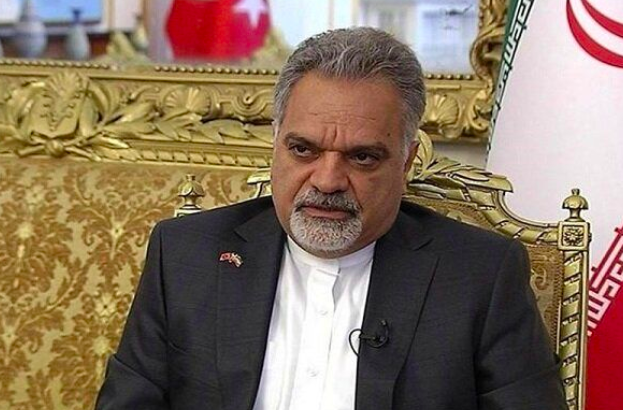
Against this backdrop, Mohammad Farazmand, a veteran Iranian diplomat and former ambassador to Türkiye, has analyzed recent developments in the South Caucasus. His long experience in foreign policy and regional affairs particularly in one of Iran’s most strategically significant neighboring regions adds depth to his assessment beyond abstract analysis.
In this conversation, Farazmand offers a clear-eyed assessment of Washington’s objectives in the South Caucasus, the messages embedded in Vance’s visit, and the potential consequences of developments surrounding Zangezur for Iran’s security and national interests.
At a time when tensions between Tehran and Washington are intensifying, how should J.D. Vance’s recent visit to Azerbaijan be interpreted? Was it primarily diplomatic in nature, or did it carry specific political and security messages for Iran?
Vance’s trip to the South Caucasus represents the highest-level visit by a U.S. official to the region in the past two decades. Its objectives should be analyzed within the context of recent conflicts and agreements in the South Caucasus. The visit took place at a moment when Trump, amid the Ukraine war, has been exerting pressure on both Russia and Ukraine in an effort to secure a peace deal that he could claim as his own achievement.
At the same time, this visit to two of Iran’s neighboring countries coincided with the large-scale deployment of U.S. military forces to waters south of Iran, as part of increased pressure on Tehran over the nuclear issue. Additionally, in August 2025, Armenia and Azerbaijan signed an agreement in Washington on the arrangements for the Zangezur route, which was branded the “Trump International Peace and Prosperity Path.” According to media reports, this agreement was also discussed during Vance’s meetings in Yerevan and Baku.
Overall, it is clear that the United States is attempting to send messages to both Iran and Russia. How these messages are received in Tehran and Moscow, however, is open to debate. It appears that both capitals have deliberately avoided public reactions that would signal heightened sensitivity—particularly since the American side refrained from explicitly adopting an anti-Iranian or anti-Russian stance during the visit.
As for the implicit signals, it seems unlikely that U.S. political maneuvering in the South Caucasus should be overstated at this stage. In this region, the United States is more vulnerable than it is capable of posing a serious threat.
Is Washington’s real objective in its active involvement in the South Caucasus and the Zangezur corridor to promote peace and regional development, or does this project primarily serve as a tool for geopolitical competition with Russia and increased security pressure on Iran?
Following the 44‑day war in 2020 and the signing of a ceasefire, Azerbaijan and Armenia, despite holding several trilateral meetings with Russia’s participation, failed to reach an agreement on reopening transport links, particularly the Zangezur corridor. Armenia opposed the creation of an extraterritorial corridor, and Russian mediation between 2021 and 2024 also failed due to the complexity of security, customs, and sovereignty arrangements. It was evident that entrusting the security and management of the corridor to Russia was itself highly sensitive, given historical considerations.
It appears that Baku and Yerevan sought, on the one hand, to reduce the geopolitical competition surrounding Zangezur in the broader regional environment by granting this concession to the United States, and on the other hand, to satisfy Donald Trump—who is known for his enthusiasm for signing agreements at the White House—by offering him a political achievement that could help recalibrate their relations with Washington. It has been reported that the concession to administer the corridor has been granted to the United States for a period of 99 years, although it is unlikely that the legal details of this agreement, like many other Trump-era deals, are clear or transparent. Trump generally favors quick and simple agreements, but the key question remains whether complex issues such as Zangezur can be resolved and sustained through such simplified arrangements. For now, Baku and Yerevan have found a way to please Trump.
Nevertheless, important questions and ambiguities remain. Among them is the issue of what security arrangements would govern the presence of Americans near Iran’s borders. Would Russia tolerate a long-term U.S. security presence in the South Caucasus? It is still too early to provide definitive answers, and much will depend on how the framework for the American presence is ultimately defined. Today, even U.S. bases in the region have become increasingly vulnerable, and we have seen Washington evacuate its bases in Iraq.
If the United States becomes directly or indirectly involved in the Zangezur route even through private companies—what security, political, and long-term consequences would this entail for Iran, Armenia, and Azerbaijan? Can a “regional-only cooperation” approach prevent such outcomes?
As noted earlier, the South Caucasus is not a region where the United States can operate unilaterally. Iran, Russia, and Türkiye are the three principal neighboring and regional actors. There was previously an understanding that issues related to the South Caucasus including the reopening of communication routes—would be addressed within the 3+3 framework.
Regarding the so-called “Trump Road,” if the presence of American companies becomes substantive, the nature of their security coverage will be a decisive factor. Iran has consistently underscored its sensitivity to the security and sovereignty arrangements of Zangezur, and for Tehran it is of paramount importance that its northern borders remain unchanged.
At the same time, it remains to be seen to what extent Russia would tolerate an American security presence associated with the implementation of this project in the South Caucasus. For now, the situation appears to be confined largely to a celebratory atmosphere surrounding the announcement of an agreement, rather than a clearly defined and enforceable reality.