


By Dure Akram, from Lahore / Pakistan
No state can ignore armed groups crossing its borders to kill its citizens. Pakistan’s strikes inside Taliban-ruled Afghanistan must be understood first in that context of self-defense. Years of escalating attacks inside Pakistan have convinced its leadership that the Afghan frontier can no longer be treated as a passive security problem. Washington has publicly supported Pakistan’s right to defend itself against cross-border militancy, reflecting growing international recognition that the Tehreek-e-Taliban Pakistan (TTP) insurgency has become a regional security issue rather than a purely domestic one.
But the smoke rising from the pockmarked hangars of Bagram Air Base in March 2026 also signals something deeper. It marks the collapse of a strategic doctrine that shaped South Asian security for decades.
For much of its history, Pakistan pursued what planners called “strategic depth”: the belief that Afghanistan could function as a stable western rear guard against India. When the Taliban returned to power in Kabul in 2021, some in Islamabad believed that vision might finally be realized. Instead, the opposite occurred. The Taliban regime has become not a buffer but a volatile neighbor whose territory increasingly serves as a staging ground for militant violence directed at Pakistan.
The declaration of open war by Pakistan’s defense minister on February 27 was therefore not a sudden rupture but the culmination of years of deteriorating relations.
Operation Ghazab lil-Haq represents a significant shift in Pakistan’s military posture. For years, Islamabad relied on limited cross-border operations against militant hideouts while avoiding confrontation with the Taliban government itself. The ongoing military offensive has fundamentally changed that calculus.
Targets included facilities near Kabul, Kandahar and the former US airbase at Bagram, signaling that Pakistan now regards Taliban-controlled military infrastructure as part of the operational environment sustaining cross-border militancy.
According to Pakistani government statements, the campaign has inflicted substantial damage on Taliban forces and infrastructure during the first week of fighting. Information Minister Attaullah Tarar reported that 481 Afghan Taliban personnel were killed in the first week of March. The destruction of 226 check posts and 198 tanks suggests a level of conventional attrition that the Taliban is ill-equipped to handle in a straight fight. The strike on Bagram Air Base on March 1, 2026, stands as the most symbolic act of this campaign. Once the crown jewel of American power, the base was utilized by the Taliban as a trophy. Satellite imagery confirmed the destruction of a major aircraft hangar and two large warehouses. The escalation has already triggered international alarm, with the United Nations warning that the fighting has displaced more than 100,000 people along the frontier, while Pakistan insists the conflict will continue until cross-border militant infrastructure is dismantled.
Pakistan’s central grievance is the continued presence of TTP fighters on Afghan territory. Terror attacks in Pakistan increased by 34 per cent in 2025. Security analysts attribute much of this surge to the safe operating environment that militant networks regained inside Afghanistan after the Taliban’s return to power.
For Islamabad, this relationship is not merely a diplomatic irritant but a direct security threat. The Taliban leadership has occasionally offered lip service or its own share of counter-allegations but has consistently resisted dismantling the group’s leadership or infrastructure.
The TTP is also highly decentralized, with autonomous factions capable of launching attacks even when leadership-level negotiations occur.
Defense Minister Khawaja Asif recently unveiled how the Afghan Taliban demanded 10 billion Pakistani rupees (approximately $35.93 million USD) to relocate Tehreek-e-Taliban Pakistan (TTP) fighters away from the Pakistan-Afghanistan border, but without any written guarantee.
That hesitation reflects a structural contradiction within the Taliban movement. Many of the militants now operating against Pakistan fought alongside Afghan Taliban factions during the insurgency, making a decisive crackdown politically and ideologically difficult for Taliban leaders. Its political legitimacy is rooted in militant struggle, yet governing a state requires suppressing precisely those militant networks when they threaten neighbors.
This strategic ambiguity has convinced Pakistani officials that Afghanistan has once again become a permissive environment for anti-Pakistan militancy.
The connection runs much deeper. The TTP itself has long described its movement as an extension of the Afghan Taliban and shares leadership networks, ideological foundations and operational history with Taliban factions across the border.
The crisis also unfolds along one of the region’s most contested historical frontiers. The Durand Line, drawn in 1893 between British India and the Afghan emir, became the internationally recognized border after Pakistan inherited it in 1947. Pakistan regards it as a settled legal boundary under international law.
For decades, the border remained porous, allowing militant networks to move freely across mountainous terrain. In recent years, Pakistan has attempted to enforce the frontier through fencing, checkpoints and surveillance. Yet insurgent infiltration has continued.
Today, the Durand Line has become the frontline of a new type of conflict: one combining conventional military strikes, drone warfare and insurgent infiltration across one of the world’s most difficult landscapes.
Pakistan is not the only state concerned about the militant ecosystem emerging in Taliban-ruled Afghanistan.
Across Central and South Asia, there is growing apprehension that Afghanistan could again become a hub for transnational extremist groups. China, Russia and several Central Asian governments have publicly expressed concern about militant activity near their borders. Iran has also warned repeatedly about extremist networks operating in the region.
These concerns intensified after attacks linked to militants operating from Afghan territory targeted foreign nationals in Central Asia. The episode reinforced a perception widely shared among regional governments: that the Taliban’s control over militant organizations inside Afghanistan is far weaker than it claims.
Pakistani officials also warn that the militant ecosystem inside Afghanistan now includes multiple armed organizations, including TTP factions and Islamic State–Khorasan affiliates operating near the border; claims corroborated by UN assessment reports.
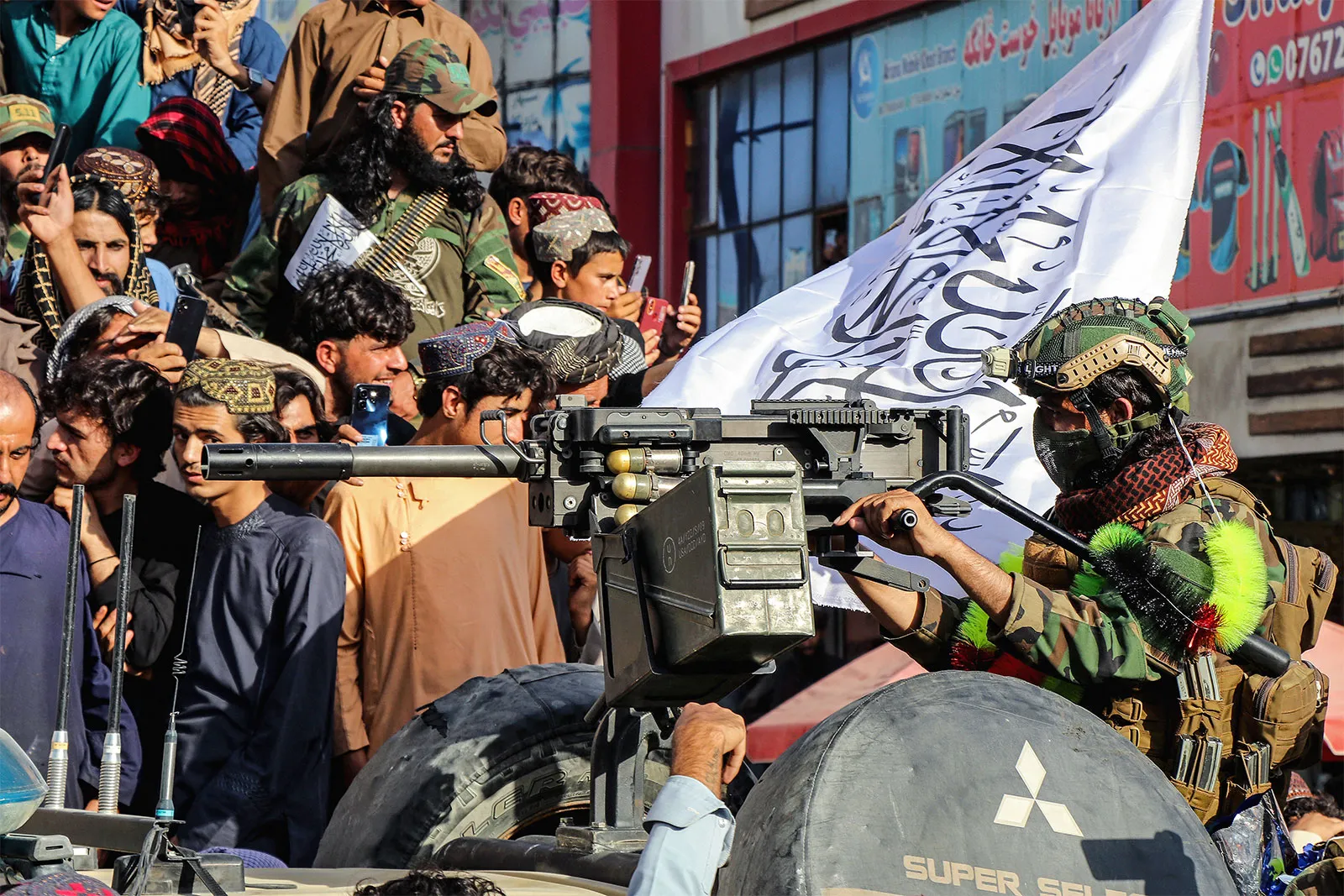
The Taliban leadership has attempted to frame Pakistan’s strikes as aggression against Afghan sovereignty. Reports from Kabul indicate that local leaders have been pressured to organize anti-Pakistan protests, reflecting the regime’s reliance on choreographed displays of nationalism to consolidate authority.
Such tactics reveal a deeper problem in Taliban governance. Public politics under the regime is tightly controlled, and dissent is suppressed. In moments of external conflict, the leadership relies heavily on mobilized outrage to reinforce its domestic legitimacy.
This strategy converts a complex security dispute into a simpler narrative in which the Taliban presents itself as the defender of Afghan sovereignty while deflecting attention from the militant networks operating within its territory.
India’s position adds another layer to the strategic picture.
India has expanded diplomatic engagement with the Taliban government through humanitarian aid, welcoming Taliban delegations and standing in unison with Tel Aviv in supporting their narrative.
The effect is to complicate Pakistan’s security environment further by expanding the geopolitical competition surrounding Afghanistan.
The conflict is also unfolding amid wider geopolitical turbulence. The recent US-Israeli strikes on Iranian targets have intensified instability across the broader Middle East and diverted international attention from South Asia.
As a result, the Pakistan-Afghanistan confrontation is developing largely without sustained international mediation. International powers, including the UN, China, and Russia, are calling for an immediate ceasefire between Afghanistan and Pakistan, but none have demonstrated the capacity or willingness to impose a settlement.
The Afghan Taliban has said that it is willing to negotiate with Pakistan, but there are growing concerns that the conflict could continue to escalate.
This leaves Pakistan confronting a difficult strategic reality: tolerating militant sanctuaries carries unacceptable security risks, yet prolonged military escalation carries its own dangers.
The events of 2026 ultimately represent the collapse of a long-standing strategic assumption.
Pakistan once believed that influence in Afghanistan could guarantee security along its western frontier. Instead, it faces a government in Kabul whose ideological affiliations complicate regional stability and whose territory continues to host militant networks hostile to Pakistan.
The Taliban, meanwhile, seeks the diplomatic legitimacy of a sovereign state while maintaining relationships with armed movements that undermine regional security.
Those two positions are fundamentally incompatible.
Pakistan’s security concerns are real and cannot be dismissed as mere geopolitical rivalry. But long-term stability will require Afghanistan to demonstrate that its territory will not be used as a sanctuary for militant organizations targeting neighboring states.
Until that happens, the frontier between the two countries will remain one of the most volatile fault lines in Asia.
The smoke rising over Bagram is therefore more than the aftermath of a military strike. It marks the moment when Pakistan’s decades-old search for strategic depth finally reached its sovereign limit.
The core issue is no longer simply border management. It is whether Afghanistan under Taliban rule will function as a sovereign state that restrains militant actors or as an ideological sanctuary that exports instability across the region.