


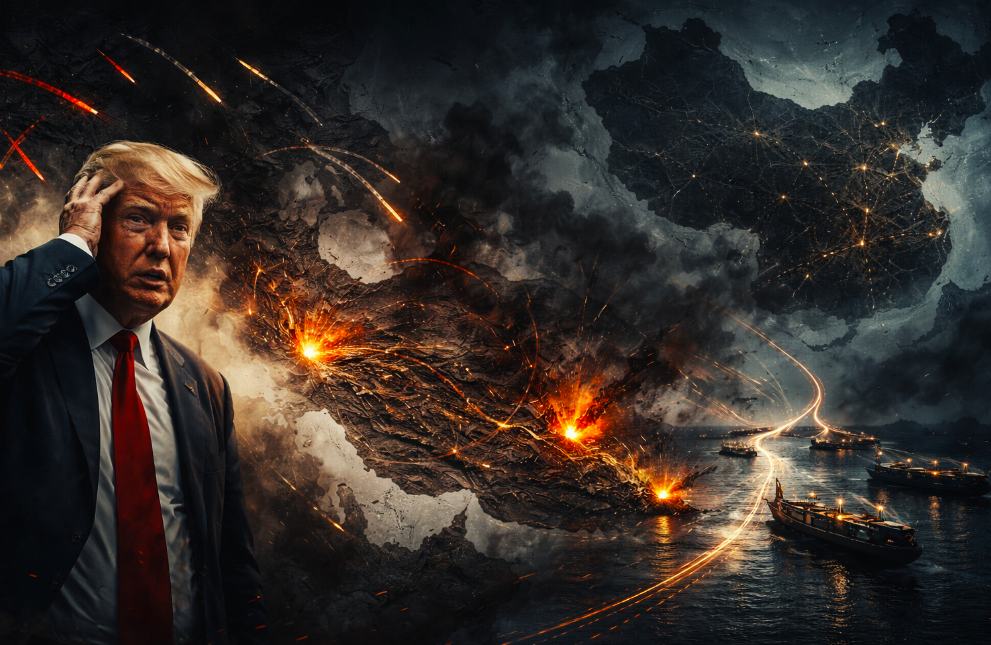
As the war between the United States and Iran intensifies across the Middle East, questions are mounting over Washington’s long-term strategy and the broader geopolitical stakes. Retired Turkish Major General Ahmet Yavuz offers a stark assessment: the conflict, he argues, is marked by unclear objectives, risky assumptions, and the potential for prolonged instability.
“When we talk about strategy, we mean the alignment between objectives and means,” Yavuz says. “In the case of the United States, we see multiple objectives—but insufficient means to achieve them.”
Unclear Goals, Limited Tools
According to Yavuz, the central problem lies in Washington’s lack of strategic clarity. He outlines several possible aims—regime change in Iran, territorial fragmentation, or the creation of a more compliant political structure—but stresses that none appear feasible under current US military capacity.
“If your objectives and tools are not aligned, your strategy becomes fragile,” he warns. “The United States seems to be relying on assumptions—such as triggering internal unrest in Iran—but those assumptions have not materialized.”
One key example, he notes, was the early killing of a senior Iranian commander. While such a strike might have been expected to destabilize the system, the opposite occurred. “It strengthened resistance among the population,” Yavuz says.
The retired Turkish general says the US had assumed a crackdown of the Iranian regime, with the leader’s assassination followed by a popular uprising, leadng to chaos. None of that happened.
A War of Attrition
On the battlefield, the conflict has evolved into what Yavuz describes as a “war of attrition,” with both sides seeking to exhaust the other over time.
“The United States is trying to wear Iran down,” he explains. “But the critical question is: how long can this be sustained?”
That question applies to both sides. The U.S. must manage the costs of maintaining missile defense systems and sustaining operations across the region, while Iran relies heavily on its missile arsenal, drones, and allied forces in countries such as Iraq and Lebanon.
“Iran is trying to maintain its will to fight while expanding pressure on U.S. assets,” Yavuz says. “But we don’t know how long either side can sustain this level of intensity.”
He questions how long the US antimissile capacities endure again continuing Iranian attacks.
Facts on the Ground
The war began on February 28, 2026, and has since spread across multiple fronts. The United States has reportedly struck thousands of targets inside Iran, while Iranian forces have retaliated against military bases and infrastructure across the Gulf.
The conflict has already taken a toll: hundreds of U.S. troops have been wounded, with fatalities confirmed, and civilian casualties reported in several countries. Meanwhile, global energy markets have been shaken, with oil prices surging amid disruptions around the strategically vital Strait of Hormuz.
Domestic Pressures in Iran
Despite internal tensions within Iran, Yavuz emphasizes that foreign intervention has not translated into domestic support for the United States.
“There is opposition within Iranian society,” he says. “But we observe that opposition against the Mullahs does not accept itself becoming a tool of US and Israeli attacks. They seem to say: ‘Yes, I don’t like this leadership, I want them gone from power, but I do not support the Americans coming and changing my county’s regime or dividing it.”
Instead, he suggests that outside pressure may be reinforcing national unity, at least in the short term.
He adds that it is also a question how long Israel can endure, pointing to reports that part of the population leaving the country.
Risk of Escalation
While a full-scale ground invasion appears unlikely under current conditions, Yavuz does not rule out limited operations.
“A large-scale ground operation is not feasible right now,” he says. “But special forces operations or limited events—especially around the Strait of Hormuz—remain possible.”
Such moves, he warns, could further escalate the conflict and draw in additional regional actors.
He points to US efforts to mobilize the Kurds, which have failed and states the US and Israel look to broaden their alliance, including neighboring countries such as Türkiye and Azerbaijan.
Several missiles have fallen on Turkish territory, claimed by Western countries to be fired from Iran – which Iranian official sources always denied. Yavuz adds: “These are provocations, which have not been very successful so far. President Erdoğan’s recent statements show that Türkiye is in a more consistent position, though one must continue watching.”
A Wider Geopolitical Struggle
Beyond the immediate confrontation, Yavuz argues that the war must be understood in a broader global context—particularly in relation to China.
“This war is not only about Iran,” he says. “It is indirectly about China.”
Iran plays a key role in China’s energy supply chain, and weakening Tehran could have ripple effects on Beijing’s global position. “The United States sees China as a rising power that threatens its dominance,” Yavuz explains. “Targeting Iran is one way of applying pressure.”
The Trump factor
For the Turkish expert, Trump’s role is exaggerated. “People connect this war to Trump’s personality. We cannot not ignore the personal factor, of course. He is a worthless, just rich person. The established US order meanwhile makes the observation that the US is in decline and has chosen him to exercise the counterattack. The problem isn’t him; it is the need that brought him to power.”
He adds, “they want an Iran that complies with them, and that only trades with China as far as they allow it to do.”
Defending the Dollar empire
The conflict with China fought also in Iran, is one about the dominance of the US dollar, Yavuz adds. “The rise of China is a dagger to America’s dollar empire. When the dollar empire of America ends, it will not be possible for the keep what they have achieved and gained with its military power in world hegemony. Maybe he will lose many of his bases. This American presence will face a recourse situation from the world to its own continent. For this reason, this means the end of the dollar empire and the weakening of its military power.”
Europe Watches Cautiously
European governments, meanwhile, are treading carefully. Italy, for example, has emphasized that it does not want to be drawn into the conflict, despite hosting U.S. military bases on its territory.
Italian officials have stressed the importance of diplomacy and de-escalation, even as NATO commitments remain in place.
An Uncertain Outcome
For now, the war shows no clear path to resolution. Yavuz describes the situation as a “strategic arm-wrestling match,” with neither side able to deliver a definitive blow.
“We are witnessing a mutual war of attrition,” he says. “The outcome will depend on endurance, resources, and external support.”
As the conflict grinds on, the risk is not only prolonged regional instability—but a broader confrontation with global consequences.