


By Adem Kılıç, Political Scientist
After the past 37 days, the U.S.-Israel-Iran conflict has moved beyond the battlefields and evolved into a phase that directly targets the resilience of nations.
The harsh tone evident in U.S. President Donald Trump’s latest statements makes it clear that the conflict has moved beyond military targets, with the intention of systematically striking Iran’s energy production infrastructure, transportation networks, and critical facilities—actions that would be considered war crimes under international law.
This approach points to a “paralysis strategy” rather than classical war doctrine, and it appears the objective is no longer merely to weaken military capabilities but to shape a strategy aimed at putting the country under internal pressure by severing the lifelines of Iran’s economy.
In this context, power plants, oil refineries, natural gas processing facilities, railway lines, and major bridges have now become primary targets.
This is because modern wars, particularly the war in Ukraine, have shown that battlefield superiority can no longer be determined solely by combat capabilities on the front lines.
In light of this reality, the choice the U.S. has made here should be interpreted as an attempt to win a war where it cannot achieve rapid results on the battlefield by eroding Iran’s “system capacity.”
However, the on-the-ground reality of this strategy could unfold into a more complex scenario than Washington anticipates.
This is because, rather than retreating in the face of such pressures, Iran consistently demonstrates a reflex that alters the nature of the conflict.
Indeed, every infrastructure attack against Iran lowers the threshold for Iran to respond across a broader geography and with more ambiguous means, effectively turning into a nightmare for the U.S.’s regional allies.
Iran’s strategy of controlled escalation
Rather than responding with direct conventional force, Iran is pursuing a strategy that increases the cost of war by spreading it out; the most notable aspect of this approach over the past 37 days is that its targets are systemic rather than merely symbolic.
Bridges, energy transmission lines, port connections, and critical logistics routes have become Iran’s primary targets. The aim is not to directly strike the U.S. military presence in the region, but to undermine the sustainability of that presence.
This strategy also has a time-based character.
For Iran aims not to achieve a major military victory in the short term, but to gradually increase the cost of the war, thereby exerting pressure on the U.S. on the global stage and in the eyes of its allies.
For this reason, attacks generally continue at low intensity but with a clear logic of retaliation and a sense of continuity.
At this stage—that is, in a protracted conflict like this one—the psychological dimension is undoubtedly just as important as the physical destruction.
Iran is pursuing a sort of “tit-for-tat” policy by responding to attacks on its own infrastructure with retaliations of similar scale. In this way, it seeks to prevent the war from turning into a one-sided destruction process; while it may not hold a psychological advantage, it also does not want to lose it.
This approach is becoming more visible through covert or direct attacks on energy lines in the Gulf and the economic lifelines of U.S. allies, and Iran is pursuing a strategy of expanding its influence without geographically expanding the war.
What would be the impact of attacks on energy infrastructure?
At this stage, there is no doubt that following the blockage of military supply lines, power plants and infrastructure networks have become one of the most critical fronts of this war.
Intensive attacks on Iran’s electricity generation capacity carry the potential to disrupt defense industry production and the continuity of military systems in the initial phase.
In particular, since air defense systems, radar networks, and missile production facilities are energy-dependent structures, disruptions in this sector could directly impact military capabilities.
Beyond this, targeting the energy infrastructure could directly affect urban life and create pressure within the domestic public sphere.
Prolonged power outages, disruptions in fuel distribution, and declines in industrial production could heighten economic and social tensions within Iran. One of Washington’s calculations is precisely this: the transformation of military pressure into internal political pressure.
However, such attacks may push Iran to respond with harsher and more widespread countermeasures rather than forcing it to back down.
Because from Tehran’s perspective, this war is no longer merely a military struggle but is viewed as a matter of survival, and this situation significantly lowers Iran’s risk threshold, leading it to adopt a more aggressive stance on the ground.
And in light of all these developments, the situation is stalling in the Strait of Hormuz, as I wrote in the pages of World of Türkiye weeks ago.
Escalation Scenario in the Strait of Hormuz
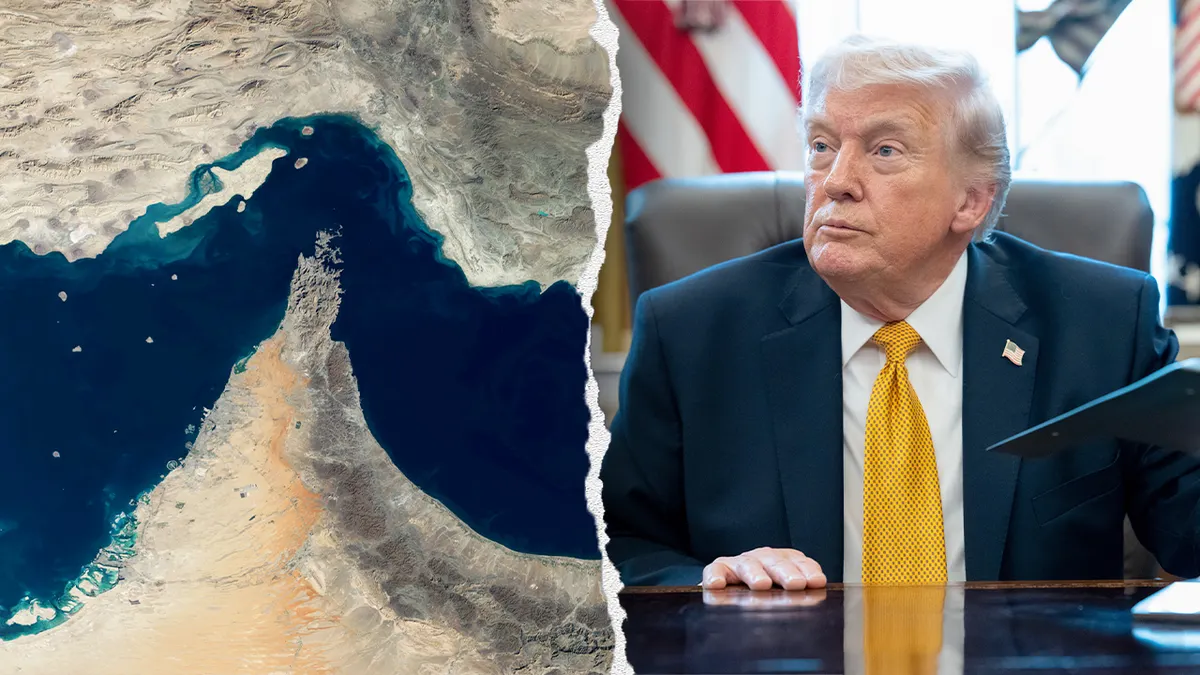
The Strait of Hormuz has emerged as the most critical flashpoint of the current war from the very first day.
Iran is using this narrow strait—through which approximately one-quarter of global oil and LNG trade passes—as a strategic lever beyond its conventional military capabilities.
Iran’s tactics here—referred to in military literature as “gray zone” tactics—not only exert constant pressure on the U.S. and its allies but also, through their global implications, make the conflict the top item on the agenda.
This is because the risk of mines laid by Iran in the strait, attacks carried out by high-speed assault boats, kamikaze drones, and anti-ship missiles stationed along the coast could render maritime traffic inoperable without completely halting it.
The U.S.’s Strategic Dilemma and Its Consequences
From Washington’s perspective, the biggest problem is that an area it once viewed as militarily controllable has now become unmanageable not only militarily, but also economically and politically.
Another dilemma for the U.S. has emerged in the realm of alliances.
European and Asian economies are highly dependent on energy flowing through the Strait of Hormuz. Consequently, the U.S.’s aggressive military moves are creating economic pressure on its allies and weakening strategic coordination. This, in turn, strengthens Iran’s “cost-spreading” strategy—exactly what Iran aims to achieve.
At this stage, the U.S.-Iran conflict has evolved beyond a conflict where the winner can be easily defined, and while the U.S.’s infrastructure-focused pressure strategy holds the potential to weaken Iran, it simultaneously renders the regional and global system more fragile.
Iran, aware that it cannot establish direct military superiority, is pursuing a strategy of globalizing the war’s costs and, in this regard, is using the Strait of Hormuz as a strategic lever.
What will be decisive in the coming period is not how far the parties can go, but at what point they will cross a point of no return.
Because this war is no longer confined to just two countries; it is unfolding at the heart of the global energy order, and any military conflict in the Strait of Hormuz will not only shake the global economy but also fundamentally transform the international system.