


By Orçun Göktürk, from Beijing / China
While the world has been focused on imperialist-Zionist aggression against Iran, the closure of the Strait of Hormuz, the US-Iran talks held in Islamabad, and the uncertain ceasefire agenda, Cheng Li-Wun, leader of Taiwan’s main opposition party Kuomintang (KMT), completed a six-day visit to China.
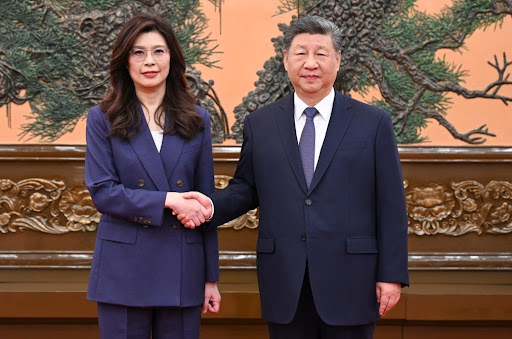
KMT leader Cheng met with Xi Jinping at the Great Hall of the People in Beijing. Before examining the details of the meeting and the impact of the visit on both sides of the Taiwan Strait, it is important to note that this was an “extraordinary” meeting.
Xi Jinping has not met with anyone outside the ruling party for a long time. I was in Taiwan throughout January, and in my discussions with various senior KMT officials, they did not expect Xi to meet the KMT leader. They explained it quite simply: “Does the KMT leader govern Taiwan? Why would Xi consider him a counterpart?”
So why did Xi Jinping engage with and meet the KMT leader, who is in the opposition?
Iran’s resistance changed the picture
At this point, it is necessary to begin with the US-Israeli war launched against Iran after February 28. The increasing risk of war in international geopolitics, combined with the closure of the Strait of Hormuz to US allies, triggered an oil and natural gas crisis across Asia, especially affecting Taiwan (it was reported that the island had only 13 days of natural gas reserves remaining). This likely played a role in Xi’s decision to meet Cheng.
Secondly, Xi, who last met a KMT leader in 2016, may also have wanted to send a message to the United States via Taiwan ahead of a highly probable visit by Trump to Beijing in early May.
The 1992 consensus
The 1992 Consensus, signed in Hong Kong regarding the ambiguity of Taiwan’s current status in Beijing-Taipei relations, remains a subject of debate today. The Consensus is based on the “One China” principle but leaves the definition of China open to political interpretation by both sides.
Beijing’s interpretation (grounded in international legitimacy) including the United Nations, is that “there is one China, and the People’s Republic of China, centered in Beijing, represents it.” The KMT, however, holds that “there is one China, and it is the Republic of China (ROC).”
Although it has recently lost political strength, the Democratic Progressive Party (DPP), which holds the presidency in Taiwan, opposes the Consensus. It argues that the Hong Kong agreement was signed without the approval of Taiwan’s political institutions or its people and therefore does not officially recognize it.
Nevertheless, the 1992 Consensus has created a “gray zone” that allows China and Taiwan to set aside their sovereignty disputes and cooperate, particularly in trade. It is worth recalling that trade volume between Beijing and Taiwan has reached nearly $350 billion.
The KMT leader’s mainland visit
Since Xi assumed the presidency in 2013, KMT leadership has changed six times (excluding interim leaders). Cheng is the fourth KMT leader to meet Xi during this period.
Cheng’s first stop in mainland China was the Sun Yat-sen Mausoleum in Nanjing. In his speech there, he referred to Sun Yat-sen as a figure uniting both the Republic of China and the People’s Republic of China. Both Beijing and Taipei regard Sun Yat-sen as the founding father of modern China.
“Western hegemonic culture”
Cheng’s main message in Nanjing was his criticism of the West. Taking a notably harsh stance against what he called “Western hegemonic culture” (西方的霸道文化), Cheng contrasted it with the peaceful Asian civilization that Sun Yat-sen described as the “Eastern culture of virtuous governance” (東方的王道文化).
He also referenced the Sino-Japanese War, emphasizing that it occurred because Japan had strayed from its own path and internalized Western influences.
The concepts of “霸道” (badao) and “王道” (wangdao) used by Cheng represent a fundamental distinction in Chinese political thought. “Badao” refers to a system based on force, power, and hegemony, whereas “wangdao” signifies a model of governance based on moral superiority, virtue, and harmony. In the modern era, this distinction has frequently been reinterpreted by Chinese thinkers in opposition to Western imperial expansionism.
The Japan example is particularly significant. In response to the strong influence of Japanese culture in Taiwan and the increasing use of the “Taiwan card” by Japan’s leadership in recent times, Cheng made an important statement directed both at Japan and the island’s domestic audience. Within the context of the Second Sino-Japanese War, Japan’s deviation from its own path and its imperial expansion leading to the occupation of Taiwan is presented by Cheng as both an internal deviation and an external, Westernized influence.
The Xi-Cheng meeting
Hosting the KMT leader at the Great Hall of the People in Tiananmen Square, a venue typically used for meetings with state leaders, Xi emphasized that “people on both sides of the Taiwan Strait are Chinese and belong to one nation.” He described reunification as a “historical inevitability” and stated that external interventions cannot halt this process. Xi also reiterated that the 1992 Consensus forms the basis of political relations across the Strait.
During Cheng’s speech, journalists were asked to leave the hall. However, after the meeting, Cheng held a press conference, stating that Xi expressed respect for Taiwan’s political system and hoped Taiwan would similarly respect China, provided both sides contribute to the “rejuvenation of the Chinese nation.” Cheng also noted that Xi’s views align with Sun Yat-sen’s “Three Principles of the People.”
Another notable development was Cheng’s invitation to Xi Jinping to visit Taiwan. Cheng expressed hope that such a meeting could take place under a future KMT government and stated that efforts are being made to establish institutional mechanisms for dialogue between the Communist Party of China and the Kuomintang based on the 1992 Consensus.
Can U.S. influence on the island be broken?
Cheng’s visit to China was significant in every respect. Recently, separatists (DPP) lost their majority in parliament and also ceded many local governments to the KMT. Cheng’s visit is clearly also a calculation aimed at the upcoming election period.
His statement, “We will not allow the island to become Ukraine” sends a message both to the United States and to separatist forces on the island. The KMT is currently pushing to reduce the DPP’s defense budget from $45 billion to $12 billion.
Pro-American sentiment remains strong within Taiwan’s official media and among the public. However, the fragmentation of the Atlantic alliance after Trump, the Iran war and other geopolitical developments are leaving the Taiwanese people with two choices: either continue aligning with the United States and risk turning the Taiwan Strait into the next conflict zone or seek ways to coexist peacefully with Beijing.