


By Doğan Akdeniz
The crisis that began in the Strait of Hormuz on February 28, 2026, has gone far beyond a conventional regional tension, creating a systemic rupture for the global economy. The disruption of a critical choke point that carries roughly one-fifth of the world’s oil supply and two-thirds of global liquefied natural gas (LNG) trade represents a manifestation of what energy security literature defines as a “shock scenario.” Such shocks do not merely drive-up energy prices; they also restructure supply chains, alter logistical preferences, and redefine the geostrategic positions of states.
Although the temporary ceasefire declared on April 8, 2026, in the Iran–US/Israel war has somewhat eased the markets, no actor no longer assumes that Hormuz will remain a permanently secure corridor. At precisely this juncture, Türkiye’s geoeconomic and geopolitical position places it at the center of a new search for global equilibrium in the post-crisis order.
The only reliable route
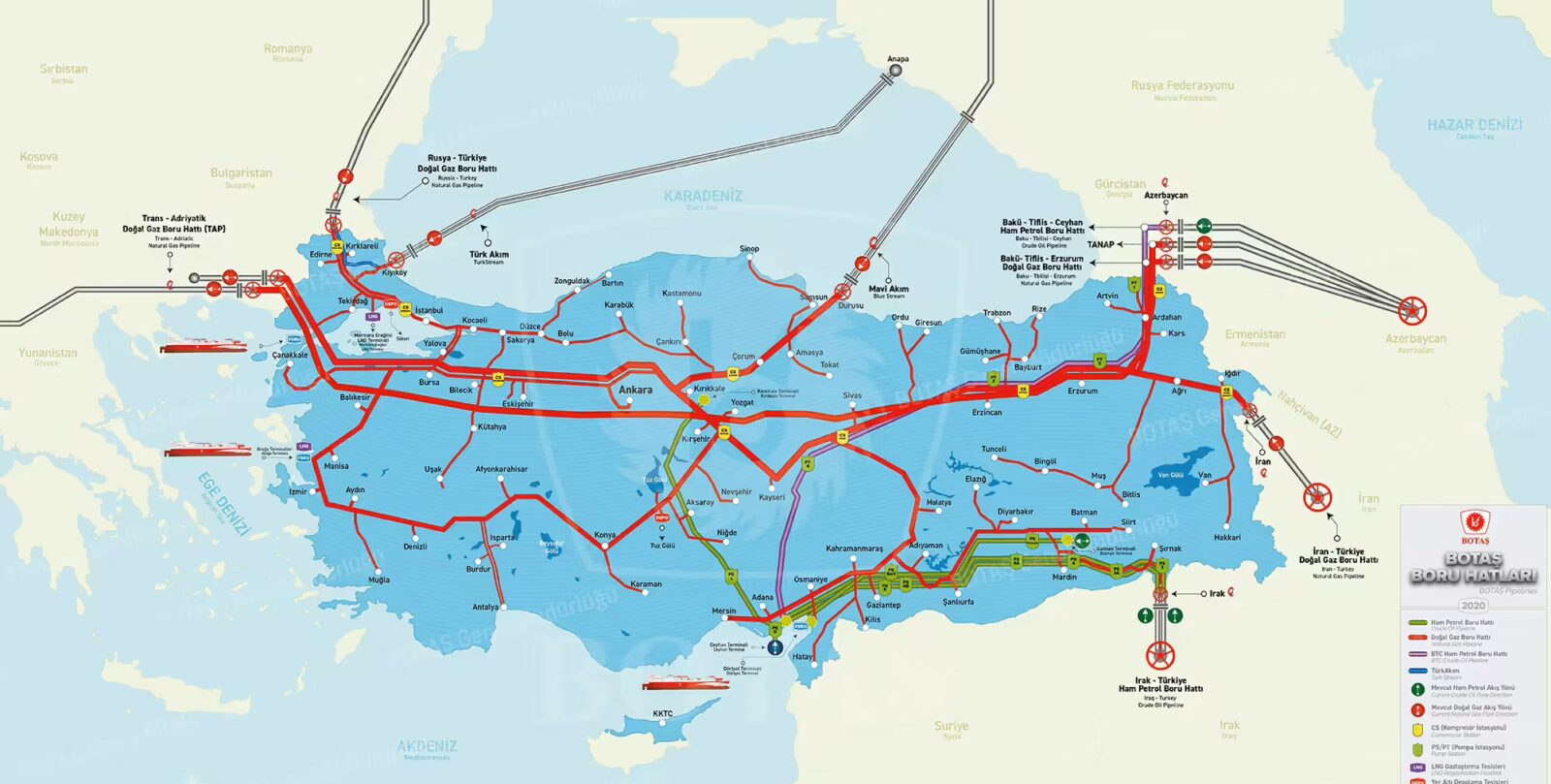
With the disruption in Hormuz, the fragility of sea-based energy transportation has become increasingly evident, elevating pipelines and overland energy corridors to strategic importance. With its existing infrastructure, such as the Eastern Anatolia Natural Gas Main Transmission Line (Iran–Türkiye), the Trans-Anatolian Natural Gas Pipeline (TANAP), and TurkStream, Türkiye has emerged as the “only reliable route” capable of ensuring uninterrupted energy flows. This is not merely a geographical advantage, but a tangible outcome of long-term infrastructure investments and sustained energy diplomacy.
In an environment where risks stemming from Hormuz are rising, the primary concern for energy-importing countries is no longer cost, but security of supply. In this context, the routes offered by Türkiye are increasingly positioned as risk-minimizing alternatives.
In the post-Hormuz energy environment, global actors’ perception of Türkiye is shifting markedly. From the perspective of the US and Europe, the main priority is to ensure the continuity of alternative and secure energy routes that reduce dependence on Russia. Within this framework, Türkiye is positioned as a “balancing energy hub” that diversifies supply security through TANAP, TurkStream, and potential Eastern Mediterranean connections. For the West, Türkiye’s value lies not only in being a transit country, but also in its capacity to secure these routes as a NATO member with significant military and institutional capabilities.
A geoeconomic security corridor
In contrast, the Asia-Pacific perspective, particularly that of China and India, is shaped by a very different set of priorities. For these countries, the central issue is minimizing dependence on choke points such as Hormuz and Malacca, and ensuring uninterrupted and predictable energy flows. In this context, Türkiye emerges not merely as an energy transit point, but as a “geoeconomic security corridor” integrated into the Belt and Road Initiative (BRI). For China, Türkiye is one of the rare geographies where energy and trade converge along the same corridor, and for rising economies like India, it serves as the most stable gateway to European markets via the Middle Corridor.
When these two aspects (for the West and for Asia-Pacific) are considered together, Türkiye’s role becomes clearer: for the West, it functions as an “energy insurance mechanism,” while for Asia, it represents a “strategic necessity.” This dual positioning not only provides Ankara with economic advantages, but also enhances its geopolitical bargaining power, transforming Türkiye from a mere transit route into a central actor capable of shaping the direction and conditions of global energy flows.
This transformation is not limited to energy. Disruptions in maritime routes have fundamentally altered global trade patterns. Given that a significant portion of trade between Asia and Europe depends on corridors such as Suez and Hormuz, rising risks at these choke points have made land and rail networks indispensable alternatives. The Trans-Caspian International Transport Route, widely known as the Middle Corridor, with Türkiye at its core, has evolved from being just an alternative into a critical artery for the sustainability of global trade. Reducing transit times from 35 to 45 days by sea to 12–18 days via the Middle Corridor offers not only a time advantage, but also a mechanism for risk diversification. For supply chain managers, such corridors are no longer “optional,” but rather a “necessary insurance mechanism”.
A backbone along the East–West axis
The rise of the Middle Corridor has also increased the strategic importance of the projects that support it. In this context, the Zangezur Corridor can be seen as the “counterpart of Hormuz in land”. This route, which will establish uninterrupted connectivity between Azerbaijan and Türkiye, represents not only a logistical breakthrough but also a geopolitical turning point. The transformation of cities like Erzurum of Türkiye into logistics hubs signals that Ankara is constructing a new economic backbone along the east–west axis.
Similarly, the Development Road Project stretching from Basra to Türkiye has emerged as one of the most critical alternatives in the “post-Hormuz era”. With an estimated economic volume of around $55 billion, the project underscores that it is not merely an infrastructure investment, but a macroeconomic lever.
In this process, the intersection of China’s Belt and Road Initiative with Türkiye’s Middle Corridor strategy marks a new model of global economic integration. Seeking to reduce its dependence on choke points such as Hormuz and Malacca, Beijing has identified the Middle Corridor as the most secure overland alternative. The goal of shifting 30% of China–Europe freight traffic to this route by 2027 positions Türkiye not just as a transit country, but as a logistics hub.
The financing of this transformation is based on a multi-layered model rather than a single source. Loans from the Asian Infrastructure Investment Bank (AIIB), public-private partnership (PPP) mechanisms and investments by global logistics firms are rapidly enhancing Türkiye’s infrastructure capacity.
The Blue Homeland doctrine
Being at the center of energy and trade routes also requires the capacity to secure them. Türkiye’s main advantage in this regard lies in its ability to integrate military and technological capabilities with logistical security. Within the framework of the “Blue Homeland” doctrine, Türkiye’s naval presence in the Eastern Mediterranean secures the exit points of energy terminals and pipelines. The military base in Qatar provides strategic depth near Hormuz, while the TURKSOM base in Somalia supports maritime security along the Red Sea–Gulf of Aden corridor. This geographic reach demonstrates that Türkiye is not merely a transit country, but also a security provider.
Technological advances in the defense industry further reinforce this security architecture of Türkiye. Unmanned aerial vehicles (UAVs) and armed drones (UCAVs) enable continuous monitoring of thousands of kilometers of energy and logistics networks. Warships domestically produced under the MİLGEM project enhance escort and protection capabilities in maritime transport. This multi-layered security framework ensures that the corridors offered by Türkiye are not only fast and cost-efficient, but also secure.
However, this transformation is accompanied by risks that must not be overlooked. The rise in oil prices triggered by the Hormuz crisis may create short-term macroeconomic pressures for energy-importing countries such as Türkiye. Inflation, current account balance, and energy costs require a careful balancing of strategic gains against economic burdens. Nevertheless, Türkiye’s relatively low level of energy dependency (around 10%) provides significant flexibility in crisis management.
In conclusion, the emerging picture shows that Türkiye has moved beyond its traditional role as a “transit/bridge country.”
In a world where the Hormuz Strait is constrained, Türkiye is no longer just an alternative, a new center of the global system.