


By Dure Akram, from Lahore / Pakistan
In Muscat this week, Iran’s foreign minister Abbas Araqchi sat opposite Oman’s Sultan Haitham bin Tariq and delivered a blunt message that echoes far beyond the Gulf: foreign military presence, Tehran argues, is not a source of security but a driver of insecurity. His call for a regional security framework echoed through Islamabad earlier in the month, where Pakistan had hosted a 21‑hour US–Iran marathon talk that ended, in the words of Deputy Prime Minister and Foreign Minister Ishaq Dar, with “progress… yet the parties remain far apart.”
U.S. Vice President JD Vance led the delegation and stood in Islamabad’s Serene Hotel, praising Pakistan’s mediation while warning that Washington will not accept any Iranian path to the bomb, and Iranian negotiators insisted that sanctions relief precede any nuclear guarantee. A fragile ceasefire arranged by Islamabad gave shipowners a temporary reprieve, yet the broader war economy remains catastrophic: the region supplies roughly one‑fifth of global oil, 40% of fertilizer and nearly one‑third of LNG. Every missile fired across the Strait of Hormuz translates into spikes in oil prices all across the globe, and Pakistan has thus staked its diplomatic capital on restraining the conflict.
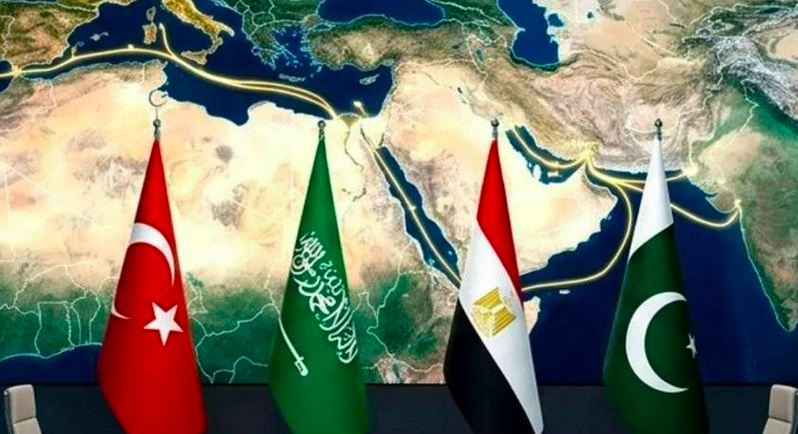
The cliff-hanging suspense of the ongoing mediation between Iran and the US, as the catastrophic war is about to hit the two-month mark, has captured most of the media’s attention, leaving little for a lesser‑known track. Even though much has been written about how foreign ministers from Pakistan, Saudi Arabia, Türkiye and Egypt met in Islamabad on 29 March, followed by a senior officials’ huddle on 14 April and a ministerial meeting in Antalya on 17 April, not many have focused on anything other than Tehran. What was perhaps equally (if not more) important was the Senior Officials’ Meeting (SOM). High-level delegations of these four states met in Islamabad, with Egypt and Turkiye led by their deputy foreign ministers, marking the institutionalization of a consultative mechanism that will last even after the US-Iran conflict comes to a close. It also sets the groundwork for strategic cooperation similar to the Pakistan-Saudi Arabia Strategic Mutual Defense Agreement (SMDA), which is already being operationalized.
For Ankara, this Quadrilateral Mechanism is about “regional solutions to regional challenges”. Turkish Foreign Minister Hakan Fidan insists the forum aims for stability and maritime security and rejects speculation about an “Islamic NATO”. His priority is restarting trade through Hormuz and preventing the war from engulfing the Red Sea.
Egyptian diplomat Badr Abdel‑Aty reminded colleagues that the group’s first round met in Riyadh on 20 March and that they would reconvene for deeper coordination.
Panning out to be more complex than a romantic pan‑Islamic awakening, it is a pragmatic response to a war that has already cost more than $25 billion in damaged energy infrastructure.
The United States remains powerful, but its ability to reassure Gulf partners has been damaged by Gaza, the strikes on Qatar, the expanding confrontation with Iran and the perception that Washington can no longer restrain Israel or stabilize the region on its own. Regional states are therefore testing new coalitions, not necessarily to replace Washington, but to reduce dependence on it.
In Islamabad, Pakistani officials openly mused about a second round of US–Iran talks–Dar and Field Marshal Asim Munir even accompanied a delegation to Tehran to deliver new proposals—while their regional partners focused on keeping freight rates from spiraling.
Pakistan’s decision to convene the Islamabad talks cannot be divorced from its security deals with Gulf monarchies. In September 2025, Prime Minister Shehbaz Sharif and army chief Asim Munir signed a Strategic Mutual Defense Agreement (SMDA) with Saudi Arabia. Analysts at the International Institute for Strategic Studies note that the pact formalized decades of transactional cooperation, introduced strategic ambiguity and signaled that Riyadh might look beyond Washington for deterrence. Pakistani officials portrayed the agreement as historic and explained that it codifies what had long been informal, making Pakistan the Gulf’s de facto nuclear guarantor. The deal coincided with Israel’s surprise strike on a Hamas delegation in Doha in September 2025, which terrified Gulf leaders and underlined the limits of US protection. Attacks on the Gulf in the last two months have cemented what Middle Eastern economies had been fearing for quite some time: they needed more options.
Türkiye, meanwhile, has woven its own threads into Pakistan’s military fabric. The Pakistan Navy inducted its second Milgem‑class corvette, built by Türkiye’s ASFAT, in early April. The contract for four corvettes, signed in 2018, includes two to be constructed in Pakistan, transferring know‑how and keeping shipyard jobs at home. Ankara also plans to open a drone assembly plant in Pakistan to produce Bayraktar TB2 and possibly Akıncı UAVs. Such cooperation has already made Türkiye Pakistan’s second‑largest arms supplier after China.
In January 2026, Islamabad’s minister for defense production revealed to media sources that Pakistan, Saudi Arabia and Türkiye are all set to draft a trilateral defense agreement after nearly a year of talks. Turkish Foreign Minister Fidan confirmed that talks had been held and emphasized the need to build trust to avoid external hegemony. However, he denied that any agreement had been signed and called for an inclusive platform. Rumors have since swirled that Qatar is negotiating its own defense pact with Pakistan as it seeks layered deterrence and interoperability after Israeli strikes on Doha. To add to the glitz,13,000 Pakistani soldiers and 18 fighter jets have already landed in Saudi Arabia.
There is an uncomfortable tension at the heart of Pakistan’s regional activism. On the one hand, Islamabad has leveraged decades of relationships with Washington, Tehran and Riyadh to broker ceasefires. On the other hand, it is cementing defense agreements that could entangle it in conflicts far from home. The Quadrilateral Mechanism offers a middle path, but its opaque functioning raises questions.
This tension is magnified by Pakistan’s domestic security history. The 2014 Peshawar school massacre remains etched in national memory: Taliban gunmen stormed the Army Public School on 16 December and murdered 150 people—134 of them children. In response, the government unveiled a twenty‑point National Action Plan against extremism. For a time, the country united around the idea that no strategic interest justified the sacrifice of its children. How does that lesson square with the possibility of Pakistani troops manning Gulf bases? Proponents argue that dispatching advisers to Riyadh or Doha will fund Pakistan’s struggling economy and expand strategic depth. Critics warn that fighting someone else’s war risk’s blowback at home; Pakistani soldiers could find themselves in the line of fire amid sectarian conflicts that have nothing to do with the Indus Valley.
The fixation with forging an “Islamic Quad” also overlooks societal debates about governance, economic reform and environmental resilience. There is also the matter of nuclear opacity. The Saudi‑Pakistani SMDA contains ambiguous language about deterrence. F. Gregory Gause III, associate fellow of the Middle East Institute in Washington, D.C, believes that Riyadh’s interest in the pact is to compel Washington to augment its protection, claiming that “while the pact is unlikely to dramatically impact US relations with its Gulf partners, it may reinvigorate efforts to enhance military interoperability and security. Pakistan has long argued that its nuclear arsenal exists to deter India. If an attack on Riyadh triggers a nuclear response, how does Islamabad maintain credibility against Delhi while fulfilling obligations to the Gulf? Without transparent debate, such questions fester.
It is notable that Fidan publicly emphasized that the quadrilateral meeting aims at economic development and ending conflicts, not confrontation. Egypt’s foreign minister has also stressed the importance of respecting state sovereignty and non‑interference. Pakistan could champion these principles by subjecting any defense pact to parliamentary scrutiny and clarifying that nuclear weapons will never be stationed abroad. And it could use the quadrilateral forum to demand an end to the blockade of Gaza and to call out Iranian proxies. In doing so, Islamabad would show that its new diplomacy is not about sectarian blocs but about concrete, accountable peace building.
The Middle East is undergoing a tectonic shift. The US–Israel–Iran war has shattered assumptions about American omnipotence and revived the specter of state collapse across the Gulf. Regional powers are filling the vacuum. The so‑called Islamic Quad—Pakistan, Saudi Arabia, Türkiye and Egypt—is one such experiment. Its success will depend on whether it remains an instrument of de‑escalation or morphs into a clandestine military arrangement. Pakistan stands at the center of this experiment. It has unique access to Washington and Tehran, a long‑standing relationship with Riyadh and an expanding partnership with Ankara. Those connections can be leveraged for genuine peace or misused to chase illusory glory.